Problem
“I built VoxAI letter by letter with my eyes,” Bernard Muller told Observer in December 2025, answering through the system itself. “It’s slow, it’s stubborn work, but when your need is real, you just keep going.”
ALS, called motor neurone disease (MND) in the UK, gradually takes away control of the muscles. In 2024 the voice company ElevenLabs cited estimates that more than 300,000 people live with it worldwide and that up to 95% of them may lose the ability to speak.
Many then spell out words letter by letter by looking at a screen. Leah Stavenhagen, an ALS advocate and early VoXAI tester, described in December 2025 what that does to a conversation: “When communication takes 30 seconds to several minutes for every response, conversations don’t wait. By the time you’ve composed your thoughts, the topic has already moved on. People stop asking complex questions and start speaking about ‘you’ instead of ‘to you.’” Leah, who founded Her ALS Story, a community for young women with ALS, died in February 2026, aged 33.
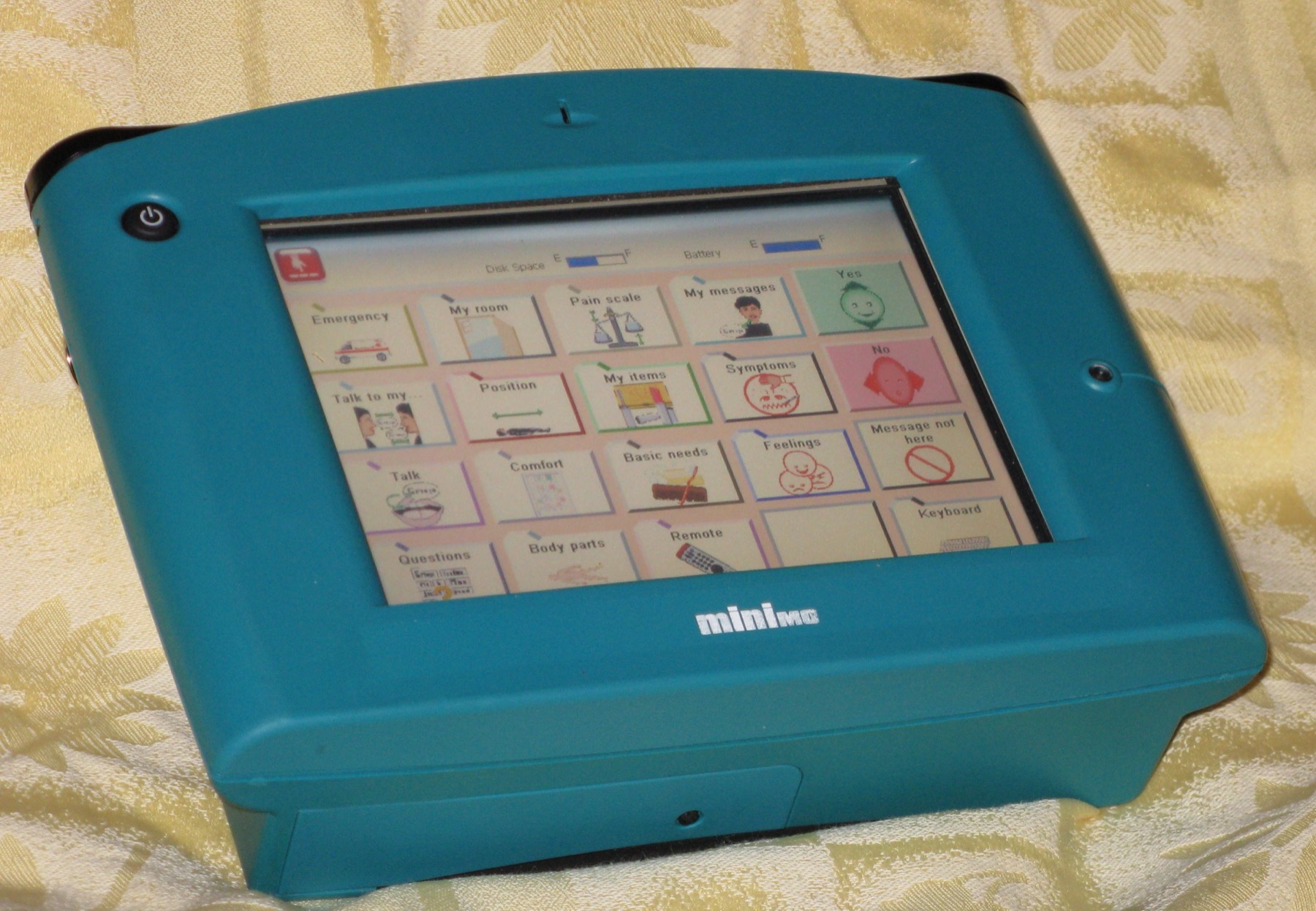
Specialist communication devices that work with eye tracking cost $10,000 to $15,000, according to the foundation.
AI solution
The Scott-Morgan Foundation continues the work of the British roboticist Dr. Peter Scott-Morgan, who saw disability barriers as engineering problems. He was diagnosed with MND in 2017 and died in 2022.

The user sits in front of a screen fitted with an eye tracker. A microphone picks up what other people say, and the AI drafts three possible replies. The user chooses one by looking at it. An avatar, on a screen above the user or on another device, then says the reply aloud in the user’s own voice, with facial expressions.
How it works
- 01 Listen A microphone picks up what other people say, and the AI drafts three possible replies.
- 02 Choose The user picks one by looking at it, with an eye tracker.
- 03 Speak An avatar says the reply aloud in the user's own cloned voice, with facial expressions.
The voice is a clone made by ElevenLabs from recordings of the person. The moving face comes from D-ID, the eye tracking from IRISBOND, computing power from NVIDIA chips, and hardware from Lenovo. The avatar keeps learning a person’s preferences and history. Leah’s AI, for example, was trained on a book she wrote and 30 interviews in English and French.
Bernard architected the whole system, which coordinates several AI programs, or “agents,” each handling part of the job. He leaned on AI to write the code: “I used A.I. agents as my ‘extra hands,’ breaking tasks into small steps, testing, refining and letting automation do what my body no longer can.”
VoXAI runs on the web. In December 2025 a simpler version for people without Wi-Fi was in development. LaVonne Roberts, who leads the foundation in the US, said many off-the-shelf computers and tablets now have workable eye tracking, and NHS-provided trackers may also work with it.
Impact
VoXAI is at the pilot stage, after years of prototypes. An early avatar of Erin Taylor, then a 24-year-old woman with ALS, was shown at CES in January 2024. In October 2024 Erin used a working prototype on stage at Lenovo Tech World to introduce herself and welcome Lenovo’s chief executive. The foundation’s own entry in the ITU’s 2025 AI for Good report describes the platform as demonstrated and still in development.
The foundation launched SMF VoXAI publicly on December 10, 2025, at the AI Summit New York. Basic access is free, and premium features cost $30 a month. The foundation compares this with the $10,000 to $15,000 it says specialist devices cost, a comparison that leaves out the computer and eye tracker a user still needs.
The foundation’s website says the platform now serves six countries, without naming them or giving user numbers.
No results have been published yet. In December 2025 the foundation announced a two-year study of 20 people in six countries, measuring speed, emotional presence and quality of life. Antonio Ortiz of Tecnológico de Monterrey leads it, and he is also the foundation’s own Head of Research, so it is not an independent evaluation. In January 2024 the foundation said Mount Sinai researchers in New York would help validate the platform; we found no published results.
The foundation also helps people with ALS apply for a free ElevenLabs voice clone. ElevenLabs says its technology has been used to restore the voices of more than 11,000 people as of October 2026, not only through the foundation.
In 2026 Bernard was first author of three preprints on using AI to measure speech changed by neurological disease; one has been accepted at the IEEE SLT 2026 conference. In Mexico, the foundation says, an ITU AI for Good hub is deploying his communication tool and free voices across the country.
People
The foundation’s principle is to design “with, not for” disabled people. Bernard has lived with ALS for 16 years, Roberts wrote in June 2026. That month he wrote that “every line of code through every blink, has gone into this”.
“When someone sees my avatar smile or shows concern, they're seeing me, not a disability. That changes everything about how I connect with my world.”Bernard Muller, in the SMF VoXAI launch announcement, December 2025
Erin Taylor was diagnosed with ALS in the summer of 2023 and had to pause a career in botany. She helped test the early versions and kept giving feedback. “Speaking with my voice as it sounded pre-diagnosis is incredible, of course,” she said in 2024, “but what excites me most is participating in the development of smarter technology for others.”
Families shaped it too. Roberts recalls a mother telling the team, “You just didn’t capture my daughter’s smile,” which pushed them to make the avatars more lifelike. She remembers Erin’s mother crying when she saw Erin on a video: “That’s her smile.”
The wider team includes designers in London and engineers in Mexico, Canada and France. Students at Tecnológico de Monterrey each spent more than 400 hours building and testing the platform. Andrew Morgan and Roberts lead the foundation, and its chief technology officer, Thorsten Stremlau, once worked on communication systems for Stephen Hawking.
Why it matters
Losing speech often means losing your place in a conversation. VoXAI was designed by someone who relies on such tools every day, and its basic level is free. The planned study should show whether it helps people keep that place.
What we could not confirm
- The latest sign of VoXAI in use that we found is the foundation’s website, read on October 25, 2026. It says the platform serves six countries but names none and gives no user numbers.
- We found no published results from the two-year study announced in December 2025, or from the Mount Sinai validation announced in January 2024.
- The $10,000 to $15,000 cost of specialist devices is the foundation’s own figure.
- Job titles differ between sources. Bernard Muller is “Chief Technologist” in most, but “Technologist in Residence” on the About page. Thorsten Stremlau is called both chief technology officer and chief scientist.
Questions people ask
What is SMF VoXAI?
A web platform from the Scott-Morgan Foundation for people who have lost their speech, for example to ALS. It suggests three replies in a conversation and speaks the one the user picks by eye, in their own voice, through an avatar.
Who built it?
Bernard Muller, the foundation's Chief Technologist, who has ALS and designed it using only eye tracking, working with technology and university partners.
How much does it cost?
Basic access is free and premium features cost $30 a month. Users still need a computer or tablet and an eye tracker.
Does it work?
It is too early to say. A two-year study of 20 people, announced in December 2025 and led by the foundation's own Head of Research, has not published results.
This story supports
Sources (14)
The Scott-Morgan Foundation, CES 2024 extended press release, January 9, 2024
Bernard Muller, LinkedIn post resharing LaVonne Roberts, June 29, 2026
Muller, Ortiz Barrañón and Roberts, arXiv preprints 2604.10123, 2604.21706 and 2609.21789, 2026
Obituary of Leah Miriam Stavenhagen (1992 to 2026), Edwards-Dowdle Funeral Home, February 2026
ITU, AI for Good Innovate for Impact Report 2025, Scott-Morgan Foundation use case, pp. 464–472
Fact-checked against sources on October 25, 2026. Spot an error? Tell us.