
Problem
Letitia is one of the Whispp users quoted on the company’s website. “I absolutely love that I can connect with people with calls - it’s been 3 years since I could last have a phone call and be heard,” she said.
A participant in a later Whispp pilot, also named Letitia in the company’s report, described what conversation had been like before: “sitting back or trying to type a response and missing the moment because the conversation moved on.”
Many conditions can take a voice away or make it hard to use. Whispp names severe stuttering, throat and laryngeal cancer, vocal cord paralysis and spasmodic dysphonia, a condition in which the muscles of the voice box spasm. Some people speak with esophageal speech, a rough voice made with air from the food pipe after the voice box is removed. IO+, a Dutch technology news site, puts the number of people worldwide with voice disabilities at 300 million.
For some, the hardest part is the phone. “Finally I can make a call and I don’t need to ask other people to make a call for me,” said David, a Whispp user quoted on the company’s website.
AI solution
The idea came from the founder, Joris Castermans, who stutters. He noticed that people who stutter severely often speak fluently when they whisper. The question was how to turn that whisper into a full, clear voice that works on a call.
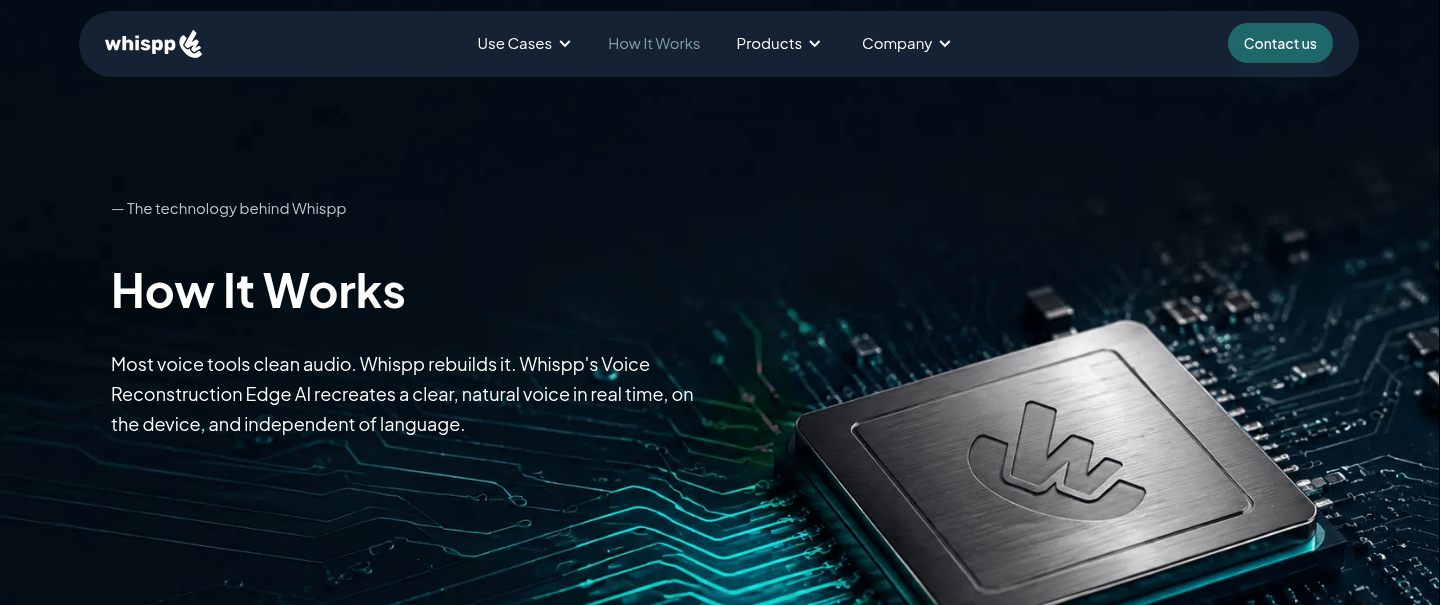
Whispp’s AI works on the sound itself, audio in and audio out, without turning the speech into text along the way. It rebuilds the whisper as a clear voice and keeps the speaker’s intonation, pauses, emphasis and emotion. The company says the design draws on the source-filter theory of how the voice is made, and that it works in any language.
The new voice can be one the user picks, or one built from recordings of their own voice from before they lost it. It works with soft whispers and with rough esophageal speech, according to the app’s description.
For its newest version, built to run inside phones, computers and wearables, Whispp says the conversion takes less than 120 milliseconds, quick enough for real-time use. That version runs entirely on the device, and the audio never leaves it.
For individual users, Whispp is an iPhone app for phone calls and voice messages, in English, Dutch and Spanish. It is free to download, with in-app purchases from $19.99 to $399.99. The listing does not explain what each purchase buys.
Impact
TIME named Whispp one of the Best Inventions of 2024 in accessibility, and it was an honoree for a 2024 Innovation Award at CES, a large consumer technology show. Forbes put it on its Accessibility 100 list in 2025, and Fast Company recognized it in its Innovation by Design awards the same year.
In 2026, the European Innovation Council (EIC), an EU program that funds startups, awarded Whispp a €2.5 million grant and committed to invest in a later round. IO+ reported the grant in February; Whispp’s own news page dates it April.
The results so far are encouraging but unverified. According to IO+, the app has shown an average 85% drop in how often people who stutter do so when they whisper with it. We found no published study behind that number.
In July 2026, Whispp and the chip maker Qualcomm described a six-week pilot, linked to Qualcomm’s Snapdragon X Elite chip for computers. Thirty people in nine countries, with 13 different voice conditions and 10 languages, used the technology in their everyday calls and online conversations. All of them used it at least once a week, and a third used it daily. In the company’s report, 79% found it easy or very easy to use, 84% scored their likelihood of recommending it at 8 or more out of 10, and 83% said on-device processing and data privacy were important to them.
The iPhone app is live and was last updated in July 2026. On the US App Store it has only five ratings, averaging 1.8 out of 5.
The company is also changing course. In November 2025 it said it had “evolved from a single assistive app into a streaming voice technology that can be licensed and integrated into various products,” with uses such as private calls by whispering. Its pilot report adds that “Whispp’s assistive applications are under development and are not currently offered as medical devices.” On its homepage, the company says: “The next phase will bring our technology to assistive applications, with the medical validation these users deserve.”
People
Castermans founded Whispp in Leiden from his own experience with stuttering. He led it as CEO and is now chief marketing officer. Co-founder Akash Raj Komarlu is chief AI officer.
Andreas Spechtler, a former president of the audio company Dolby International, joined Whispp’s board in November 2025 and has since become CEO, following what the company calls a recent €5 million funding round. Whispp says he was appointed to drive commercial growth and partnerships with device makers, as it works to bring its technology into phones, computers and wearables.
“This collaboration with Qualcomm allowed us to test Whispp where the technology ultimately needs to perform: in real conversations, on the devices people already use,” Castermans said of the pilot.
On its website, Whispp shares video messages from users including David, José and Letitia, and features Roger Gillespie, who had laryngeal cancer. “Whispp is opening doors of reconnection for me,” Letitia said there. “It is bringing inclusion back to my life.”
Why it matters
For people whose voice has become a whisper, a phone call can be out of reach for years. Whispp’s AI rebuilds a voice from a whisper in real time, by the company’s account, and its pilot users describe getting phone calls and conversations back. Whether that becomes a tested, affordable tool for people with voice conditions depends on the next phase the company has promised.
What we could not confirm (9)
- Whether the results hold up. The 85% drop in stuttering and the pilot survey results are reported by Whispp. We found no clinical study or independent evaluation. The pilot’s method is described in a company white paper we did not read.
- Whether the two Letitias are the same person. The Letitia quoted on Whispp’s About page and the Letitia quoted as a pilot participant share a first name, but Whispp does not say they are the same person, so we treat them separately.
- How many people use the app. Whispp has not published a user count. The App Store listing has five ratings, averaging 1.8 out of 5, too few to judge.
- The status of the assistive app. The iPhone app is live and described as assistive voice technology, while the company says its assistive applications are under development and not medical devices. We could not confirm which features the live app offers today, or when a medically validated version will come.
- What it costs and who can get it. The in-app purchases range from $19.99 to $399.99, and we could not confirm what each buys. We found no health insurance reimbursement and no free route for people who cannot pay.
- Android. The consumer app we found is for iPhone only; Whispp’s software kits for device makers cover Android and Windows.
- The funding details. The €5 million round is mentioned on Whispp’s site, but we did not see its date or investors. IO+ reported the EIC grant in February 2026; Whispp’s own news page dates it April 2026.
- The year Whispp was founded. None of the sources we read gives it.
- When Andreas Spechtler became CEO. Whispp’s news page dates his board appointment to November 2025 but does not date the CEO appointment.
FAQs (5)
What is Whispp?
Whispp is a Dutch startup based in Leiden that makes AI that turns whispered or affected speech into a clear, natural voice in real time. It started as an iPhone app for phone calls for people with voice conditions and severe stuttering, and now also licenses its technology to device makers.
Who is Whispp for?
The company names people who stutter severely and people with throat or laryngeal cancer, vocal cord paralysis, spasmodic dysphonia or esophageal speech, as well as people who have lost their voice to illness or trauma.
How is Whispp different from text-to-speech?
Text-to-speech reads typed words aloud. Whispp converts live speech directly into a new voice without turning it into text, so the speaker's own timing, emphasis and emotion carry through.
Is Whispp a medical device?
No. Whispp says its assistive applications are under development and are not currently offered as medical devices. It says medical validation will come in a later phase.
Does Whispp work?
In a company-run pilot of 30 people in 2026, 79% found it easy to use and 84% rated their likelihood of recommending it at 8 or more out of 10. These results are self-reported, and no independent study has been published.
Sources (5)
IO+, Voice reconstruction startup Whispp secures €2.5 million grant, February 18, 2026
Whispp, How Whispp and Qualcomm brought Voice Reconstruction AI to Snapdragon X Elite, July 14, 2026
Whispp, official site (home, about, news and How It Works pages), accessed November 6, 2026
Apple App Store (US), Whispp listing, version 1.53, accessed November 6, 2026
Fact-checked against sources on November 6, 2026. Spot an error? Tell us.
This story supports