Problem
On Wednesday, October 28, 2026, two men with ALS tried out their new voices in front of reporters in Madrid. Juanan, diagnosed in 2020, can still talk, but his voice has become distorted. Antonio, diagnosed in 2022, has lost his voice completely.
ALS is a disease of the nerves that control the muscles, including the ones used to speak. According to adELA, about 4,000 to 4,500 people live with it in Spain. About 40% are in speech therapy, trying to hold on to their voice for as long as they can, according to adELA’s figures (EFE gave this as a share of all patients, Europa Press as a share of the association’s members).
When speech goes, many people use a communicator. Luis Carrascosa, the adELA board member who coordinates its technology projects, describes the usual setup: a camera follows the person’s eyes as they look at the letters of a keyboard on a tablet. Until now, the words often came out in a robotic voice that sounded like no one in particular.
“I decided to clone my voice because, from the first moment of the diagnosis, I knew my voice was going to fade,” Juanan said at the launch (translated from Spanish by AI for Kind).
AI solution
The voices come from ElevenLabs’s Impact Program, which has offered free voice clones to people losing their speech since August 2024; our story on the Scott-Morgan Foundation covers another tool that uses these voices. The software learns how a person sounds from recordings, then reads any typed text aloud in that voice.
adELA changes how people in Spain get one. It is the program’s first Spanish partner. Its own post sets out three steps:
How it works
- 01 Open an account Create a free account on the ElevenLabs website and choose Apply for Impact Program.
- 02 Apply with adELA Pick adELA as the partner and attach a medical report that confirms the diagnosis.
- 03 adELA checks adELA checks the report and tells ElevenLabs the application is in order.
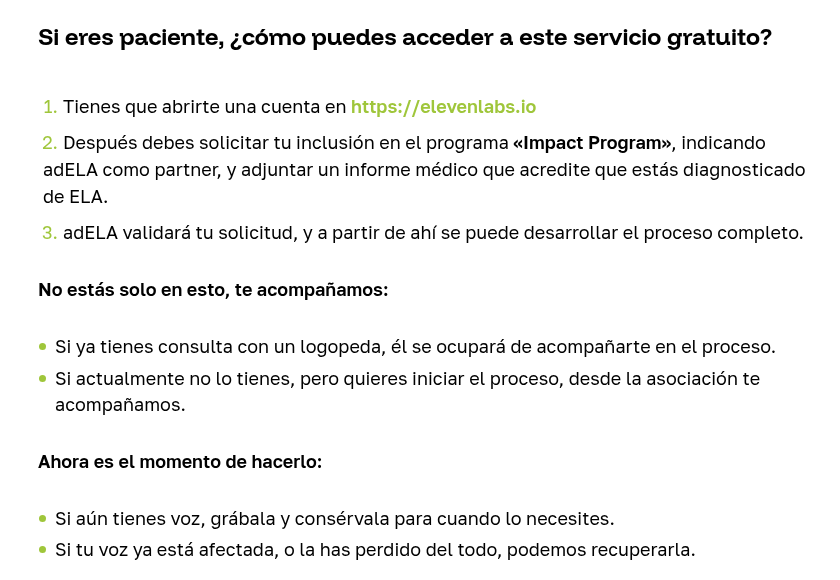
People whose voice is still clear can record new samples. Those whose voice has changed or gone can send old recordings and home videos instead. EFE gave Antonio, who spoke at the launch in his recreated voice, as an example of this route.
After approval, a speech therapist, trained by adELA, sets up the voice during a home visit so that it works inside the person’s communicator. People who do not have a speech therapist get help from the association directly.
Patients pay nothing. ElevenLabs, a for-profit company, donates the licenses: a person gets a five-year Pro license that can be renewed, with no credit card or code needed, and a clinician gets a free one-year license. adELA and the Spanish press called the donation generous and altruistic. No source says that money changes hands between the company and the association.
Impact
It is too early to measure. As of November 3, 2026, neither adELA, ElevenLabs nor the press had published how many people have applied, been approved or made a voice.
So far there are only personal accounts. Aníbal Martín, an aviation engineer and programming teacher near Madrid, still speaks, but his voice is fading, and he has built a digital copy of it. “Being able to hear my own voice means being able to remain myself,” he told ElevenLabs. Alfonso Muñoz, a speech therapist who works with adELA, called the tool “a before and after” (translated from Spanish by AI for Kind).
adELA was already working with many people before the launch. In 2025, by its own count, it supported 915 people with ALS and gave 7,367 speech therapy sessions. Across all countries, ElevenLabs says its program had given voices back to more than 11,000 people by October 2026, a figure it reports itself.
The new voice does not make talking faster. People still type their words with their eyes, and that is slow. “Typing is slower than speaking,” Carrascosa said (translated from Spanish by AI for Kind). Antonio said conversation now takes “much more patience” and cannot move at the speed it used to (translated from Spanish by AI for Kind). adELA is watching tools that listen to a conversation and suggest replies, but they are not part of this agreement.
People
adELA has supported people with ALS and their families for more than 30 years, with specialist care, psychological support, social guidance and advocacy. Its president, Carmen Martínez Sarmiento, signed the agreement with Jorge Riquelme, a go-to-market manager at ElevenLabs.
“We have great hopes for the project,” Martínez Sarmiento said. She hopes it will let people with ALS “go on being themselves and communicate with the outside world without the disease causing isolation” (translated from Spanish by AI for Kind).
The work started a little over a year earlier, when adELA heard about the program and contacted the company. Martín, a volunteer with adELA since 2020, spent the past year working with it to help patients preserve their voices before they lose them. Carrascosa, who has led its technology projects for about a year, put the change simply: “What we are doing now is that this voice can be your voice” (translated from Spanish by AI for Kind).
At ElevenLabs, the program is led by Gabi Leibowitz, the company’s Head of Impact and a former speech-language pathologist. “Voice is deeply tied to identity and how we connect with and contribute to the world,” Leibowitz said.
Why it matters
A free tool only helps the people who can reach it. In Spain, a patient association now handles the paperwork and sends trained speech therapists to people’s homes, so that someone losing their speech can keep talking in a voice their family knows. It is a days-old service with no numbers yet, and we will check back to see how many people it reaches.
What we could not confirm (7)
- How many people have applied, been approved or created a voice through adELA. No figures had been published as of November 3, 2026.
- Who can apply. adELA’s post says people diagnosed with ALS, and ElevenLabs lists adELA as its partner for ALS. But Carrascosa told El Plural that anyone with a voice condition, “not only ALS”, can request a license once a partner certifies it, and Europa Press described the service as open to patients with a voice disorder.
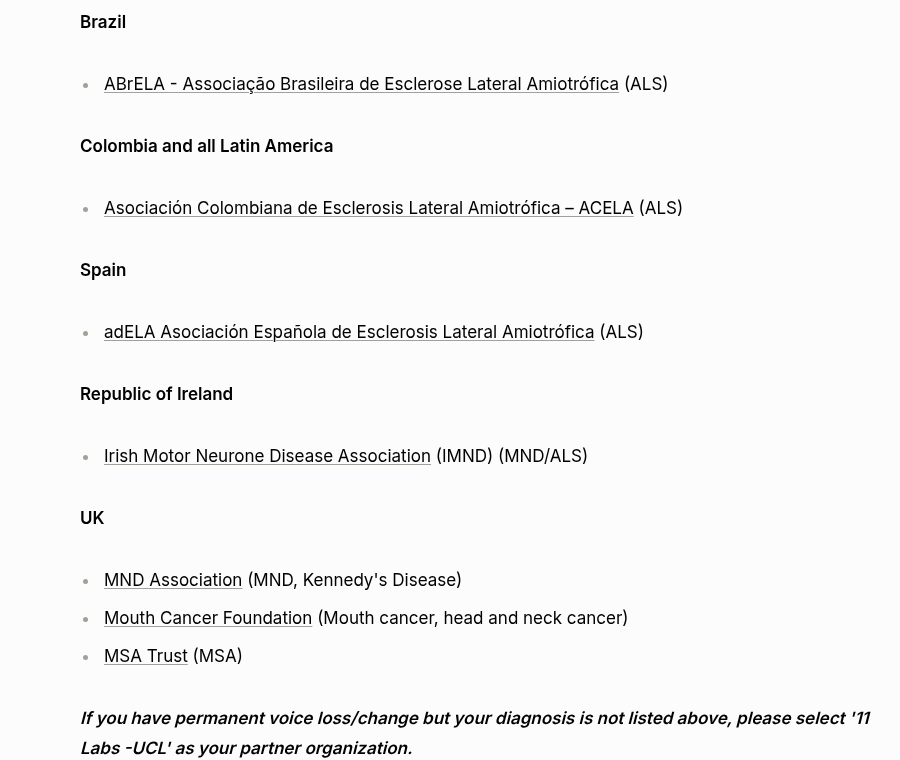
- adELA and ElevenLabs say Spain is the first country where the technology is offered through a national patient association. ElevenLabs’s own partner list already includes national ALS and motor neurone disease associations in other countries, so we describe adELA only as the program’s first Spanish partner.
- Whether ElevenLabs pays adELA or funds the training of speech therapists, and what the donated licenses are worth.
- What happens after five years. ElevenLabs calls the license renewable but gives no conditions.
- Whether the agreement covers communication devices such as tablets and eye trackers. No source says it does.
- How good the Spanish voice copies are, and whether the process works for people who only have short or poor-quality old recordings. We found no independent evaluation.
FAQs (5)
Who can get a free AI voice through adELA?
adELA says the service is for everyone diagnosed with ALS in Spain, and at the launch the two partners said this includes people who are not members of the association. Applicants need a medical report confirming the diagnosis.
Does it cost anything?
Not for the patient. ElevenLabs donates a five-year Pro license that can be renewed. adELA checks applications and its speech therapists help with setup.
What if my voice is already gone?
People who have lost their voice can send old recordings or videos so the software can rebuild it. People who can still speak can record new samples.
How do I use the voice day to day?
A speech therapist sets it up in the communicator the person already uses, often a tablet controlled by eye movements. The person still types what they want to say.
How many people have used it?
No figures have been published yet. The service launched on October 28, 2026.
Sources (7)
ElevenLabs, ALS patients in Spain can now restore their voices for free, October 28, 2026
Fact-checked against sources on November 3, 2026. Spot an error? Tell us.
This story supports