
Problem
No app, no account: a caller dials a dedicated number and starts talking to an AI health assistant. The service comes from China Mobile Internet Company, a unit of the state-owned telecom group China Mobile, and Ant Group, the Hangzhou technology company behind the payment app Alipay.
The line is meant for people most health apps miss. At the end of 2025, China had 323 million people aged 60 or older, about 23% of the population. Yet only 5.1% of people using generative AI were in that age group, Nikkei Asia reported, citing the China Internet Network Information Center.
Distance from doctors is the other gap. In its entry for the ITU’s AI for Good report, China Mobile Internet describes a 1:3 gap in doctor density between rural and urban China (Source: ITU, AI for Good Innovate for Impact Interim Report 2026).
Ant’s 2025 sustainability report gives one example. In Puan County, in the southwestern province of Guizhou, a 68-year-old village doctor who uses Afu, Ant’s AI health assistant, saw a patient of about 40 who was dizzy and vomiting. Afu flagged a possible stroke and advised a referral, and the doctor sent the patient on to a higher-level hospital in time. The company tells this single case, and it happened in the Afu app, not on the phone line.
AI solution
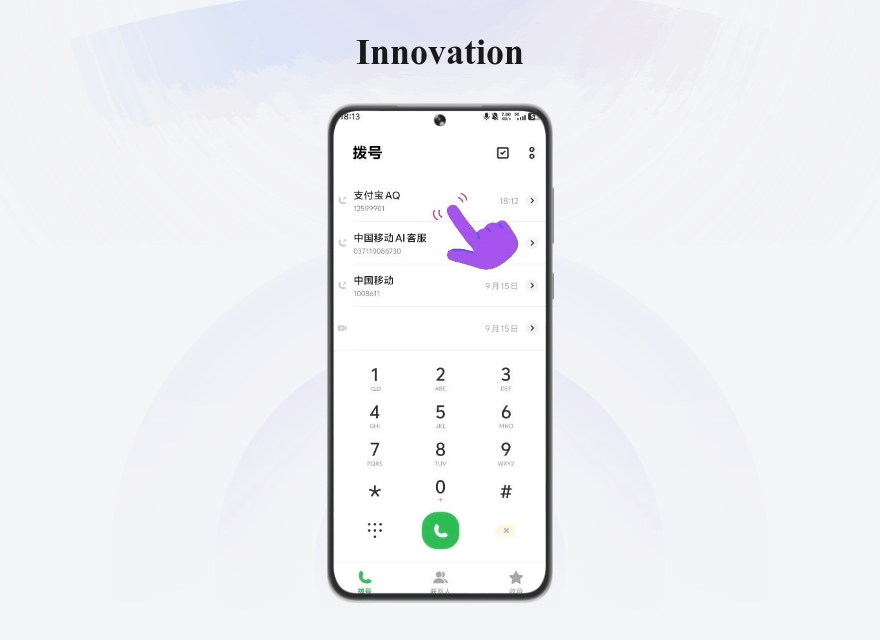
The voice on the line is Afu, the same assistant that runs Ant’s health app. Ant launched it in China in June 2025 under the name AQ; in Chinese it is called Ant Afu, and Ant’s own reports now use that name. In September 2025, Ant said it had teamed up with China Mobile on a hotline for seniors, who could use the assistant by speaking into their phones.
By January 2026, the line was reported as live, with more than 100 services: callers can ask health questions, find a doctor, or have a medical report read or a medicine identified. China Mobile Internet says callers can also book appointments and pay during the same call.
China Mobile’s New Calling service, built on 5G, opens a data channel next to the voice call. Mid-call, a caller can send a photo of a lab report or a medicine box, and the assistant can send simple visual cards back to the screen. Huawei is the technology partner. According to the ITU entry, the caller’s SIM card identifies them and links the call to their records.
In the ITU entry, China Mobile Internet describes several safety layers. The assistant looks up structured medical knowledge before it answers. Each question gets a risk grade, and high-risk ones go to a separate safety model. Answers that break its rules are blocked, and sensitive cases can go to medical professionals for review. The company says it tested the system on MedBench, a set of medical questions used to score AI models, and with expert reviews. We found no outside test of these safeguards. Ant also set up a medical expert advisory committee in 2025, and Afu received a personal-information protection certification from the China Academy of Information and Communications Technology.
Impact
In March 2026, at Mobile World Congress in Barcelona, the line won two Global Mobile Awards from the GSMA, the association of mobile network operators: one for accessibility and inclusion, one for connected health. The New Calling technology behind it won first prize in the 2025 China Communications Society Science and Technology Award. Neither award is a measure of health outcomes.
Nobody has published how many people use the line. Ant’s best-known figure, 140 million users by September 2025, counts the people the AQ app has served since its launch, 60% of them from third-tier cities and smaller places; that press release mentions the hotline only as a new addition. China Mobile Internet’s ITU entry ties user figures to the call-based assistant, but they match Ant’s app totals, and the entry says more than 100 million in one place and 140 million in another.
The app figures hint at who Afu reaches. Ant’s 2025 sustainability report says Afu served more than 84 million users in third-tier and smaller cities, counting the app and Alipay, and that more than 30% of its users are middle-aged or older. Company figures given to Nikkei Asia put 55% of users in third-tier and smaller cities and more than 25% above age 55. These describe the app, not the phone line, and all come from Ant.
Independent reporting has raised two concerns. The first is commercial: Afu points people who need care to doctors and hospitals, and Nikkei Asia reported concern over whether those suggestions serve the user, recalling how Baidu once ranked hospitals in search by paid advertising. Afu said in late December 2025 that its answers carry no advertisements or product recommendations and no commercial ranking.
The second is accuracy. Nikkei Asia cited a Mass General Brigham study of chatbots in general, not Afu, that found misdiagnosis could exceed 80% when patient information is incomplete. An expert quoted in the piece warned that older users could leak sensitive data or be misled by AI-made medical misinformation.
People
China Mobile Internet Company runs the New Calling service; its parent group, China Mobile, led the research behind it that won the 2025 award. Ant Group builds the assistant. Huawei, the network technology partner, summed up the shared aim in its award announcement: “Making health for 1.4 billion people as easy as making a phone call.” Huawei also said the partners plan to offer the service in other countries and regions.
When Ant announced the hotline, its CEO, Cyril Han, said: “We hope AI can empower doctors by extending their reach to more patients, freeing up time for medical research and the fight against complex diseases, while equipping community doctors with powerful AI assistants.”
We found no older caller, family member or rural patient describing the line in public. The clearest rural voice is the Guizhou village doctor in Ant’s report, who used the app.
Why it matters
Most health technology assumes a smartphone, an app store and some confidence with screens. A phone call asks for almost none of that, so this design could reach people that apps leave out. Whether it does, and whether its answers keep callers safe, is something only independent data on the phone line can show.
What we could not confirm (7)
- How many people use the phone line, and how many of them are older or rural. All published user figures (140 million; 60% or 55% from smaller cities, depending on the source and date; 84 million in smaller cities; 30% middle-aged or older; 25% above age 55) describe Ant’s Afu app, not the line.
- The figures in China Mobile Internet’s ITU entry: more than 100 million users in one place and 140 million in another, 3.36 million questions a day and 98% user satisfaction. They are self-reported, the questions and satisfaction figures are undated, and only the 140 million (which the entry dates to September 2025, matching Ant’s app total) appears in another source.
- Any independent check of the safety or accuracy of the assistant’s answers on the phone line. The safeguards are described by the company only.
- The hotline number, whether calls are free, and which provinces or phone models the service covers.
- How doctor and hospital referrals are paid for, and whether Ant earns money from them.
- When the line went live and when the name changed from AQ to Afu: Ant announced the hotline in September 2025, and the first launch report we found is from January 2026.
- The name of the Guizhou village doctor, which the source gives two different ways, and whether any older caller would speak about the line.
FAQs (5)
What is China's AI health phone line?
A service from China Mobile Internet Company and Ant Group that lets people call a dedicated number and talk to Ant's AI health assistant, Afu (formerly AQ), without installing an app.
What can callers do on the line?
Ask health questions, find a doctor, have a medical report read or a medicine identified, and book appointments, according to the companies. Over 5G, they can also share photos during the call.
Does it have 140 million users?
Not as far as anyone has shown. The 140 million figure, from September 2025, counts users of Ant's whole AQ app. No separate number has been published for the phone line.
Is the AI's health advice safe?
The companies say high-risk questions go to a separate safety model and sensitive cases to medical professionals. No independent evaluation of the phone line has been published.
Has the service won any awards?
Yes. It won two GSMA Global Mobile Awards in March 2026, for accessibility and inclusion and for connected health.
Sources (7)
ITU, AI for Good Innovate for Impact Interim Report 2026, Mobile AI Health Assistant, ChinaMobile Internet Company, pp. 1011–1017
Ant Group, AI Health Assistant public page (official site), screenshot taken November 3, 2026
Fact-checked against sources on November 3, 2026. Spot an error? Tell us.
This story supports