Problem
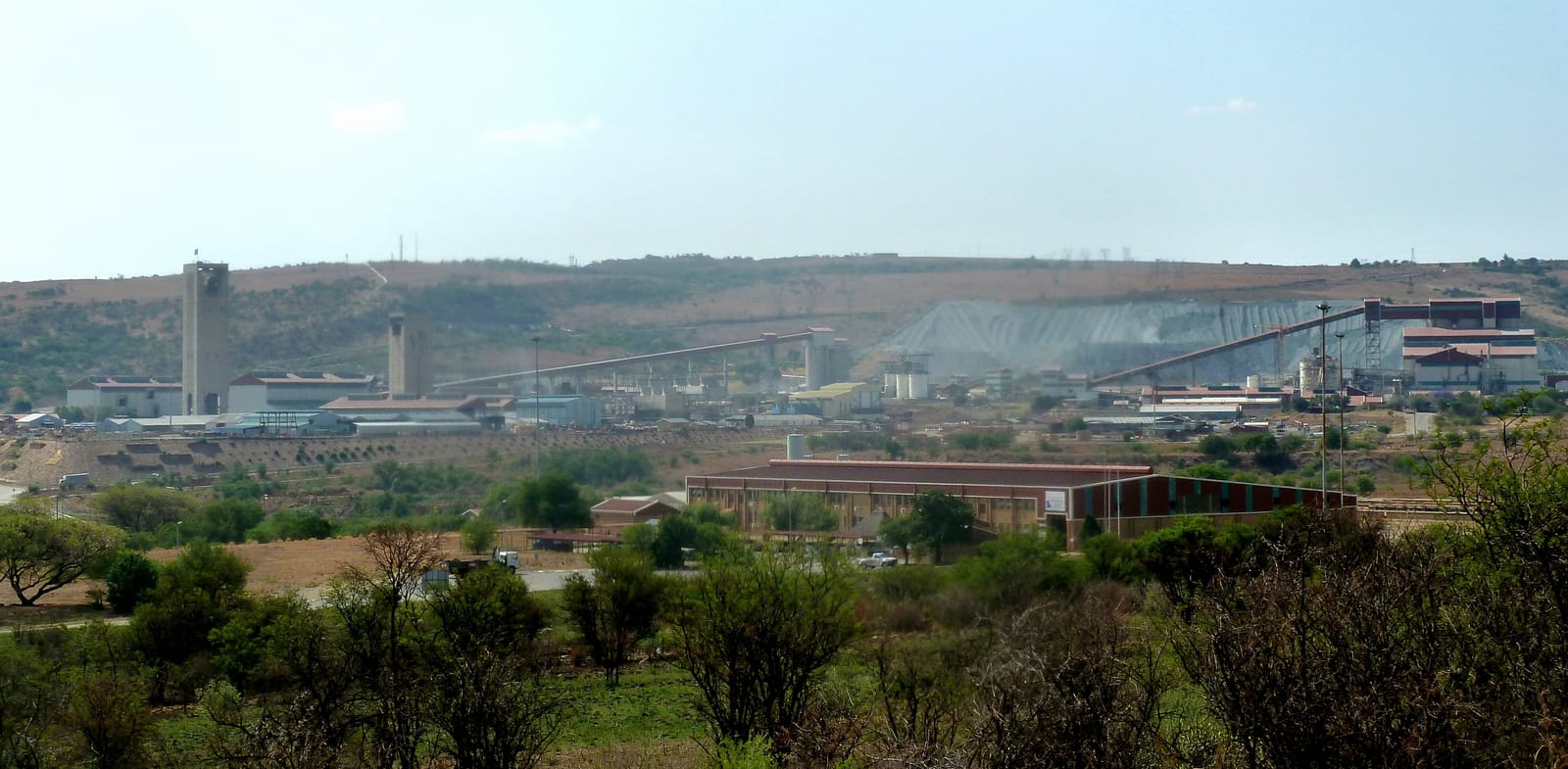
Mponeng Gold Mine in South Africa is one of the deepest mines in the world. The spot where the screening took place lies more than 3,800 meters below the surface, where temperatures reach 66°C, Nexus Intelligence says.
Miners in deep shafts breathe silica dust for years, which raises their risk of lung disease. The company says silicosis, the scarring caused by that dust, makes TB up to three times more likely, though it gives no source for the figure.
TB can be cured. It still kills an estimated 1.23 million people a year, Google Research wrote in October 2026. Radiologists, the doctors trained to read X-rays, are scarce, and for people in remote villages or deep in a mine, imaging is often days away.
Dr Lucica Ditiu, executive director of the Stop TB Partnership, put the challenge this way: “To end TB by 2030, we must reach the millions who remain undiagnosed. Technology that operates beyond the reach of traditional power grids and hospital walls is the only way we achieve that goal”.
AI solution
The basic idea will be familiar to readers of our stories on Paraguay’s prison screening and Uganda’s mobile X-ray teams: software reads a chest X-ray and flags who should get a lab test. The Nexus version comes from a small South African company and runs entirely offline.
The software, Nexus AI CXR, runs two models side by side on every image. One decides whether the lungs look normal and highlights any area that does not. The other looks for findings that suggest TB. Within as little as 45 seconds, the clinician sees the X-ray with heatmaps and contour lines over the areas of concern. That time covers the software’s reading, not the whole visit. The clinician makes the final call, and anyone flagged can be referred for a molecular test that confirms TB.
At Mponeng, the team paired the software with an ultra-portable X-ray made by MinXray.
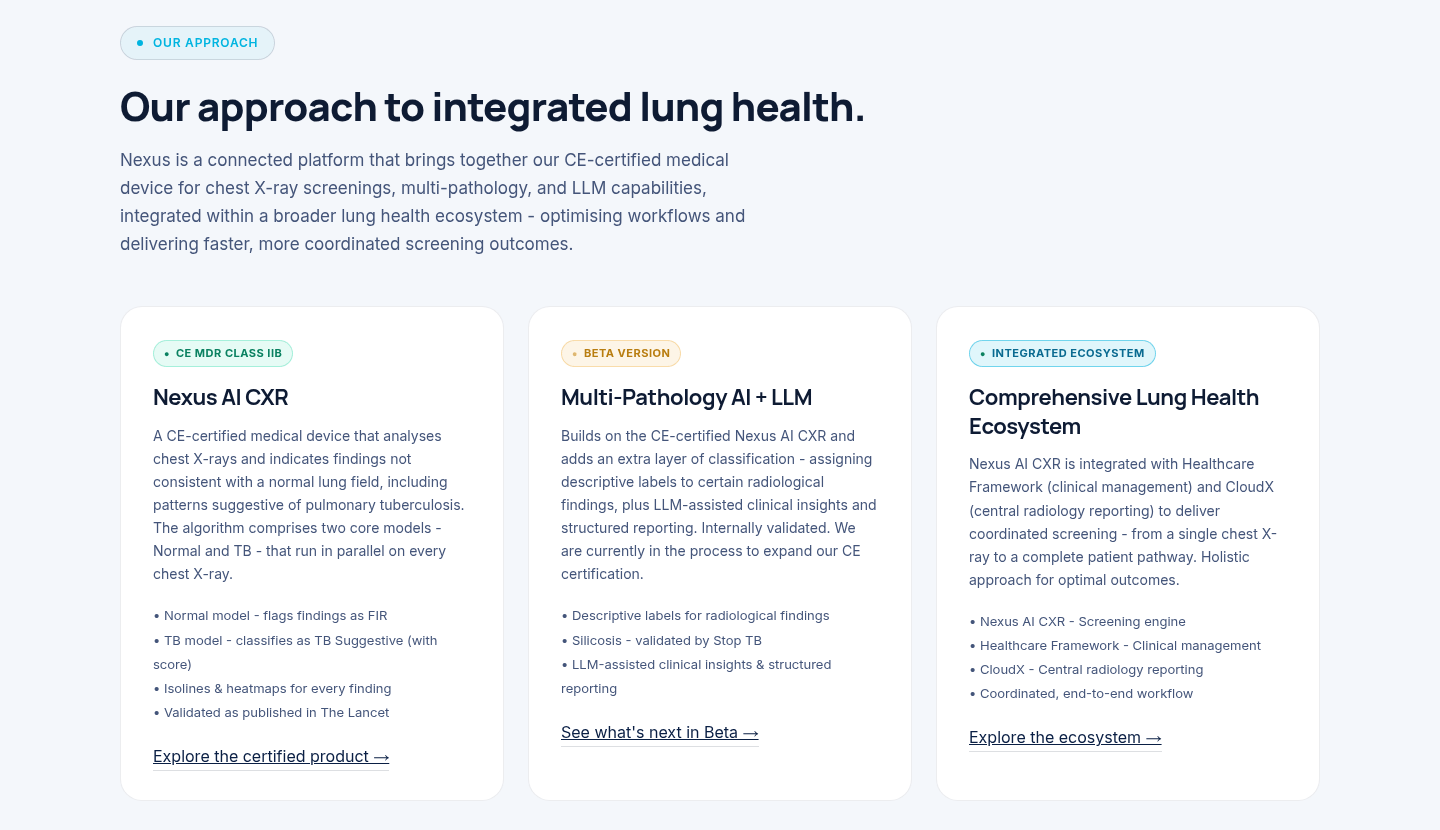
The model underneath came from Google Research. In 2019 its deep-learning model matched experienced radiologists at spotting active TB in the lungs, in a study published in the journal Radiology. Google licensed that model to Nexus, and Nexus built a regulated product around it.
Much of that work was regulatory. The tool is certified in Europe as a class IIb medical device, and the company holds ISO 13485, a quality standard for medical device makers. Nexus has an agreement with the diagnostics organization FIND to seek WHO prequalification. Clearance from the US Food and Drug Administration (FDA) is in progress and has not been granted.
Google has also openly released medical AI models, called MedGemma and MedSigLIP, that others can retrain on their own X-rays. Google says Indonesia’s Ministry of Health is adapting them on Indonesian chest X-rays, aiming to screen 50 million people a year. The ministry’s own August 2026 announcement describes AI-assisted X-ray screening and about 10,000 X-ray units for community health centers, but it names no software and no 50 million target.
Impact
Nexus ran the Mponeng screening with the Stop TB Partnership, the mining company Harmony Gold and South Africa’s National Department of Health. Miners were X-rayed on site, and anyone the AI flagged could be referred straight away for a confirmatory test. Neither the company nor Google has said how many miners took part, how many were referred, or how many had TB.
Above ground, the tool is in routine use. In October 2026, Google said more than 90 clinicians in about 40 health facilities had used it to evaluate more than 25,000 chest X-rays, cutting the wait for a reading “from weeks to under 45 seconds”. These numbers are self-reported, and Google gave the same 25,000 and 40 figures in June 2026, so the count may not have been updated.
Google says Nexus is deployed in South Africa, Sierra Leone and Côte d’Ivoire, with expansions underway in DR Congo, Zambia and Cameroon. Google also says Nexus has given more than 3,000 free screenings to under-resourced public clinics, toward a goal of 10,000 sponsored screenings a year. The company’s own website gives a much higher figure, more than 15,000 in-kind screenings, without explaining the difference.
The best outside check so far is a 2024 study in The Lancet Digital Health, which tested 12 commercial X-ray reading products on 774 people from a South African TB survey. Nexus scored an area under the curve (AUC) near 0.9 (a measure of how well a test separates sick from healthy, where 1.0 is perfect and 0.5 is a coin toss). It was one of four products that kept catching more than 90% of TB cases across a wide range of cut-off settings. Every product did worse in older people, people who had had TB before, and people with HIV. The study used a selected sample rather than a live clinic, and it may have tested an earlier version of the software.
“What stands out is how many patients we are now identifying who could have been missed,” said a clinician quoted by Google. “Without the AI flagging subtle findings, they would not have been referred for further testing”.
People
Nexus Intelligence was founded in 2022 by Dr Gerhard Ferreira, a medical doctor with 30 years of experience, and Andries Vorster, a clinical engineer with 25 years in the field.
The Stop TB Partnership worked with them at the mine and supported pilots of the tool in Cameroon and Vietnam. Nexus also supports Côte d’Ivoire’s national TB program and runs mobile screening studies in South Africa’s Northern Cape.
Day to day, the tool depends on the clinicians in those facilities, who look at each flag and decide what happens next, and on the miners who lined up for an X-ray far below ground. None of them has been named in public accounts.
Why it matters
A company founded by a doctor and an engineer in Pretoria took a research model from Google, got it certified as a medical device, and brought it to workers that radiologists rarely reach. The results from Mponeng have not been published yet, and they will show whether screening underground finds people who would otherwise be missed.
What we could not confirm (9)
- How many miners were screened at Mponeng, how many were referred for testing and how many had TB. No source gives these figures.
- Whether screening at the mine continued after World TB Day 2026.
- The reach figures (about 40 facilities, more than 90 clinicians, more than 25,000 X-rays, more than 3,000 free screenings) are self-reported by Google and were unchanged between June and October 2026.
- Whether Indonesia’s national TB screening uses Google’s MedGemma and MedSigLIP, and where the 50 million a year target comes from. Only Google says so; the Indonesian ministry’s release names no software, and a news report names a different tool, TBScreen.AI.
- Whether the 2024 Lancet Digital Health study tested the current version of Nexus AI CXR.
- The company’s statement that silicosis raises TB risk up to three times has no source.
- How many free screenings Nexus has given: Google says more than 3,000, while the Nexus home page (checked November 7, 2026) says more than 15,000 in-kind screenings. Neither explains how it counts.
- Nexus also quotes a “98.4%” performance figure without saying what it measures, so we left it out.
- We could not find any miner or named health worker speaking about the screening.
FAQs (5)
What is Nexus AI CXR?
It is software from Nexus Intelligence, a company in Pretoria, South Africa, that reads chest X-rays, flagging lungs that do not look normal and findings that suggest tuberculosis. It is certified as a medical device in Europe and works offline.
Did AI screen miners underground in South Africa?
Yes. On March 26, 2026, Nexus used a portable X-ray and its AI nearly 4 km underground at Mponeng Gold Mine, with the Stop TB Partnership, Harmony Gold and the National Department of Health. Results have not been published.
Does the AI diagnose tuberculosis?
No. It flags X-rays that look abnormal or suggest TB. A clinician decides, and a molecular lab test confirms the diagnosis.
How accurate is it?
In a 2024 independent study of 774 people in South Africa, published in The Lancet Digital Health, Nexus scored an AUC near 0.9 and was among the products that kept detecting more than 90% of TB cases across a wide range of settings.
What is Google's role?
Google Research developed the chest X-ray model and licensed it to Nexus, which built and certified the product. Google has also released free medical AI models that other countries can adapt.
Sources (6)
Nexus Intelligence, "World-first AI deployment 4km underground," April 2, 2026 (company page)
Fact-checked against sources on November 7, 2026. Spot an error? Tell us.
This story supports