Problem
A child’s age does not tell a teacher what that child can read. At a 2020 reading camp in Kenya, learners aged 9 to 17 were sorted instead by what they could manage on the page: letters, words, paragraphs or stories.
Catch-up programs based on an approach called Teaching at the Right Level start from exactly that information. Children are taught according to what they can do, whatever their age. Grouping them means testing each child first, and Nyansapo’s website calls traditional assessments time-consuming. In a 2023 application to MIT Solve, it said many rural Kenyan communities did not have access to effective programs of this kind.
Schools have little slack to absorb that work. Rest of World reported in April 2025 that Kenya lacked 98,261 teachers. It also cited a 2024 survey by the Elimu Yetu Coalition in which only 35% of 1,000 schools in 10 counties had working internet.
AI solution
Nyansapo began in 2020 at Penn State University in the US, where seven engineering students built the first version for the Nittany AI Challenge and won $10,000. It is now based in Nairobi and in 2023 described itself as a hybrid of for-profit and nonprofit.
The Android app listens as a child reads aloud. Speech recognition turns the child’s voice into text, and natural language processing, software that analyzes language, assesses the reading and gives teachers details such as the words children commonly miss. Children are then placed at a level. At the 2020 camp these were letter, word, paragraph and story. In 2025 the company’s chief technology officer told Rest of World that the app uses an OpenAI speech-recognition model fine-tuned to recognize the Kenyan accent.
How it works
- 01 Read aloud A child reads into the Android app while speech recognition turns the voice into text.
- 02 Place Language software assesses the reading and places the child at a level: letter, word, paragraph or story.
- 03 Group Teachers see results at once and group the class by level for short catch-up lessons.
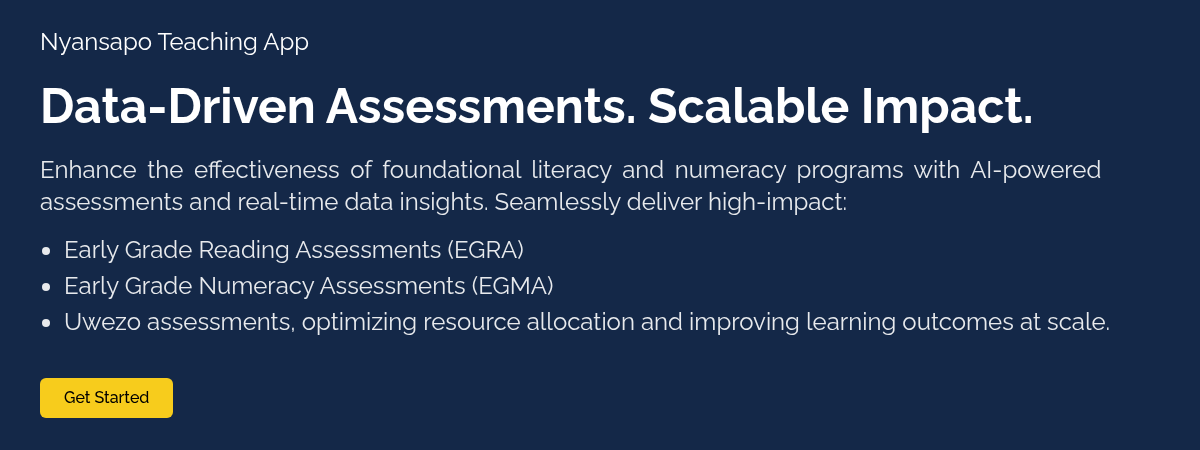
The company says the app digitizes standard early-grade reading and math tests, along with Uwezo, a household survey tool for children aged 6 to 16 in Kenya, Tanzania and Uganda. Results come back at once and children are grouped by level. Results can also be viewed on a web dashboard.
A writer from Shule Direct, a Tanzanian education platform, visited Nyansapo in Nairobi in November 2025. The visitor reported that an assessment takes about five minutes per child and needs a quiet corner, which the writer called nearly impossible to manage in Tanzanian classrooms, with 60 or more pupils in a 45-minute lesson. At five minutes each, 60 pupils would take five hours.
Later descriptions call the tools offline-first. In Kitui County, Nyansapo’s Read, Count and Play program uses the groups in two-hour, game-based camps, with training and coaching for teachers. A funder’s page says the program also uses community football tournaments and workshops to reach parents and local leaders.
Impact
We class Nyansapo as a pilot: 2025 reports of its Kitui work describe a pilot, even though the company already offers the Teaching app to programs on a quote basis. The outcome data we found comes from two exercises.
The first was a boot camp in Kenya in August 2020: 10 days and 80 hours of teaching, with an average of 13 learners aged 9 to 17 per teacher. Team member Tanish Rastogi said about 96% of the children improved by at least one level, with progress tracked on the app. The figure is the student team’s own, and Penn State’s article describes no control group.
The second is the 2025 Read, Count and Play pilot in Kitui County. EdTech Hub, an education research group, summarized Nyansapo’s endline report in a 2025 brief. It counts ten schools and 859 learners, with overall literacy rising from 36% at the start to 54% at the end, a gain of 18 percentage points. Eight of the ten schools showed substantial progress, and the brief mentions gains “as high as +64%” without saying what that figure measures.
Those figures come with limits. They come from Nyansapo’s own report, and the link to that report was dead when we tried it on November 9, 2026, so we could not check the numbers against the original. The brief calls the pilot “strong evidence”, but it does not define “literacy” and describes no comparison group. Children’s reading can improve over time for many reasons, so a before-and-after figure cannot show how much the camps added.
EdTech Hub says evidence on AI-supported catch-up teaching in low- and middle-income countries is mostly small pilots and reports from the groups running them, with limited proof of cause and uncertain long-term effects. Nyansapo said in 2023 that it wanted to run a randomized controlled trial, which compares children in a program with similar children outside it. We found no published result from one.
On reach, the startup told Rest of World in April 2025 that more than 800 teachers had tried the app and that it had more than 100 Google Play downloads.
People
The name Nyansapo means “wisdom knot.” Mumbe Mwangangi was listed in the 2023 application as team lead and head of programs, building partnerships with government agencies, NGOs and schools and co-leading business development.
Tanish Rastogi was among the Penn State students who built the first version. Since then the group has been a finalist in MIT Solve’s 2023 LEAP Challenge and a 2024 grantee of the Youth To The Front Fund, run by We Are Family Foundation.
Teachers and partners run the camps. Esther Tabitha, a primary school teacher at Kivanake Comprehensive School in eastern Kenya, tested the Nyansapo Teaching app. “We were able to know children who could only read letters, those who could read words, and those who were able to read paragraphs,” she told Rest of World in 2025, and she said she would use it again.
Her account may not be independent. In August 2025 The Star quoted an Esther Tabitha, described as an education consultant, showing Nyansapo’s Hekima app at a conference and saying “we’re ready to expand.” We could not confirm whether she is the same person.
Why it matters
Teaching by level depends on knowing what each child can read, and finding that out takes time teachers rarely have. A spoken check of a few minutes could make that easier, if it holds up in crowded classrooms.
A University College London professor quoted by Rest of World warned that education technology can distract from root causes such as too few teachers. An app cannot fill Kenya’s teacher shortfall. A group that began with a student prize and a 10-day camp is now testing whether a phone can help the teachers Kenya does have, and a study with a comparison group would show how far that help goes.
What we could not confirm (10)
- Nyansapo’s 2025 endline report: the link cited by EdTech Hub was dead on November 9, 2026, so the 36% to 54% figures come only from EdTech Hub’s summary of the company’s own data. We do not know what “literacy” measures, how children were selected or who ran the tests.
- Whether the 2025 pilot had a comparison group. EdTech Hub’s brief calls the result “strong evidence” but describes no control group, and we could not read the report itself.
- The size of the Kitui pilot. EdTech Hub reports 859 learners in ten schools. The Star reported in August 2025 that the Hekima app had been piloted in 23 schools in Kitui East. A Designing Futures 2050 project page, seen only in search results, describes a plan for about 1,000 children in 30 schools. These may be planned, partial or different counts. We use the figures attributed to the endline report.
- Which Nyansapo app the Kitui pilot used. The Star names the Hekima learning app; EdTech Hub says the “Nyansapo AI App”.
- Whether the teacher in Rest of World and the education consultant in The Star, both named Esther Tabitha, are the same person. If so, her praise may not be independent.
- The 2020 figure of about 96%, reported by the student team. Penn State’s article describes no control group and gives no total number of children.
- The company’s claims of more than 800 teachers and of work in five countries, which appear without independent checks. The five-country counter on its website carries no date.
- Whether the Zizi Afrique Foundation uses the tool. A Tanzanian visitor wrote that it does, and Nyansapo named it as a partner in 2023, but we found no statement from Zizi Afrique.
- Which languages children can be assessed in beyond English, and how exactly the app works offline.
- Current funding and partners in 2026.
FAQs (4)
What is Nyansapo AI?
A Nairobi education group, begun in 2020 as a Penn State student project, that builds AI tools to assess children's reading and math and group them by level.
How does the Nyansapo Teaching app work?
A child reads aloud into the Android app. Speech recognition and language software assess the reading and place the child at a level: letter, word, paragraph or story. Teachers use the groups in catch-up lessons.
Did the 2025 Kitui pilot improve reading?
Overall literacy rose from 36% to 54% across 859 learners in ten schools, according to Nyansapo's own report as summarized by EdTech Hub. The brief describes no comparison group, so the program's effect is unknown.
Is Nyansapo AI a pilot or a finished product?
The Teaching app is sold to programs on a quote basis, but the only outcome data we found comes from a 2020 camp and a 2025 pilot.
Sources (10)
Rest of World, Kenya's solution to teacher shortage: Embrace AI, April 23, 2025
MIT Solve, Nyansapo AI, 2023 LEAP Challenge finalist application, July 5, 2023
Nyansapo AI, official website, accessed November 9, 2026
Brookings Institution, Roundtable on measuring learning in East Africa, April 30, 2012
GAiF, The Algorithm of Hope, February 23, 2026
We Are Family Foundation, Nyansapo AI, Youth To The Front Fund, January 27, 2025
Fact-checked against sources on November 9, 2026. Spot an error? Tell us.
This story supports