Problem
On Wednesday, October 14, 2026, a team from Paraguay’s National Tuberculosis Control Program set up a tuberculosis screening day at the Itapúa regional prison in the south of the country. The national prison health directorate, led by Dr. María Claudia Piñánez, arranged the visit, and prison director Javier Rodas coordinated it, according to the newspaper La Nación.
The team went there because that is where the disease is concentrated. By the end of 2025, Paraguay had recorded 5,593 new tuberculosis cases and 505 deaths in the year, and people deprived of liberty made up 31% of detected cases, the highest share of any group, according to national program data reported by ABC Color.
A study in The Lancet Regional Health Americas, reported by Última Hora, found that in 2020 tuberculosis incidence in Paraguay’s prisons was above 3,000 per 100,000 people, against 48 per 100,000 nationally. The risk grew with every year inside and stayed about 10 times higher than in the community even years after release.
Crowding is a big part of the reason. Epidemiologist Guillermo Sequera, described by ABC Color as a former director of health surveillance at the Ministry of Health, warns that prisons fuel the disease nationally, and the paper reports overcrowding of 200 to 300%. By late April 2026, the Concepción penitentiary had confirmed 28 cases that year, and four of those people had died.
AI solution
Tuberculosis mainly affects the lungs, which is why a chest X-ray is a common first check. Paraguay’s program uses an ultra-portable digital X-ray unit, small enough for the team to carry from place to place. In 2022 the Ministry of Public Health and Social Welfare named the model as the Fujifilm FDR Xair. After each chest image is taken, AI software reads it and estimates how likely it is that the person has tuberculosis in the lungs.
The AI does not make the diagnosis. People it flags give a sputum sample (mucus coughed up from the lungs), which is tested with GeneXpert, a rapid molecular test that looks for the bacteria’s genetic material. La Nación’s report on the Itapúa day makes the same point: the AI result is only a first screen, and health professionals must confirm or rule out the disease.
How it works
- 01 X-ray A team takes a chest X-ray with an ultra-portable unit it carries to the prison.
- 02 AI read Software estimates how likely each image is to show tuberculosis.
- 03 Lab test People flagged give a sputum sample for a rapid GeneXpert test that confirms or rules out the disease.
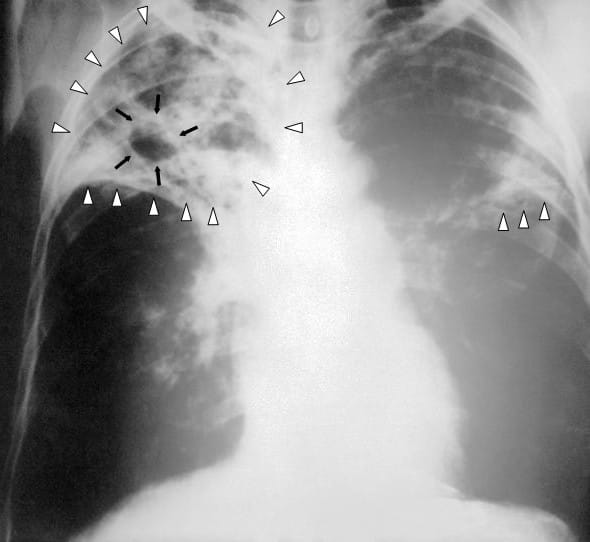
None of the public sources we found name the AI software. For context only: a peer-reviewed study in a Brazilian prison used the same family of Fujifilm X-ray units with a program called Lunit TB. Among 3,409 people screened between February 2023 and May 2024, the software caught 88.5% of the people who had tuberculosis, at a setting where it cleared 70% of those who did not. That study says nothing about how Paraguay’s own software performs.
Impact
In 2022 the program received its second portable AI X-ray unit, a donation supported by the Global Fund through the NGO Alter Vida. The ministry said the second unit could double its screening work, carried out by a team of doctors, nurses and radiology technologists in all of the country’s health regions. In January 2024, Paraguay told the WHO Executive Board that it was “one of the few countries in the Americas” using digital X-rays with AI (our translation), and named people deprived of liberty as a group that still needed stronger action.
The clearest public numbers come from single days. On December 12, 2025, a health day at Tacumbú, Paraguay’s largest prison, reached 65 people, according to the Ministry of Justice. The same day offered HIV and syphilis testing and vaccination against tetanus, hepatitis B and yellow fever. The ministry said the AI showed “high performance” in finding active tuberculosis, but gave no figures.
The Itapúa day in October 2026 is the newest activity we found, and La Nación gave no count of people screened or cases found. The program is in real use, but its results are self-reported, and we found no national count and no independent evaluation in Paraguay.
People
Sara Aguirre directs the National Tuberculosis Control Program, and Claudia Piñánez directs prison health at the Ministry of Justice. Both took part in the Tacumbú day, and both are listed, as Sarita Aguirre and Claudia Piñañez, among the authors of the prison cohort study described above.
The prison’s own health staff are part of the work too. At Tacumbú, Ada Vera runs the prison’s tuberculosis program, and Fabiana Cuéllar coordinates its integrated health unit. A team from the Pan American Health Organization (PAHO) interviewed both about how tuberculosis is managed in prisons.
Not everyone thinks screening is enough. Sequera told ABC Color that the health ministry contributes little beyond its tuberculosis program, and that this “es como poner curitas a una herida profunda,” which translates as “it’s like putting band-aids on a deep wound”. The cohort study’s authors also called for legal and architectural reform, such as early release and fewer people held without a conviction.
Why it matters
Tuberculosis is preventable and treatable, but people first have to be found. A portable X-ray with an AI first read lets one screening team check people where the risk is highest and send those it flags for a lab test. It does nothing about crowded cells, which the cohort study’s authors say need legal and architectural reform.
What we could not confirm (8)
- How many people have been screened, and how many cases found, since the AI units arrived, nationally or in prisons.
- How many AI X-ray units the program has now. The last figure we found is two, in 2022.
- Which AI software the program uses, and whether it has been checked on Paraguayan patients.
- What the Tacumbú and Itapúa days found: cases flagged, confirmed and treated.
- Whether AI screening is routine across all prisons or happens on occasional health days.
- A PAHO video about the approach, said to date from March 2026. We could not find it, so we do not cite it.
- Guillermo Sequera’s current role. A Ministry of Justice note says he represented PAHO at Tacumbú; other sources describe him as an independent epidemiologist.
- First-hand accounts from health workers or former patients. None are published.
FAQs (4)
How does Paraguay use AI to screen for tuberculosis?
The national tuberculosis program takes an ultra-portable digital X-ray to high-risk places such as prisons. AI software reads each chest image and estimates the chance of tuberculosis, and people it flags give a sample for a rapid GeneXpert lab test.
Does the AI diagnose tuberculosis?
No. It is a first screen. Health professionals confirm or rule out the disease with lab tests.
Why focus on prisons?
People deprived of liberty made up 31% of Paraguay's detected tuberculosis cases in 2025, according to national program data, and prison incidence in 2020 was more than 60 times the national rate.
How accurate is the AI in Paraguay?
No Paraguayan results have been published. A Brazilian prison study using the same family of X-ray units, with named software (Lunit TB), found the AI caught 88.5% of people with tuberculosis, but that does not tell us how Paraguay's system performs.
Sources (7)
Paraguay, statement to the WHO Executive Board, 154th session, January 2024
Fact-checked against sources on October 28, 2026. Spot an error? Tell us.
This story supports