Problem
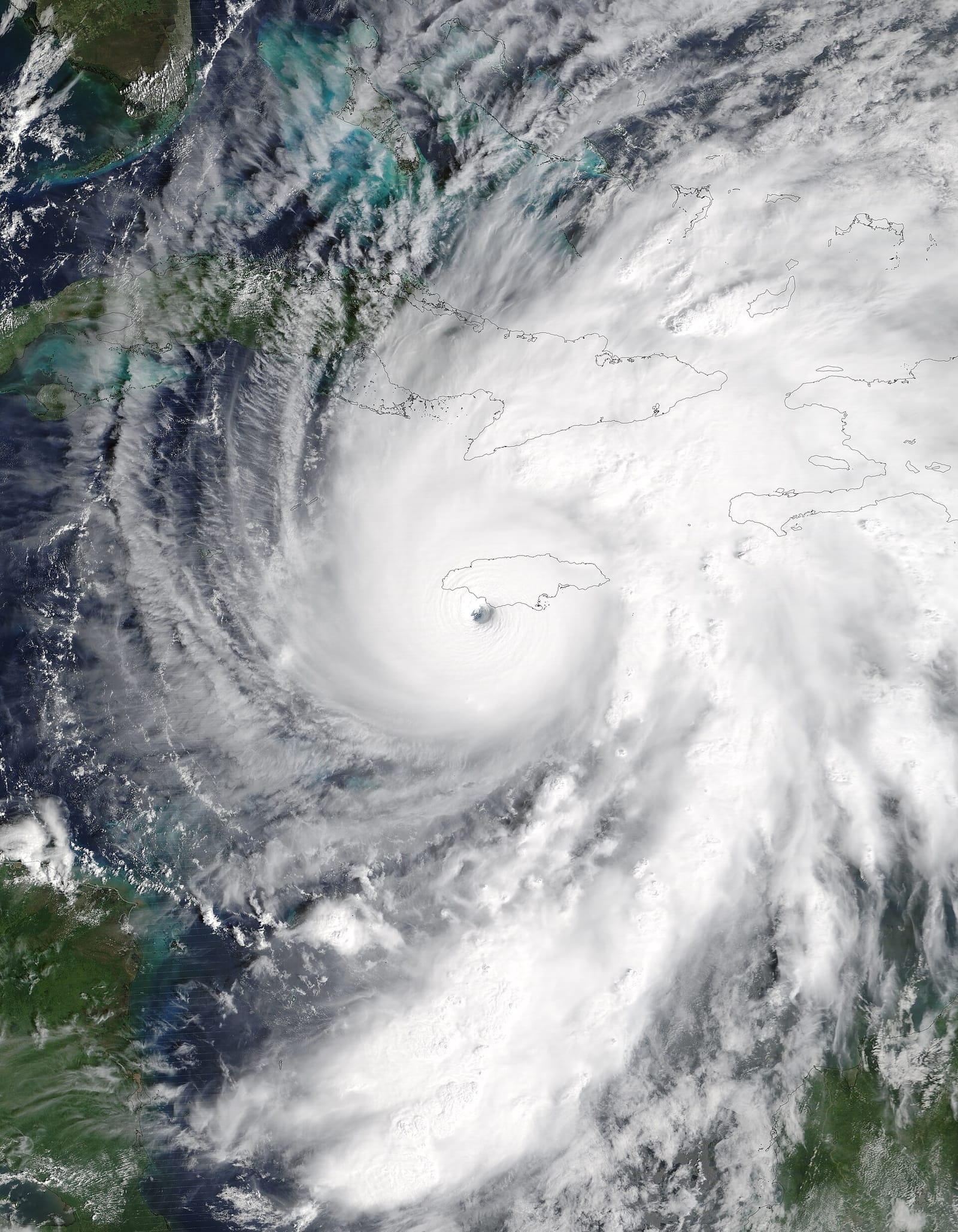
The forecast map shows where the hurricane may come ashore. For the UNICEF staff planning a response in Latin America and the Caribbean, key questions stay open: which schools may be damaged, which clinics may end up under water, and which communities may lose safe water.
Those are “critical questions that are usually unanswered for weeks,” says Mjrko Rennola, a UNICEF regional emergency specialist. “Knowing a storm is coming isn’t enough. We need to know what it will do and where.”
Money tends to follow the same delay. Funding is usually released after a disaster, and it often depends on damage and needs assessments that arrive weeks after the storm has passed.
Children are hard to find in the numbers. UNICEF says data on how disasters affect them “remains limited,” including damage to schools, disruption to health services and the number of children affected.
AI solution
UNICEF launched Ahead of the Storm through its Frontier Data Network, a group that works on new uses of data. A field assessment with staff in the region identified the gaps. Teams in health, nutrition, water and sanitation, emergency response and logistics described what they were missing.
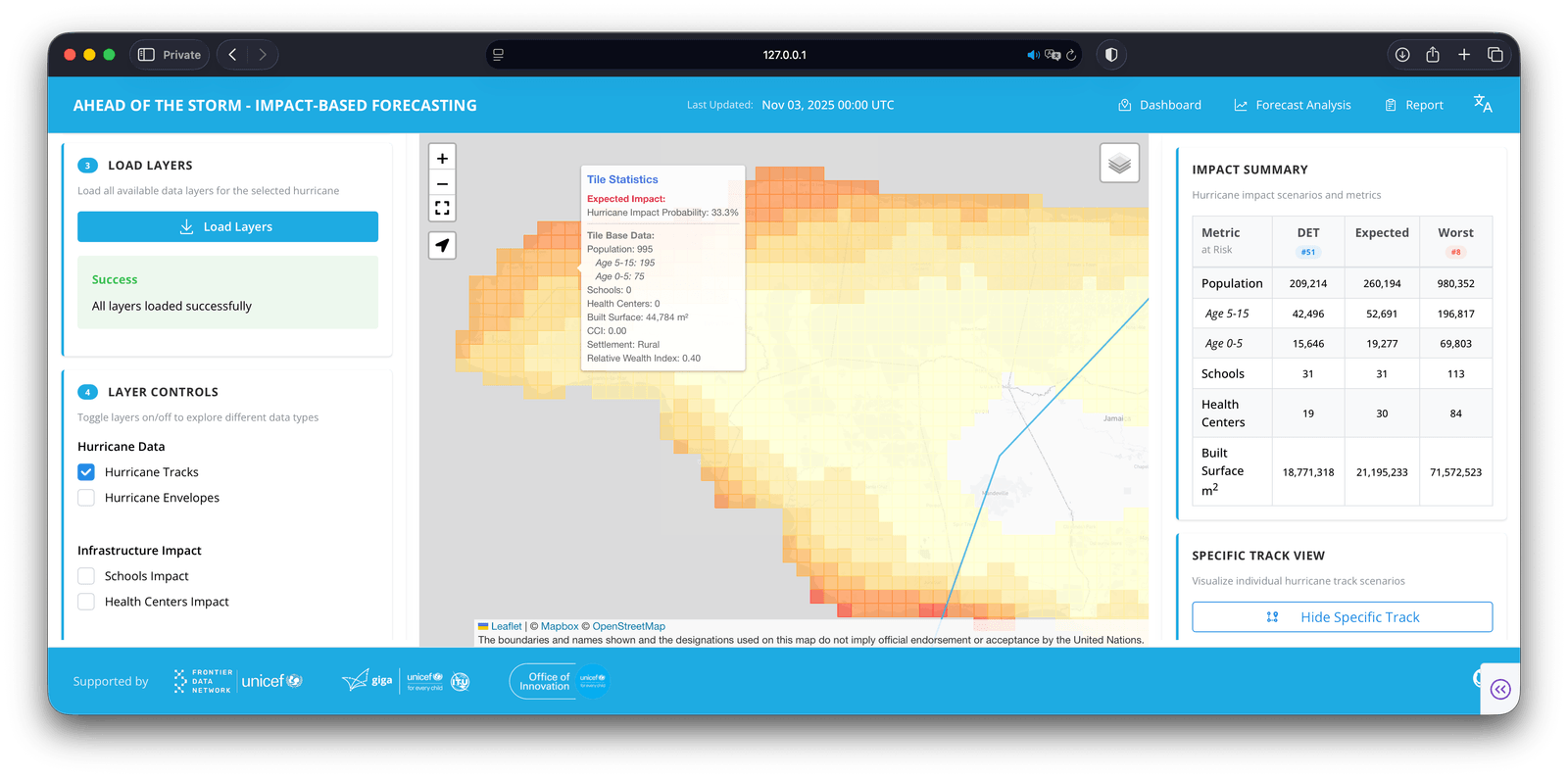
The method starts with a hurricane forecast, laid over maps of where children live and where schools, health centers and water and sanitation facilities stand. Indicators of need, such as child population density and poverty, go on top. Where these overlap, the team gets an estimate of who and what lies in the storm’s path.
UNICEF has put the dashboard’s code online under an open license. It uses storm forecast data from the European Centre for Medium-Range Weather Forecasts and shows the population, children, schools, health centers, shelters and water facilities at risk. An older page, still kept in the code, set out impact for a single forecast run, a probability-based case and a worst case. The interface also comes in Spanish, French and Bengali.
UNICEF’s own accounts of how much of this is AI do not match.
UNICEF’s January 2026 blog describes a prototype built by two students. It drew on outside forecasting systems that use AI, including Google DeepMind’s hurricane models and NASA’s landslide monitoring, but the blog states that “the current prototype uses traditional analytical methods,” with AI and machine learning a possibility for future versions.
The public code, last updated in September 2026, names one AI component: an agent running on the data platform Snowflake that writes situation reports from the impact tables. The project’s two main code guides name no trained model behind the impact estimate.
UNICEF’s November 2026 article says the platform combines “artificial intelligence and machine learning” with climate, geographic and population data to estimate how many children could be affected.
These accounts may describe different stages of the work: the January sentence is about the students’ prototype, and the November one is about the platform. We could not confirm whether a machine learning model produces the child estimate today. The public record clearly shows forecasts linked to maps of people and services, with AI confirmed in some of the forecasts the prototype drew on and in the report writer.
Impact
There are no impact numbers to report yet. In January 2026, UNICEF said the initiative was being piloted in Nicaragua and other Caribbean countries. We found no published results from a real storm, no accuracy figure and no case of a team acting on an estimate. As of November 2026, the project’s data pipeline guide does describe a scheduled job that processes new storm forecasts 16 times a day, and its examples name real storms, but it reports no outcomes.
On November 5, 2026, UNICEF wrote that the next step is to “validate the platform’s estimates against what happens on the ground,” with further testing planned in the Caribbean and feedback from local teams.
UNICEF’s blog does offer a picture of how the tool could be used: “AI-enhanced forecasts could predict” flooding at three rural health clinics in Nicaragua within 48 hours, giving field teams time to move medical supplies first. The blog adds, “These aren’t hypothetical gains.” But it is written as what could happen, and it names no storm, date or clinic where this took place.
Fernando Jambrina, a monitoring and evaluation specialist at UNICEF Nicaragua, explains why the team wants this: “every hour of warning matters.” Knowing which communities and services could be affected has a practical use, Jambrina says: “This changes how we prepare and who we reach first.” We found no published case, so we read that as what the team expects.
In October 2026, UNICEF and the Spanish Agency for International Development Cooperation brought around 50 experts to Geneva, from academia, UN agencies, the Red Cross, the World Meteorological Organization, the European Space Agency, Microsoft, Google and others. They focused on analyzing climate and population data, turning it into something users can act on, and building datasets centered on children.
People
Two students in the Master of Business Analytics program at the Massachusetts Institute of Technology’s Sloan School of Management, Caio de Prospero Iglesias and Sidharth Vijay, built the prototype as a capstone project hosted by the Frontier Data Network. “The framework is experimental, but it shows what might be possible,” Iglesias says.
The project team spans UNICEF’s Frontier Data and Tech Unit, Office of Innovation, Giga (whose data supplies school locations), Latin America and the Caribbean Regional Office and Nicaragua Country Office. Data scientist Felix Schwebel wrote the January account. Liliana Carvajal manages data and monitoring at the regional office, which hosted the field assessment.
Henrietta Ridley, UNICEF’s Chief of AI, puts the condition plainly: “Ahead of the Storm will only work if children are part of the data from the very start.”
Why it matters
If these estimates hold up against real storms, the people who stock clinics and plan for schools could see what a hurricane means for children before it arrives, instead of weeks later. UNICEF has opened its code and named its next test, comparing estimates with what happens on the ground. Other early-warning teams, such as a landslide pilot in Nepal, are working on the same step from forecast to warning.
What we could not confirm (6)
- Whether a machine learning model produces the child-impact estimate today. UNICEF’s January 2026 blog, its public code and its November 2026 article describe the role of AI differently.
- Whether any real storm has been run through the tool before landfall, and how its estimates compared with what happened. The dashboard preview image is dated November 3, 2025, days after Hurricane Melissa, and shows an area near Jamaica, but we found no UNICEF account of that use. The code guides mention real storms and a scheduled forecast job, without saying whether a run came before landfall or how it compared.
- How accurate the estimates are. No accuracy figure is public.
- Which Caribbean countries are in the pilot beyond Nicaragua, and whether national disaster agencies use it.
- Whether a public live version exists. We found only the code, whose guides describe a production setup but give no public address.
- How much funding the initiative has. The blog says the project was made possible in part through the Spanish Agency for International Development Cooperation’s support of the Frontier Data Network, without a total.
FAQs (4)
What is UNICEF's Ahead of the Storm?
A UNICEF initiative that links hurricane forecasts with maps of children, schools, health centers and water facilities, to estimate who a storm could affect before it lands. It is being piloted in Nicaragua and other Caribbean countries.
Does Ahead of the Storm use AI?
UNICEF's accounts differ. A January 2026 blog says the prototype used traditional analytical methods, the public code names only an AI agent that writes reports, and a November 2026 article says the platform uses AI and machine learning.
Has it been tested on a real hurricane?
We found no published results from a real storm. In November 2026 it said the next step is to validate the estimates against what happens on the ground.
Is the tool open to the public?
Its code is public on GitHub under an MIT license. We did not find a public live version.
Sources (5)
UNICEF Digital Impact Division, Using AI to protect children before disaster strikes, 2026-11-05
UNICEF, Ahead-of-the-Storm code repository and README, last updated 2026-09-29, accessed 2026-11-09
UNICEF, Ahead-of-the-Storm data pipeline guide, accessed 2026-11-09
UNICEF Office of Innovation, AI for climate resilience, undated, accessed 2026-11-09
Fact-checked against sources on November 9, 2026. Spot an error? Tell us.
This story supports