Problem
Rehema Chananta has worked for six years as a public health inspector at Magogoni Dispensary, a government health facility in Zanzibar. Her job covers sanitation, clean water and disease prevention in her district. For the past two years she has also supervised community health workers across seven shehias, as Zanzibar’s neighborhoods are called.
Those health workers come from the communities they serve, and they open doors for her. “Before I supervised community health workers, it was hard for me to go into the community and explain myself and share information and knowledge,” she told D-tree, which published her words in English translation.
Community health workers are often the first point of care for families, and sometimes the only one. Each month, their supervisors are expected to explain local health trends, remind them of national protocols and answer their questions. D-tree International, a digital health nonprofit, says that going through large amounts of data and searching for the right protocol, on top of every other duty, takes a lot of time. When D-tree studied the work, it found that supervisors “were drowning” in data and spent hours each month compiling and reconciling it, according to Medic, the organization that stewards the software Zanzibar’s community health program is built on.
Rehema used to go through the data by hand and ask her health workers which problems they had noticed. It took a lot of time, and she could not be sure the picture was right for each shehia.
AI solution
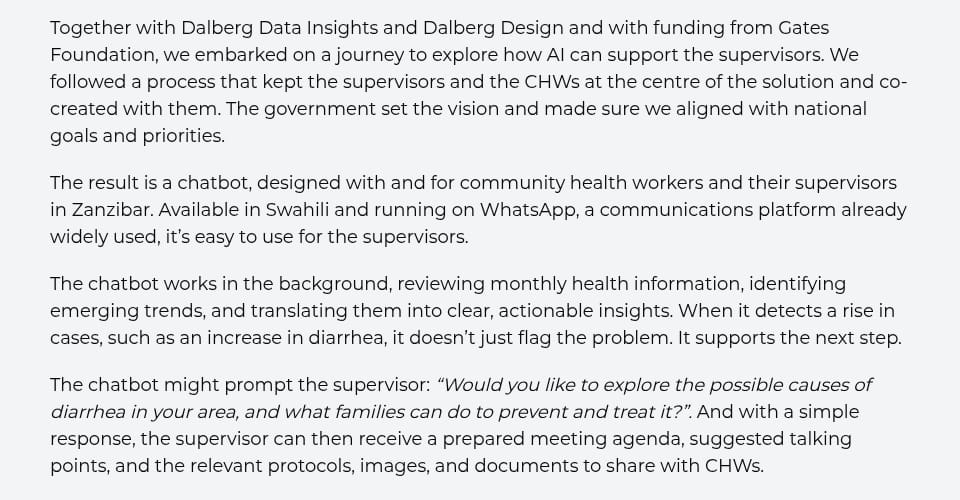
D-tree calls the tool the CHW Supervisor Companion. It runs on WhatsApp, a messaging app already in wide use, and it works in Swahili. Rehema opens WhatsApp on her phone, types “Habari,” a Swahili greeting, and asks what she needs.
In the background, the chatbot reads the month’s health data from Jamii ni Afya, Zanzibar’s national digital community health program, and looks for changes. If diarrhea cases are rising in an area, it might ask the supervisor: “Would you like to explore the possible causes of diarrhea in your area, and what families can do to prevent and treat it?” One short reply brings back a meeting agenda, suggested talking points, and the protocols, images and documents to share with health workers. Supervisors can also ask it questions of their own.
The assistant runs on a large language model, the kind of AI that powers chatbots that write text. According to Medic, it answers from Jamii ni Afya data and ministry-approved protocols, and it “is designed to guide, not decide,” so the supervisor keeps the final judgment. D-tree has not said publicly which model it uses or how it checks the answers.
When D-tree began testing this kind of AI in 2024, it named the risk that such models make up false information in health care, and said it would start with low-risk uses. Its research turned up seven possible uses for AI, and it went ahead with one: a planning tool built for supervisors, not for patients.
Impact
The tool is in a pilot. D-tree describes it in different ways: as a “prototype” in a 2026 conference abstract, as being piloted in February 2026, and in July 2026 as part of AI work it is “designing, testing and in some cases deploying”. Every result below comes from D-tree. It has not published how many people took part or how it measured the results, and no independent evaluation has been published.
In February 2026, D-tree reported that all the supervisors in the pilot said they felt fully prepared for their monthly meetings, and 95% said they felt more confident answering questions accurately.
By July 2026, D-tree reported that supervisors had cut their meeting preparation time by 90%. Eight in ten community health workers said they were getting clearer, more actionable guidance, and 97% wanted their supervisors to keep using the tool.
“It saves me time and reduces my workload. I also find it useful for my role as a public health inspector. If I’m unsure of something, I try to ask the chatbot and often get good answers,” she told D-tree. D-tree chose her for the profile, so hers is one user’s account.
Health outcomes are not measured yet. D-tree expects better guidance to lead to better health over time and says it “will closely monitor those results”. Its conference abstract names the next step: showing how better guidance turns into better services and health.
People
D-tree co-created the chatbot with supervisors and community health workers, working with Dalberg Data Insights and Dalberg Design, two teams of the advisory group Dalberg, with funding from the Gates Foundation. Zanzibar’s government set the vision and made sure the work fit national priorities. D-tree announced its work with Dalberg Data Insights on the tool in December 2024.
Rehema has also changed how she meets her team. “I used to call all of my CHWs to the facility and conduct one meeting per month. But I realised that was too complicated. The focus isn’t there with a larger group. So now, I’m dividing them into groups depending on their needs,” she told D-tree.
Dr. Hannah McCarrick Mikidadi, D-tree’s Country Director in Zanzibar, is the listed speaker for a session on the work at ICT4D 2026, a conference on information and communication technologies for development. In Medic’s account of a conversation with her colleague Abbas Wandella, he framed the supervisors’ workload as a problem worth solving with or without AI.
Underneath the chatbot is Jamii ni Afya, which D-tree and the government built over more than a decade on the Community Health Toolkit, software stewarded by Medic. The program grew from three modules to fourteen, and its community health workers went from volunteers to a paid government workforce. D-tree hopes Jamii ni Afya can carry the chatbot to every community health supervisor in Zanzibar and make it “the first AI companion used at national scale in Africa”. That has not happened yet.
Why it matters
Many health systems are trying AI chatbots, and the hardest questions are about safety. D-tree and Zanzibar’s government picked one low-risk job, built it into a national program the government already runs, and left the decisions with the supervisor. If independent results confirm D-tree’s early numbers, this careful approach could help community health workers in other countries, too.
What we could not confirm (8)
- How many supervisors and community health workers took part in the pilot, in which districts and for how long, and how D-tree measured the survey results.
- Which AI model the chatbot uses, who hosts it, what it costs, and how wrong or unsafe answers are caught or logged, beyond the “guide, not decide” design and ministry-approved protocols.
- Dalberg’s exact role beyond being a partner in the design.
- How many supervisors use the chatbot today, and any date or government commitment for national scale-up through Jamii ni Afya.
- Any effect on health services or health outcomes. D-tree says it will monitor this.
- Any independent evaluation. All results in this story are D-tree’s own.
- Whether the ICT4D 2026 session has taken place and what was presented there.
- Rehema Chananta’s words come from D-tree’s English translation; we have not seen the original Swahili.
FAQs (5)
What is the D-tree supervisor chatbot in Zanzibar?
It is an AI assistant on WhatsApp, in Swahili, for the people who supervise community health workers in Zanzibar. It reads monthly data from the national Jamii ni Afya program, spots rising health problems such as diarrhea, and offers a meeting agenda, talking points and protocols to share with health workers. D-tree calls it the CHW Supervisor Companion.
Does the chatbot give medical advice to patients?
It is not built for patients. It is a planning and guidance tool for supervisors. According to Medic, it answers from program data and ministry-approved protocols and is "designed to guide, not decide," so the supervisor keeps the judgment.
Who built it?
D-tree International built it with supervisors and community health workers, with Dalberg Data Insights and Dalberg Design as partners and funding from the Gates Foundation. Zanzibar's government set the vision.
Does it work?
Early signs are positive but self-reported. D-tree says supervisors cut meeting preparation time by 90% and that eight in ten community health workers reported clearer guidance. It has not published sample sizes, and no independent evaluation or health outcome data have been published.
Is it used across Zanzibar?
Not yet. It is a pilot. D-tree aims to offer it to every community health supervisor in Zanzibar through Jamii ni Afya, but we found no date for that.
Sources (5)
D-tree, The chatbot changing community health supervision in Zanzibar, 2026-02-05
D-tree, AI in action: exploring how LLMs can help us to innovate and improve, 2024-12-16
Fact-checked against sources on November 25, 2026. Spot an error? Tell us.
This story supports