Problem
Edidiong Ekong grew up in Nigeria with three Deaf friends. “At age 9, I realised I was being left out of their world, not the other way around. So I learned American Sign Language to join their conversations,” he told TechCabal, a Nigerian technology news site, in February 2026. By his own account, he was teaching sign language to hearing people by age 12, and ran classes for 10 years.
Without a shared language, a conversation between a Deaf signer and hearing people can mean waiting for a human interpreter. In a worldwide survey of Deaf and hard-of-hearing people by Northeastern University in the US, reported in March 2026, respondents with limited access to interpreting services were more hopeful about sign language technology. Such tools, one said, offer “independence, autonomy, and critical support in situations where human interpreters are not available.” The survey did not look at Talksign.
The world also has more than 100 registered sign languages, plus dialects. American Sign Language and Nigerian Sign Language are two of them.
AI solution
Talksign builds two main models. Palm watches signing through a camera and turns it into text or speech. It tracks 133 points on the body, including the hands, head and shoulders, which the company says lets it follow a whole signed sentence in context. Echo goes the other way: it turns English text or speech into a video of a signing avatar, a computer-generated figure that can be made from a single reference photo.
According to the company, the body points are worked out on the user’s own device, and only those data points, not raw video, reach its servers. It says it does not store raw video or audio, and that nothing is saved unless the user turns on history.
When Palm is unsure of a sign, it asks the signer to confirm before it speaks. “A wrong word said with confidence is worse than a pause. We’d rather ask,” Ekong wrote on the company blog in October 2026, adding that Deaf signers who tested the tool said being misunderstood is worse than a brief pause.
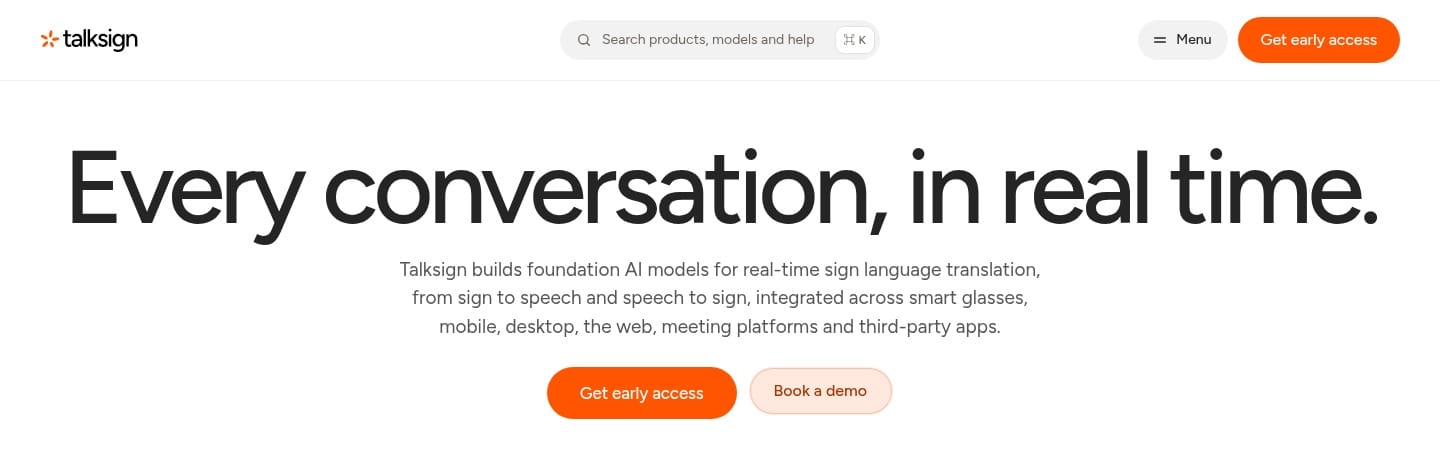
A blog post of September 23, 2026 says signing on video calls is “now in early access”.
The models learn from videos of real people signing. Talksign says Deaf advisors, educators and accessibility advocates reviewed its datasets, and its site states: “Every sign in our data is recorded with consent,” and “Deaf signers review all signing before it ships”. In August 2026 it opened a Dataset Marketplace where signers, Deaf communities and researchers can record, annotate and license sign language data. Contributors earn about $10 an hour on average, the company says, and a verification portal ties each dataset to its source and consent.
Impact
Talksign is at the pilot stage, and every performance figure here comes from the company. Its first model, Talksign-1, launched in February 2026, recognized 250 single ASL signs and scored 84.7 percent on them in the company’s own test.
On May 20, 2026, Talksign released Palm 1.0 and Echo 1.0. It said Palm, trained on more than 71,000 ASL samples, reached 84.2 percent “semantic accuracy,” which it describes as capturing the meaning a signer intends, and 79.6 percent accuracy word by word. Echo learned from 94,410 ASL sentence pairs and makes video at 30 frames per second. In September, the Nigerian tech site Techgix noted that the company’s figures “have not been independently verified”.
The company listed its own limits: specialist words in medicine, law and engineering need more tuning, multi-word ASL phrases are only partly covered, and Palm is not yet tuned for all continuous signing. In February it warned that its tools should not be the only authority in medical, legal or safety-critical settings without human oversight.
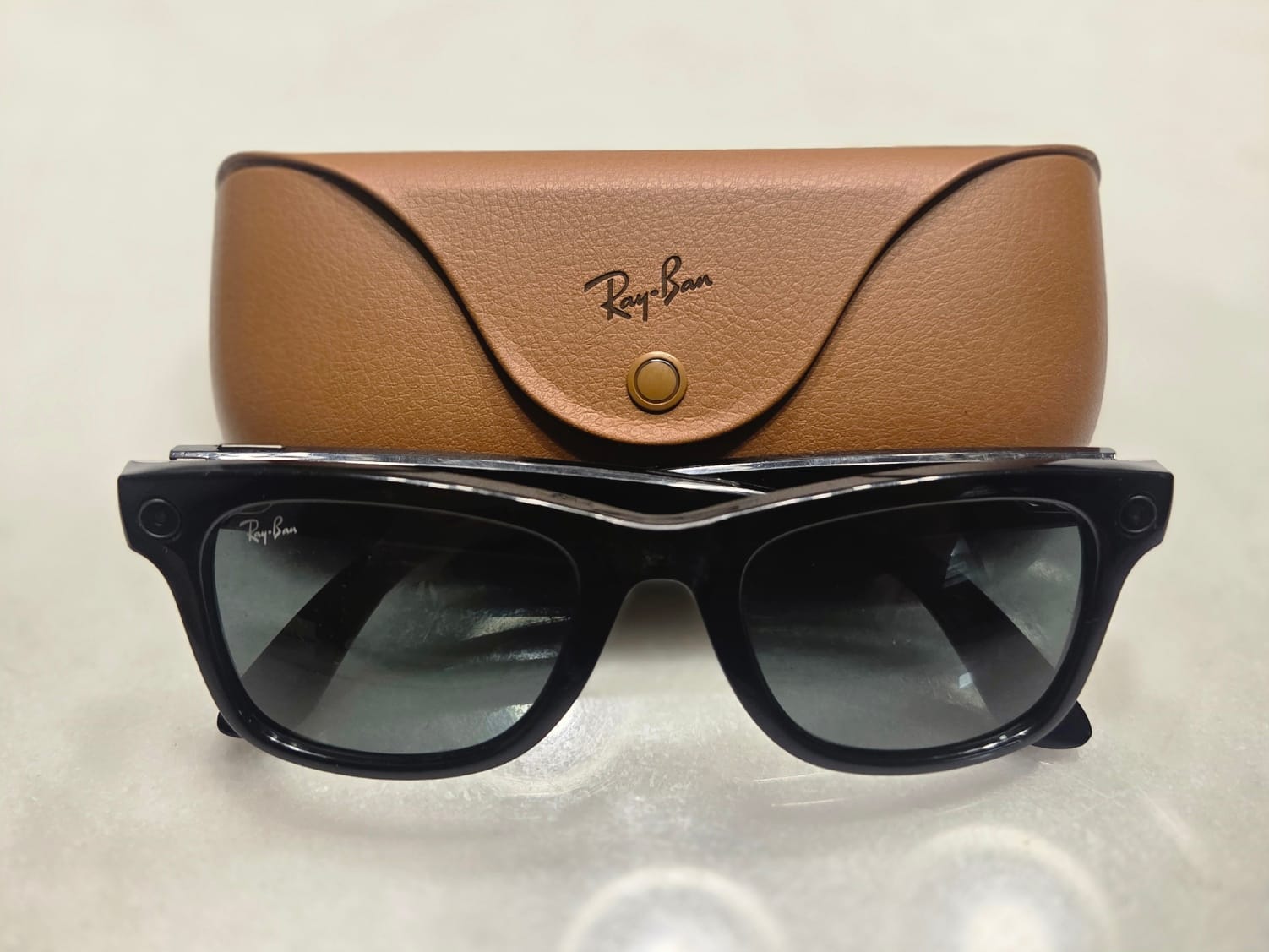
“Palm 1.0 is the first model we are confident putting into the hands of Deaf users at scale,” Ekong said at the launch. A full rollout on desktop and Meta’s Ray-Ban smart glasses was planned for August 20, 2026. We found no sign that it happened. In November 2026 the site still asked people to join an early-access waitlist and gave no user numbers.
The site now lists Palm 2.0, with the same 84.2 percent figure as Palm 1.0, and Echo 2.0, at 60 frames per second.
In November 2026, ASL was the only sign language marked “Live” on the site. British, Chinese, German and Australian Sign Language were “In development”. Techgix had reported in September that the company’s website said the tool “now supports” British and German Sign Language; we follow the site as we read it in November. Nigerian Sign Language, which Talksign named as planned in May, is not on the current list.
People
Ekong is Talksign’s co-founder and CEO. Kazi Mahathir Rahman, an AI engineer, is co-founder and chief technology officer. Rahman says the models open the door to “signing as a first-class interface” for computers.
TechCabal calls Talksign Nigeria- and UK-based; the website footer names Talksign Ltd and says it is “building” from London. The site shows NVIDIA and Wild & Mild logos under “backed and supported by”.
“We believe AI should augment, not replace human interpreters,” Ekong said in February.
Respondents in the Northeastern survey, led by PhD student Saki Imai with assistant professor Malihe Alikhani, raised the same worry. Many were skeptical of sign language tools, and Imai said developers had long built them without working with Deaf communities. Some feared software would erase local signs by standardizing them, or become a cheaper substitute for interpreters. “We want [this community] to decide what is success, not just a number or an accuracy rate,” Alikhani said.
Rachel Berman-Kobylarz, a deaf lecturer at Northeastern who was not part of the survey, is “cautiously optimistic” about tools made by or with Deaf people. “It should be used as a tool, not a solution to replace real-life interpreters,” she said.
Why it matters
Talksign’s tools could help Deaf and hearing people talk when no interpreter is around, and the company says Deaf signers review its data and test its tools, which is what many respondents in the Northeastern survey asked of developers. What it has not yet shown is independent results, a count of real users, or progress on Nigerian Sign Language in the country where its founder first learned to sign.
What we could not confirm (7)
- Whether the planned August 20, 2026 rollout on desktop and Meta’s Ray-Ban smart glasses happened. We found no report or company post, and in November 2026 the site still showed an early-access waitlist. A Techgix report of a LinkedIn post about the glasses is the only other mention, with no statement from Meta.
- How many people use Talksign, and whether any schools, clinics, Deaf organizations or pilots in Nigeria are involved.
- Any progress on Nigerian Sign Language, such as data, partners or a date.
- Which Deaf advisors, signers or organizations review Talksign’s data. The company says they exist but does not name them in the sources we read.
- Any independent test of the 84.2 percent figure, and how the company calculates “semantic accuracy.”
- What kind of support NVIDIA and Wild & Mild provide, and how Talksign is funded.
- Where the team mainly works. The site says Talksign Ltd is “building” from London, its terms give a registered office in Birmingham, UK, and press describes it as Nigeria- and UK-based.
FAQs (5)
What is Talksign?
Talksign is a startup founded in November 2025 by Edidiong Ekong and Kazi Mahathir Rahman. It builds AI models that translate American Sign Language into text or speech (Palm) and English text or speech into signing avatars (Echo).
Does Talksign work with Nigerian Sign Language?
Not yet. American Sign Language is the only sign language marked live on its site in November 2026. The company named Nigerian Sign Language as a future language in May 2026, but it is not on the current list.
How accurate is Talksign?
The company reports 84.2 percent "semantic accuracy" and 79.6 percent word-level accuracy for its Palm model. These are its own figures and have not been independently verified.
Can people use it today?
Access is through an early-access waitlist and demos. We found no public user numbers.
Is Talksign meant to replace sign language interpreters?
The founder says no: "We believe AI should augment, not replace human interpreters." The company also warns against relying on it alone in medical, legal or safety-critical settings.
Sources (7)
TechCabal, Talksign-1 launch, 2026-02-16
Talksign, official website and blog, accessed 2026-11-25
Techgix, Edidiong Ekong built Talksign to make AI understand sign language, 2026-09-10
Talksign, blog index, trust centre, privacy policy and terms, checked 2026-11-25
Slator, Talksign launches sign language data marketplace, 2026-08-31
Fact-checked against sources on November 25, 2026. Spot an error? Tell us.
This story supports