Problem
Larry Wade used to paint in oils. The Navy veteran from Utah lost his sight about 10 years ago to an eye disease called retinitis pigmentosa. “I thought it was the end of the world,” he told the Deseret News. Reading a food or prescription label usually meant asking for help.
On September 29, 2026, in Salt Lake City, Wade got a free pair of Ray-Ban Meta glasses and one-on-one training. “Everything’s going to be much easier,” he said, “just being able to do things like read the labels on cans in the pantry”.
Meta says more than 130,000 American veterans are legally blind, without saying where the figure comes from. Anthony Woodson, an Army veteran who leads BVA’s Illinois Regional Group, told FOX 32 Chicago what vision loss often does: “A lot of veterans with low vision and blindness, they kind of become reclusive”.
AI solution
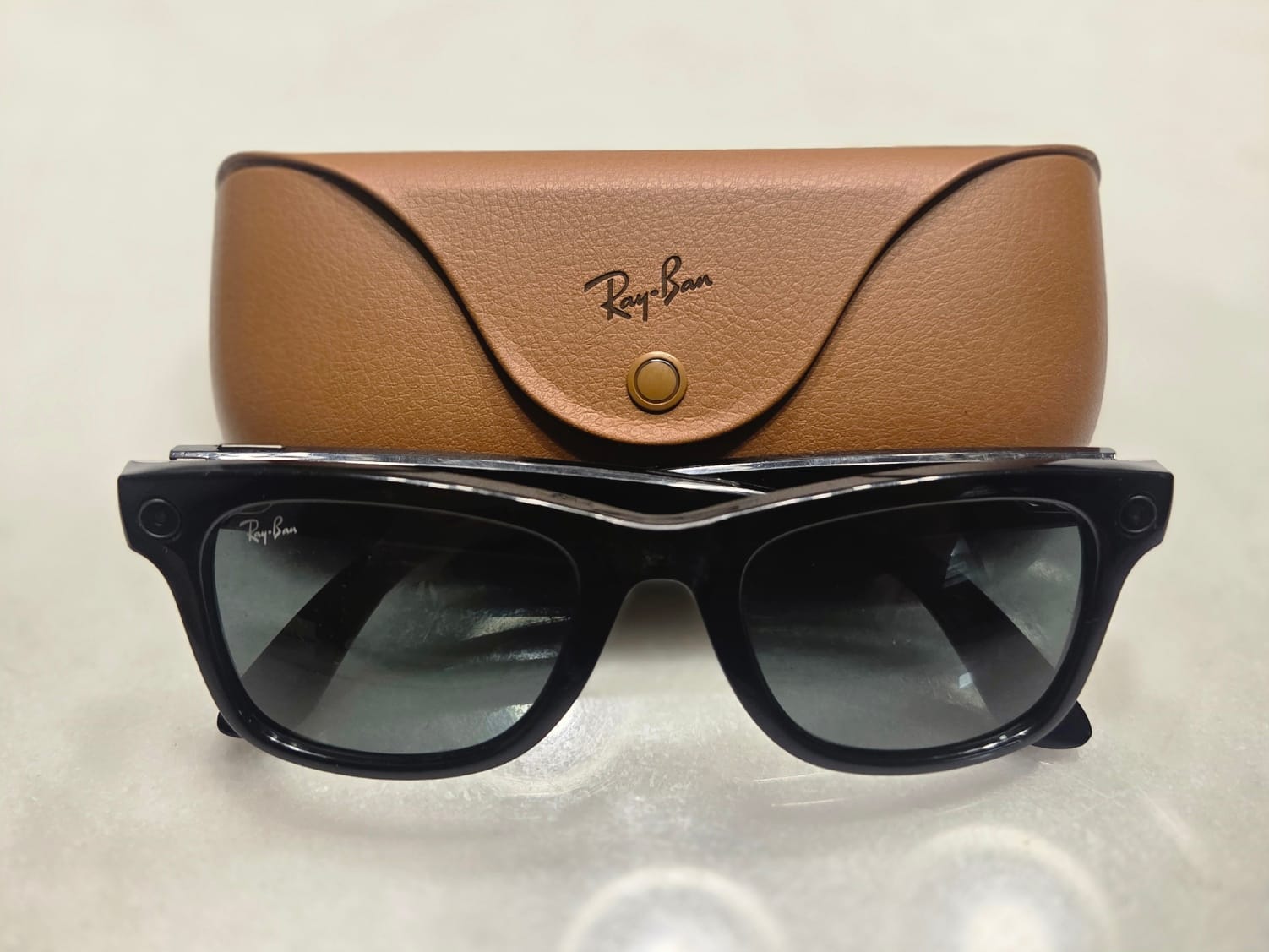
The glasses have a camera and open-ear speakers built into the frame. The wearer says “Hey Meta” and asks a question out loud. Meta AI, the company’s assistant, looks at what the camera sees and answers through the speakers.
For a blind wearer, that means the glasses can read a menu or a label, describe objects and colors, keep up a running conversation about what is in view, and handle calls and messages by voice. When the AI is not enough, a “Call a Volunteer” feature connects the wearer to a sighted volunteer through Be My Eyes, the free app we wrote about on November 23.
The program gives out the first generation of Ray-Ban Meta, a consumer product. The donation terms bar organizations from presenting it as a medical device or a replacement for mobility training. Wade Davis, BVA’s national president, wears his own pair and puts it simply: “You still need a white cane to maneuver around for you to be safe, but these glasses describe your settings”.
BVA wrote the training. Its guide covers voice commands, reading documents and answering calls, and it runs monthly live webinars with TechSoup, which handles the nonprofit side of the donation. Other veteran nonprofits can apply through TechSoup for up to 100 pairs per standard request, and their staff must complete a BVA-built “train-the-trainer” course. About 150 organizations are listed as taking part.
Impact
The program is capped at 130,000 pairs, “subject to availability”. Meta, BVA and TechSoup have not published how many pairs have reached veterans.
Meta gave out “dozens” of pairs in Salt Lake City on September 29, the Deseret News reported. In Rosemont, Illinois, roughly 50 veterans received glasses and hands-on training on November 6, ahead of Veterans Day, according to FOX 32 Chicago, with practice on email, map directions, calls, music and reading.
The veterans’ accounts are first impressions, given at handout events with the donor present. Woodson said directions used to mean pulling out a phone while holding a cane: “So now, you can do all of that hands-free.” Davis asked the glasses to read the scriptures on the big screen at his church, “and it did”.
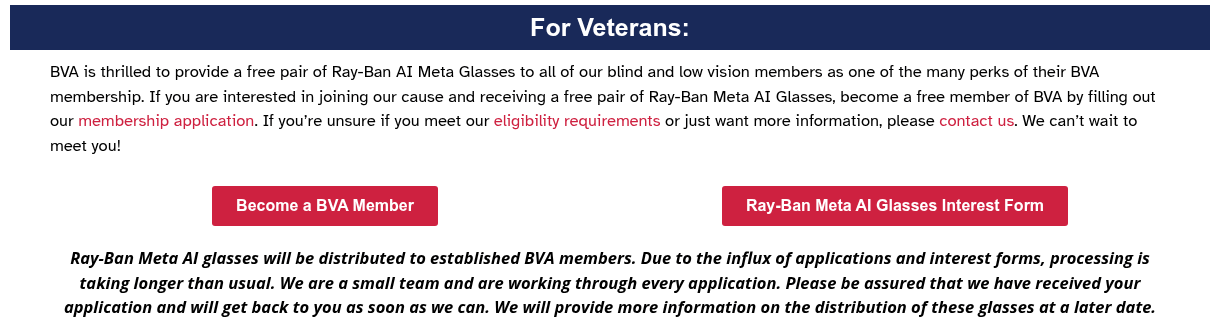
Demand has outpaced BVA’s small team. As of November 27, 2026, its program page says that because of the volume of interest, “all new requests for Meta glasses will now be added to a waitlist.” Members who cannot attend an event will get their glasses by mail.
No one has independently evaluated how the donated glasses work for blind veterans. The nearest outside test measured one narrow task. In a 2025 lab study with 12 blind and low-vision people, Penn State researchers compared their prototype app, NaviSense, with other tools (we covered it on November 26). Ray-Ban Meta glasses picked up the right item from a shelf in 55.9% of tries, though the researchers noted the glasses offer a hands-free design and the test covered only a few household items.
Privacy is the other open question. In Tech Policy Press in August 2026, Ariana Aboulafia of the Center for Democracy & Technology argued that the glasses’ only recording signal is a small, dim light that blind and low-vision people nearby cannot see. She also pointed to a reported internal Meta memo about adding facial recognition. The donation terms say users can delete their photos, videos and voice interactions in the Meta View app, and they require recipient nonprofits to give Meta information for a case study or testimonial.
People
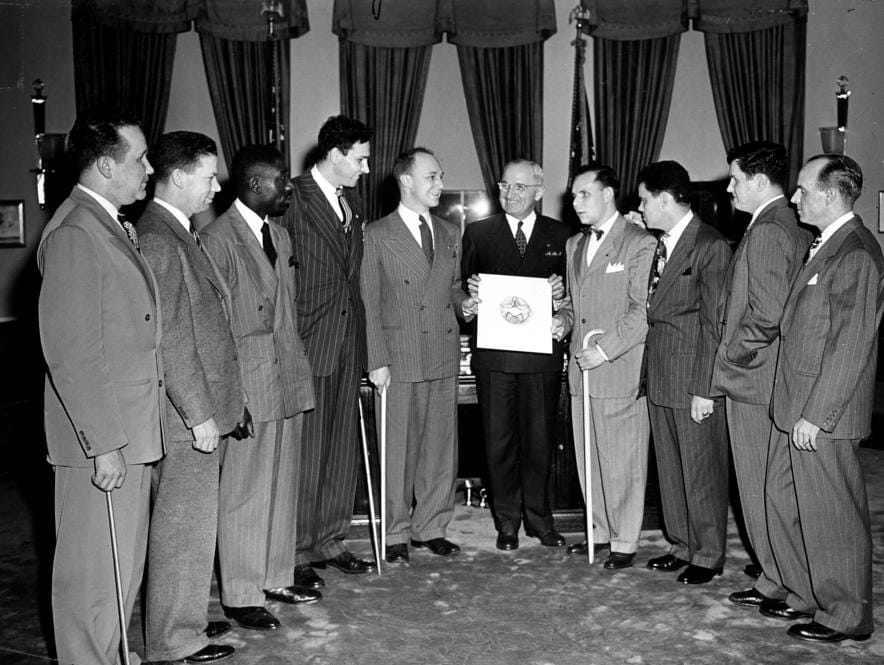
BVA was founded by veterans in 1945. “The Blinded Veterans Association was built on a simple, powerful promise: blinded veterans helping blinded veterans,” said Lea Rowe, its national executive director, when the program was announced.
Several of the people handing out glasses live with vision loss. Davis is an Army veteran of the Vietnam War who began losing his sight in his 40s. Dominique Lawless, BVA’s national program director, is blind and helped hand out glasses and train veterans in Salt Lake City. Woodson uses the glasses himself. Partners including the American Council of the Blind, Lighthouse Guild and Tunnel to Towers share the distribution.
Meta credits a veteran with the idea. Don Overton served in the US Army’s 82nd Airborne Division and lost his sight in a bunker explosion during Desert Storm; Meta says he worked with its wearables team on features. “The moment I put on my Ray-Ban Meta glasses, I got my independence back,” he said in Meta’s announcement.
Why it matters
A blind veteran who gets AI glasses in the mail still has to learn to use them, and BVA, founded by veterans in 1945 on a promise of “blinded veterans helping blinded veterans,” is teaching that veteran to veteran. The program also has the limits of a corporate gift: it is a consumer gadget with marketing value for Meta, nobody has said how many people have one, and the privacy questions affect both wearers and the people around them. A count of pairs delivered, and a look at how veterans use them a year from now, would show whether the help lasts.
What we could not confirm (8)
- How many glasses have been delivered to veterans so far. Meta, BVA and TechSoup have not published a total; the only counts we found are from two events (“dozens” in Salt Lake City and about 50 in Rosemont).
- Where Meta’s figure of 130,000 legally blind US veterans comes from. Meta does not give a source.
- How the glasses work for blind veterans over time. We found no independent evaluation; the veterans’ comments are first impressions at donor-run events.
- How long the waitlist is, and when people on it can expect glasses.
- Whether all distribution channels mail glasses. BVA says members who cannot attend an event get them by mail; a search summary of the American Council of the Blind’s pages said its events require in-person pickup and a compatible smartphone. We could not check this at the source.
- How Meta handles photos, video and voice recordings made by veterans in this program, beyond the general controls in the Meta View app. Reports of contractors reviewing user video and plans for facial recognition come from press accounts we could not verify.
- What the National Federation of the Blind thinks of the glasses for this program. We saw only a summary of a CBS News report and could not open the article.
- The retail value of the donation.
FAQs (5)
Who can get free Ray-Ban Meta glasses through this program?
Legally blind and low-vision US veterans. Veterans apply through the Blinded Veterans Association (membership is free) at bva.org/glasses, or get them through a veteran nonprofit approved via TechSoup. As of November 27, 2026, new BVA requests go on a waitlist.
What do the glasses do for a blind person?
A camera in the frame and Meta's AI assistant read text such as menus and labels aloud, describe objects and surroundings, and handle calls and messages by voice. A "Call a Volunteer" feature connects the wearer to a sighted Be My Eyes volunteer.
Do the glasses replace a white cane or a guide dog?
No. BVA's national president says a white cane is still needed for safe travel, and the donation terms bar presenting the glasses as a medical device or a substitute for mobility training.
How many veterans have received them?
No total has been published. The program is capped at 130,000 pairs, subject to availability. Local reports describe dozens of pairs at a Salt Lake City event in September 2026 and about 50 at a Rosemont, Illinois, event in November 2026.
Are there privacy concerns?
Yes. The Center for Democracy & Technology has warned that the small recording light cannot be seen by blind people nearby, and press reports have raised questions about facial recognition plans and how Meta handles recordings.
Sources (8)
Meta, The Future Is for Everyone: Free AI Glasses for Every Blind Veteran in America, 2026-06-12
Blinded Veterans Association, Blinded Veterans and Meta AI Glasses Donation, accessed 2026-11-27
TechSoup, Ray-Ban Meta AI Glasses for Blind Veterans, accessed 2026-11-27
Jason Swensen, How Meta is offering 'sight' to Utah's blind veterans, Deseret News, 2026-09-29
Ariana Aboulafia, For Meta's smart glasses, access is an afterthought, Tech Policy Press, 2026-08-12
Penn State NaviSense study (conference paper, 2025)
Fact-checked against sources on November 27, 2026. Spot an error? Tell us.
This story supports