Problem
Anne-Marie Poirier, who lives in Quebec, first noticed symptoms in August 2024 and was diagnosed with ALS a year later. The disease slowly destroys the nerve cells that control movement. In October 2025 she began to lose her voice, and from January 2026 she talked through communication apps.
In May she switched to a new one, Vocality. “It’s so much simpler, more intuitive,” she told The Canadian Press in November. “It gives me energy, a feeling of being alive”.
Nearly 4,000 Canadians live with ALS, and about 1,000 more are diagnosed each year, according to the ALS Society of Canada.
For people who type to talk, speed is the problem. Thomas Houlachi, Vocality’s co-founder, says speech therapists all told him the tools on offer were not fast enough. In 2025 he put numbers on it: everyday conversation runs at about 100 words a minute, and commercial tools reach about a quarter of that.
Houlachi saw this in his own family. In 2021, two of his relatives were diagnosed with ALS, and by 2023 both had lost their speech. They died before the app was finished.
AI solution
Vocality runs on iPhones, iPads and Android phones. It is made for people who can no longer speak, or speak only with difficulty, but can still read, write a message and touch a screen with at least one finger.
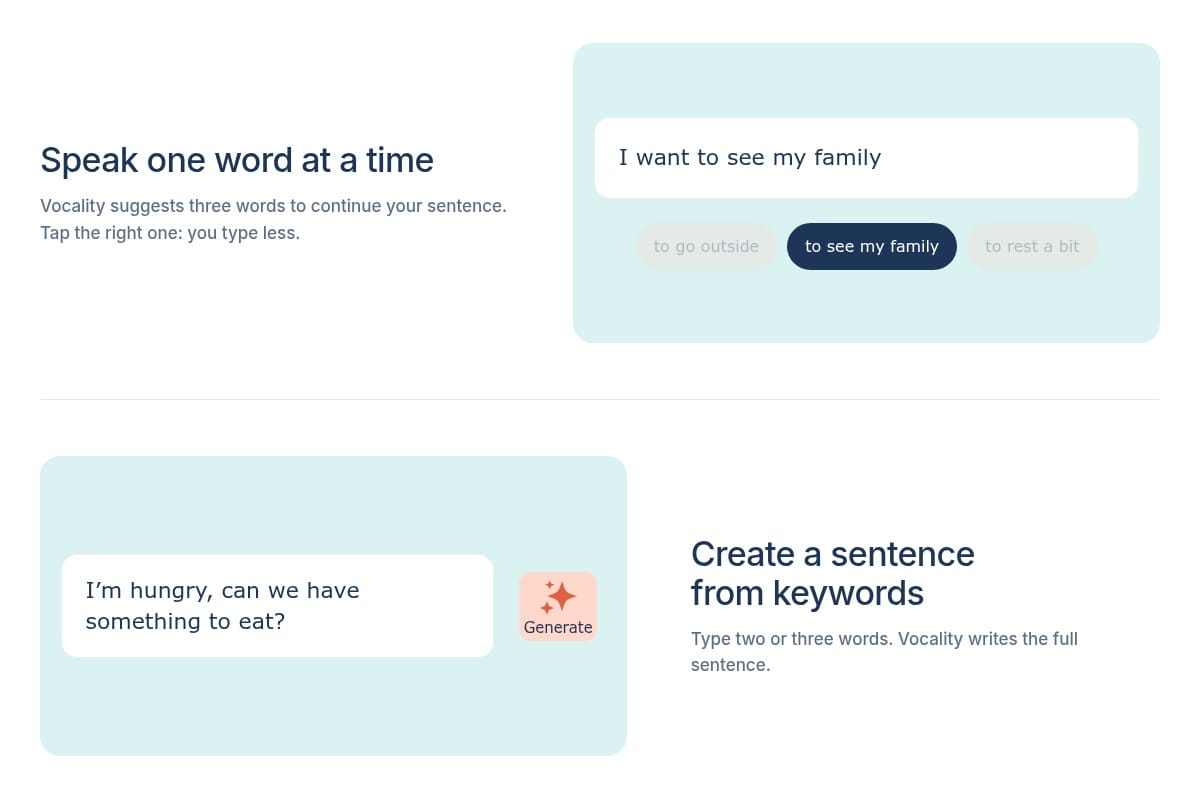
As the user types, the app suggests three words to continue the sentence, and one tap adds the right one. With a button called Generate, two or three keywords become a full sentence: in the example on its website, “hungry pls” becomes “I’m hungry, can we have something to eat?” When someone asks a question out loud, Listen hears it and proposes replies, and the user always picks which one is spoken. Correct fixes typos and missing accents in one tap.
Behind these shortcuts is AI that, Houlachi says, was designed specifically for people with speech impairments: it predicts which words are likely to come next. Vocality also learns each person’s own words and turns of phrase over time. The word suggestions stay on the phone. Generate, Listen and Correct use the internet, and the company says it encrypts and pseudonymizes the text first, which means masking details that would identify the user.
The app reads the message aloud. It can use voices from two voice technology companies, ElevenLabs and Acapela. Anyone who wants to sound like themselves first makes a copy of their voice on ElevenLabs, from recordings, with their own account, then connects it to Vocality. “Vocality does not create voices,” its site says. Without a personal voice, the app uses the phone’s built-in voices. Poirier’s voice mixes recordings of her real speech with words the AI generates.
Vocality works in six languages: English, French, Spanish, German, Italian and Portuguese. Poirier understands Italian but does not usually speak it. Now she writes sentences in Italian and lets the app read them to her partner, who speaks it fluently.
Impact
Vocality launched on iPhone and iPad in June 2026, after more than two years of building and testing with people living with ALS. By November 27, 2026, its site also listed Android phones.
More than 100 people across North America use it every day, Houlachi told The Canadian Press in November 2026, a figure we could not check. Users include people with cerebral palsy and some forms of aphasia, a language disorder.
An undated 2026 profile on the site of the Forces AVENIR student awards says the team worked with 15 speech-language pathologists and about ten patient partners, and that the technology was in use in two rehabilitation centers. No one has checked these figures independently.
In December 2025, La Presse reported the team’s aim: to be twice as fast as existing tools. We found no published test of whether it is. Poirier’s view is one user’s experience, not a study.
The app is paid. After a 14-day free trial, the site lists $8.99 a month, or a one-time launch price of $82.99 until December 31, 2026, with a switch between Canadian and US dollars. In Quebec, the site says, ALS Québec covers it for people living with ALS; The Canadian Press put it more cautiously: eligible users may qualify for financial help from ALS Québec.
People
Houlachi was starting biomedical engineering at Polytechnique Montréal when he set out to make talking less of a struggle. He teamed up with David Ruiz, who studied software engineering at Concordia University, and they founded Vocality in 2023. Ruiz, the company’s technology lead, is now studying for a master’s degree in AI at Concordia.
“Speech is something so fundamental to the human experience. If you lose it, you lose half of that experience.”Thomas Houlachi, Vocality co-founder, quoted by The Canadian Press, November 2026
ALS Québec helped find people to test the app, and that is how Poirier joined. She sends Houlachi feedback regularly. When people asked her to repeat something, she sometimes had to retype it, because the app erased each sentence after reading it. Vocality now has a phrase library and a repeat button.
Propolys, the Polytechnique Montréal incubator, coached the team and gave it CAD 16,000. Its partnerships manager, Paul Shenouda, noticed how early the founders brought in patients. “It’s rather rare to have a story that’s so sincere,” he said.
Houlachi sees the app as the opposite of AI replacing people: “It’s a tool that gives people control, allowing them to continue expressing themselves authentically, while helping them communicate faster and more smoothly”.
Why it matters
A reply that arrives a minute late can leave someone out of their own conversation. Earlier stories here, like Talk to Me, Goose! and Voice Back, were about giving people back the sound of their own voice. Vocality works on speed: fewer taps between a thought and a spoken sentence. People living with ALS helped shape it, and a Quebec patient group now helps pay for it. No one has yet shown that it doubles the pace, but for Poirier it already means joining in, even in Italian with her partner.
What we could not confirm (9)
- The figure of more than 100 daily users comes from the CEO (November 2026). We could not find an independent count, or how many users are paid for by ALS Québec.
- No published study shows that Vocality is faster than other communication tools. “Twice as fast” was a goal stated in 2025.
- The news report said Vocality works with eye-tracking equipment; the company’s site says some people use it that way but the app is “not yet optimized for that use”.
- The news report said ElevenLabs technology creates the user’s voice through the app; the company’s site says Vocality does not create voices, and a personal voice needs the user’s own ElevenLabs account.
- When the Android version went live. The news report (November 11, 2026) said it was expected the following week; the site listed it by November 27.
- Which currency the listed prices are in by default. The site offers Canadian and US dollars.
- Whether Vocality has, or needs, approval from Health Canada or the US Food and Drug Administration. The founders said in 2025 that they had started the process; we found no update.
- The “two rehabilitation centers” using it are not named, and the Forces AVENIR profile is undated.
- Who exactly ALS Québec pays for, and how much. The company’s site says it covers Vocality for people living with ALS; The Canadian Press said eligible users may qualify for financial help.
FAQs (5)
What is Vocality?
A communication app from Montreal for people who have lost their speech but can still read and type. It suggests words, writes full sentences from two or three keywords, suggests replies to spoken questions, and reads the message aloud.
Does Vocality speak in the user's own voice?
It can. Vocality uses ElevenLabs and Acapela voices. A personal voice is made separately on ElevenLabs with the user's own account and then connected to the app. Otherwise, it uses the device's built-in voices.
How much does Vocality cost?
After a 14-day free trial, the site lists $8.99 a month or a one-time launch price of $82.99 until December 31, 2026. In Quebec, the company says ALS Québec covers it for people living with ALS.
Which devices and languages does it support?
iPhone, iPad and Android phones (not Android tablets yet), in English, French, Spanish, German, Italian and Portuguese.
Is it proven to work?
It is in daily use, and a user describes it as simpler than earlier apps, but the results are early. The usage figures come from the company, and no independent study has been published.
Sources (4)
Vocality, official website (home, how it works, pricing, FAQ, about), accessed 2026-11-27
La Presse (Megan Foy), Une voix pour ceux qui n'en ont pas, 2025-12-15
Forces AVENIR, 2026 laureate page, Vocality, undated (2026), accessed 2026-11-27
Fact-checked against sources on November 27, 2026. Spot an error? Tell us.
This story supports