Problem
David Betts is a keen cyclist. A couple of years ago his muscles began to twitch and he had trouble with his pedals. Then his voice began to change. Several doctors told him it was nothing, the Pittsburgh TV station WPXI reported, until he pushed one specialist. The diagnosis was ALS.
ALS breaks down muscle control, which can take away a person’s speech. Most people with the disease die within three to five years of their first symptoms, though about 1 in 10 live for 10 years or more, according to the US National Institute of Neurological Disorders and Stroke.
“I didn’t know how long I would have my voice,” Betts told the local tech news site Technical.ly. “I faced this uncertain deadline.”
Betts, a Pittsburgh native, says he has always worked through problems by talking them out. He went looking for the tools people use once speech goes, and every one he found sounded robotic. “I remember Stephen Hawking and the robotic voice, and I didn’t want to sound that way,” he told WPXI. He tried computers controlled by eye movement, but each word took a long time to form.
A turning point, he said, was hearing another ALS patient talk about “the ‘awkward pause’ in conversation, that long silence while you type, while people wait, while the conversation slowly moves on without you”.
AI solution
Betts had been a senior partner at the consulting firm Deloitte and had never written code. He learned from online classes and started the app on January 5, 2025. He launched it in March 2025 and named it after Goose, the character from the film Top Gun.
Talk to Me, Goose! is a text-to-speech app: you type, tap or use a switch, and the phone or tablet says the words aloud. It also works with eye-gaze devices, which let people pick letters and words by looking at the screen.
The app speaks through a voice clone, an AI copy of how one person sounds, made with ElevenLabs, a company that builds AI voices. According to Betts, a clone can start from about 45 seconds of recorded audio, so old voicemails or home videos can work. Users without a clone can pick from more than 20 library voices.
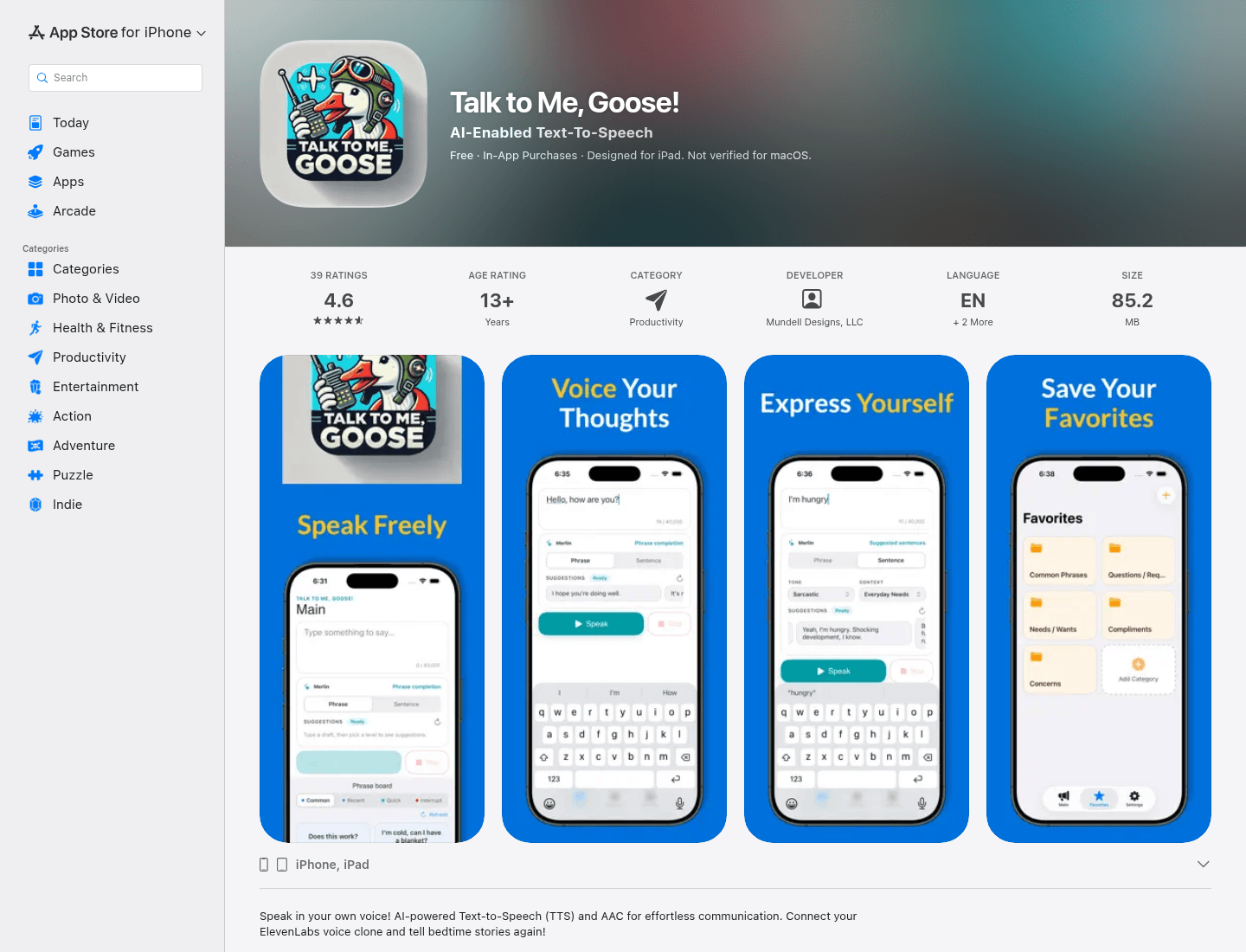
To shorten the pause, the app has an AI assistant called Merlin. The user types a few words, picks a category and a tone, and Merlin offers full sentences to choose from. The app’s Zero Project profile says it uses AI from Anthropic, alongside ElevenLabs, to produce these responses. In Technical.ly’s example, “I’m cold” becomes “Hey, when you have a moment, I’m starting to feel a little bit chilly, could you grab me a blanket, please?”
A story builder on the iPad writes children’s stories that a parent can read aloud in their own voice. Users can also upload messages they recorded earlier, a practice known as voice banking. The app can produce up to about 40 minutes of speech at once in around 30 languages, and runs on iPhone, iPad and Android, with a Windows version in testing.
Impact
The app is live and still being updated: version 9.1 came out in July 2026. Every user figure comes from Betts or his company’s award profile. They reported 554 users in 64 countries by mid-2025, “650-some odd users” in January 2026, and 1,000 downloads worldwide in May 2026. Downloads are not the same as people using the app every day. On the App Store it has 4.6 out of 5 stars from 39 ratings.
No study has measured how the app changes conversations or daily life, so the evidence so far is family accounts. Elizabeth Stricker told WPXI that she and her husband Darin, who has ALS, used the app to clone his voice so he could tell bedtime stories to their two young daughters. “I couldn’t believe how much it sounded like him,” she said. “I mean, we all just were bawling. It was a really big deal.”
On December 3, 2025, the Zero Project, a program that collects solutions for people with disabilities and holds its conference in Vienna, named Talk to Me, Goose! a 2026 awardee.
Since October 2025, people living with ALS in the US and Canada can get unlimited access free if they register with the Live Like Lou Foundation, an ALS charity in Ohio that relies on donations to keep it free. Everyone else pays after a free trial, through a $4.99 monthly plan for people with their own ElevenLabs clone, character bundles, and two lifetime products at $159.99 and $359.99. The team says it has committed to raising $250,000 for the foundation to fund free access.
People
The work was self-financed: the app’s Zero Project profile lists a $50,000 investment and $350,000 worth of development time. The app’s site says it was “built by a person living with ALS and their caregiver”. It is published by Mundell Designs, a small Pittsburgh start-up. The app’s site now names StoryFlight Labs, a public benefit corporation that builds products for people who have lost their voice, as its new parent company and owner.
“Communication should be a right not a privilege,” Betts told Technical.ly. He added: “I didn’t want to communicate as a generic machine when technology was already capable of better, and I didn’t want anyone else to have to settle for that either.”
Some of the criticism of his use of AI has surprised him. He said he has at times been taken aback by how negative some feedback has been “from maybe outside the disability community in particular.” He has also built a spinoff app, Fable’s Adventures, that helps families make audio stories.
“It’s like a fingerprint in some cases. It’s part of who you are,” he told WPXI of a person’s voice. “I don’t have time to waste,” he said in January.
Why it matters
Voice cloning is better known for scams. Betts uses it so people with ALS can keep sounding like themselves after their speech goes. The user numbers are small and self-reported, and the app is free only for registered ALS families in two countries. Still, a man living with the disease, with no coding background, built and launched it within three months and has kept improving it since.
What we could not confirm (7)
- How many people use the app today. All figures come from David Betts: 554 users (mid-2025), about 650 (January 2026) and 1,000 downloads (May 2026). Downloads are not active users. We found no independent count.
- What happens to voice recordings and clones. The app’s privacy policy, last updated February 9, 2025, lists names, contact and payment details and usage data, and sharing with service providers “such as cloud storage and analytics”. It does not mention voice recordings, voice clones, ElevenLabs or Anthropic. The App Store privacy labels are declared by the developer and not checked by Apple.
- How many people got it free, and whether places are limited. The Live Like Lou registration form is still linked from the app’s site (November 2026), but we could not confirm how many families use the free program, whether it has a cap, or how much of the $250,000 pledge has been raised.
- The full cost for paying users. The cheaper lifetime product needs the user’s own ElevenLabs account. We did not check what ElevenLabs charges.
- Outcomes. No study or independent evaluation of the app’s effect on conversation speed or quality of life has been published. The family stories are personal accounts.
- Who else built it. The official site mentions a caregiver as co-builder but does not name them.
- The change of owner. The app’s site announces StoryFlight Labs as its new parent company and owner, but gives no date or details of how it relates to Mundell Designs, which is still listed as the App Store developer.
FAQs (5)
What is Talk to Me, Goose!?
An AI text-to-speech app for people who are losing or have lost their speech, especially people with ALS. It speaks typed or AI-suggested words in a clone of the user's own voice, made with ElevenLabs, and works with eye-gaze devices.
Who made it?
David Betts, a former Deloitte partner from Pittsburgh who was diagnosed with ALS in 2024. He taught himself to code and launched the app in March 2025.
Is the app free?
Only for people living with ALS in the US and Canada who register with the Live Like Lou Foundation. Others get a free trial, then pay through a monthly plan, character bundles, or lifetime products at $159.99 or $359.99.
How much recorded speech is needed to clone a voice?
According to Betts, about 45 seconds of audio can be enough, and old voicemails or home videos can be used.
What does the Merlin assistant do?
Merlin turns a few typed words, plus a chosen category and tone, into full sentences the user can pick from, so replies come faster in conversation.
Sources (7)
WPXI-TV, Before the Silence: Voice app preserves what ALS takes away, Liz Kilmer, May 21, 2026
Zero Project, Talk to Me, Goose! (2026 awardee profile), accessed November 16, 2026
Apple App Store, Talk to Me, Goose! listing (version 9.1, July 13, 2026), accessed November 16, 2026
Live Like Lou Foundation, Talk to Me, Goose! program page, accessed November 16, 2026
Fact-checked against sources on November 16, 2026. Spot an error? Tell us.
This story supports