Problem
“I know the remote is on the desk, Be My AI says it is there on the table, but it doesn’t tell me where the remote is. It is no help in a scatter of objects.”
A participant said this to the Penn State team in interviews held before the app was built. Another said tubes of sunscreen and moisturizer confuse Be My AI, and that telling brown rice from white rice can mean trying three different apps.
Finding one thing among many gets much harder without sight, and the researchers saw a gap in the tools. Some research systems guide a hand precisely, but only to objects scanned in advance. AI photo describers recognize almost anything, yet they mostly just say what is in the picture. Video calls with a sighted helper, through services such as Be My Eyes and Aira, raise privacy, availability and cost concerns, the team notes.
In those early interviews, one request kept coming up. “There was really no off-the-shelf solution that actively guided users’ hands to objects, but this feature was continually requested in our survey,” said Ajay Narayanan Sridhar, a computer engineering doctoral student and the project’s lead student investigator.
AI solution
The user opens the app and says what they want in ordinary words, such as “I am looking for rotini pasta.” The iPhone turns the speech into text. That text goes to GPT-4o-mini, a large language model from OpenAI (the kind of AI behind chatbots), which works out what the person is after. If the request is unclear, the app asks a follow-up question.
As the user points the phone around, the app sends a camera image about once a second to Moondream, a vision-language model: an AI that can look at a picture and answer questions about it. Moondream picks out the requested item even if nobody taught the app that item beforehand.
When the item is found, the iPhone’s light detection and ranging (LiDAR) sensor measures depth, so the app can pin the object’s position in space and track the user’s hand by following the phone’s movement. Spoken directions say which way to go. Vibrations pulse slowly when the hand is far away, faster as it gets closer and rapidly when it is almost there.
One test user summed it up in a survey: “I like the fact that it is giving you cues to the location of where the object is, whether it is left or right, up or down, and then bullseye, boom, you got it”.
NaviSense is built for iPhones with a LiDAR sensor; the team developed and tested it on an iPhone 16 Pro. The two AI models run on outside servers, so the app needs an internet connection. The team tried smaller models that could run on the phone itself, but in early tests they did not recognize everyday items well enough.
Impact
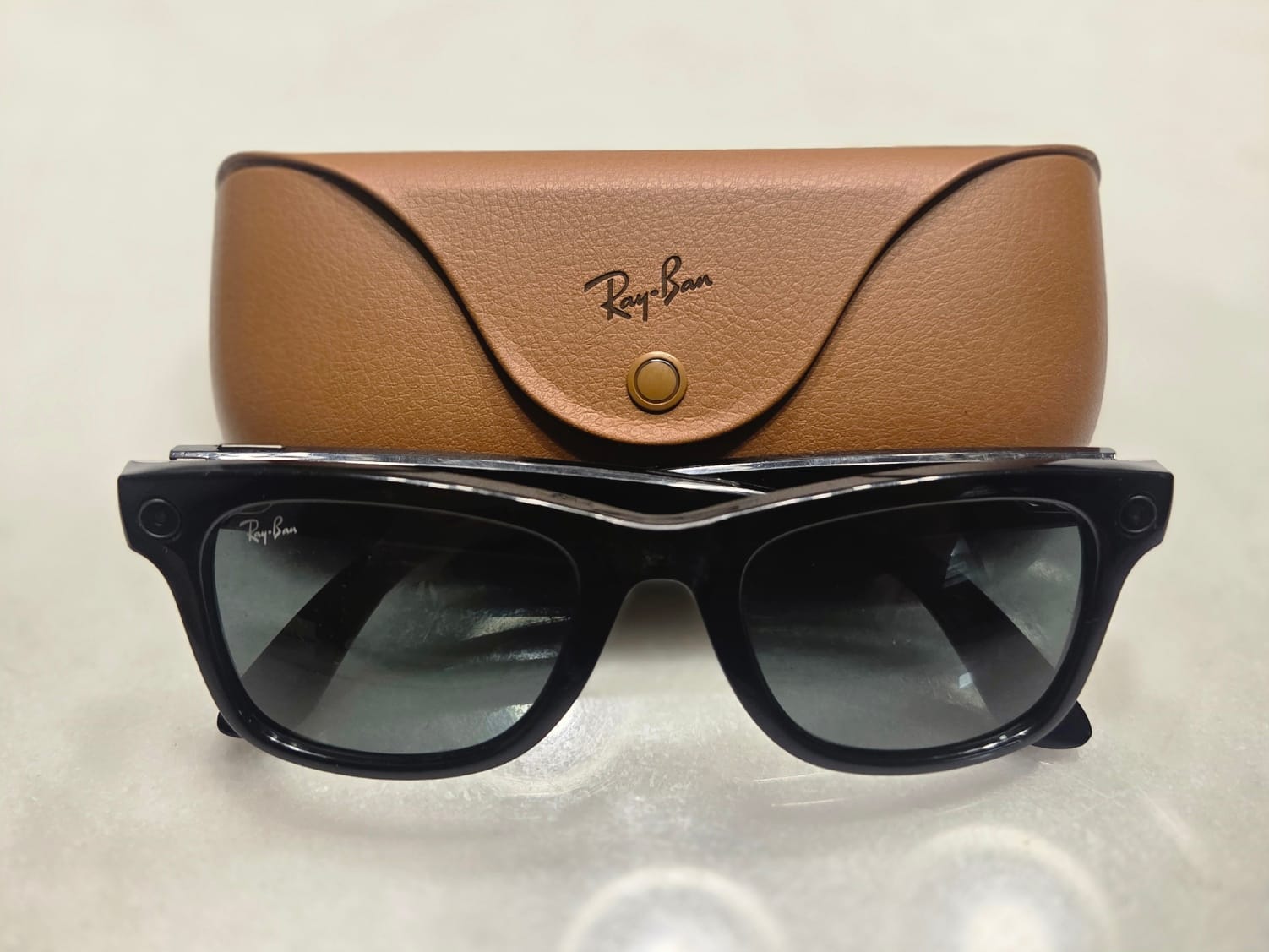
The team tested NaviSense with 12 people: 9 totally blind and 3 with low vision, aged 39 to 73, recruited through local chapters of the National Federation of the Blind. In two-hour sessions, each person tried three tools: NaviSense, Be My AI (the AI photo describer in the free Be My Eyes app) and Ray-Ban Meta smart glasses. The task was to find and pick up a milk carton, a stack of party cups and a box of rotini from a four-shelf unit holding eight household items, in repeated timed trials with each tool.
According to the team’s paper in the conference proceedings (2025):
- Time to get the item in hand: 31.75 seconds on average with NaviSense, 40.80 with the Meta glasses and 64.19 with Be My AI.
- Right item picked: 95.4% of tries with NaviSense, 85.7% with Be My AI and 55.9% with the Meta glasses.
- Wrong items touched per try: 0.52 with NaviSense, 2.65 with Be My AI and 4.37 with the Meta glasses.
- Overall rating out of 5: 4.63 for NaviSense, 3.81 for Be My AI and 1.90 for the glasses.
The developers designed and ran the study themselves, with one shelf and three items, and they call their sample small and demographically narrow. NaviSense’s lead in search time over the Meta glasses was not statistically significant. The other tools do broader jobs: in the authors’ own assessment, the glasses are hands-free and Be My AI gives useful descriptions of whole scenes. A few participants found NaviSense’s cues sometimes came too quickly, and holding the phone steady with the object in view may be physically demanding, the authors say.
The team presented NaviSense at ASSETS ‘25, the Association for Computing Machinery’s conference on accessible computing, in Denver in October 2025, and received the Best Audience Choice Poster Award.
In November 2025, team lead Vijaykrishnan Narayanan said: “This technology is quite close to commercial release, and we’re working to make it even more accessible.” The team was working on battery use and on making the AI models more efficient. A year later, we found no app store listing, newer paper or public update.
People
Narayanan, a professor of electrical engineering at Penn State, leads the team, with Sridhar as lead student investigator. At Penn State they worked with Mehrdad Mahdavi and Fuli Qiao. Co-authors include Nelson Daniel Troncoso Aldas, an independent researcher, and Laurent Itti and Yanpei Shi of the University of Southern California. The US National Science Foundation funded the research.
The blind and low-vision people who took part also shaped the app: their interviews set its main feature. “These interviews gave us a good sense of the actual challenges visually impaired people face,” Sridhar said.
Why it matters
AI that describes the world is now common on phones and glasses. Be My AI alone is free to more than a million registered blind and low-vision Be My Eyes users, by the company’s November 2026 count. Hearing that the remote is on the desk still leaves a blind person feeling around for it. NaviSense shows that the last step, from shelf to hand, can be built around blind people’s own requests. The next test is outside the lab: a released app, more testers at home, and a clear answer about what happens to their camera images.
FAQs (5)
What is NaviSense?
A research iPhone app from Penn State. A blind or low-vision user says what they are looking for, the app finds it with AI and then guides their hand to it with spoken directions and vibrations that speed up as the hand gets closer.
Can I download NaviSense?
Not yet. As of November 2026 it is a research prototype with no public release. In November 2025, the team lead said it was "quite close to commercial release".
How is it different from Be My AI or Ray-Ban Meta glasses?
Those tools can tell a user what is in front of them, and they are available today. NaviSense adds step-by-step hand guidance to one specific object. In the developers' own 12-person lab test, it was faster and more accurate, but the sample was small and the study was not independent.
Does NaviSense work offline?
No. It uses two AI models on outside servers (GPT-4o-mini and Moondream), so it needs an internet connection. The team has said it wants to explore models that run on the phone.
Which phones does it need?
It was built for iPhones with a LiDAR depth sensor and tested on an iPhone 16 Pro.
Sources (3)
Be My Eyes and Be My AI user figures: see our story "Be My Eyes lets blind people ask a volunteer or an AI what is in front of them. A new nonprofit wants to keep it free."
Fact-checked against sources on November 26, 2026. Spot an error? Tell us.
This story supports