Problem
Riya Jain’s grandmother was “a social butterfly,” in the words of Jain’s company’s press release. In 2024, ALS took her voice.
In ALS, the nerve cells that control muscles are damaged and die, and as the disease progresses it can weaken the muscles used for speech. Jain’s family found speech apps that turn typed text into spoken words. Every one sounded flat and robotic, nothing like her grandmother, who would rather stay quiet than sound like someone else. In the end, the North Carolina startup news site GrepBeat reported, her grandmother could only communicate through a text-to-speech board with a robotic voice she hated.
An older option, voice banking, has a person record their voice while they still can, to build a synthetic copy later. It can mean reading dozens to hundreds of scripted sentences, ALS News Today reports, and it works poorly for people whose speech has already changed. For about a third of people with ALS, speech and swallowing problems are among the first symptoms.
Jain looked for an app that could clone the voice of someone who had already lost it, and found none.
AI solution
At 19, with no formal engineering training, Jain taught herself to code and launched Voice Back in summer 2025.
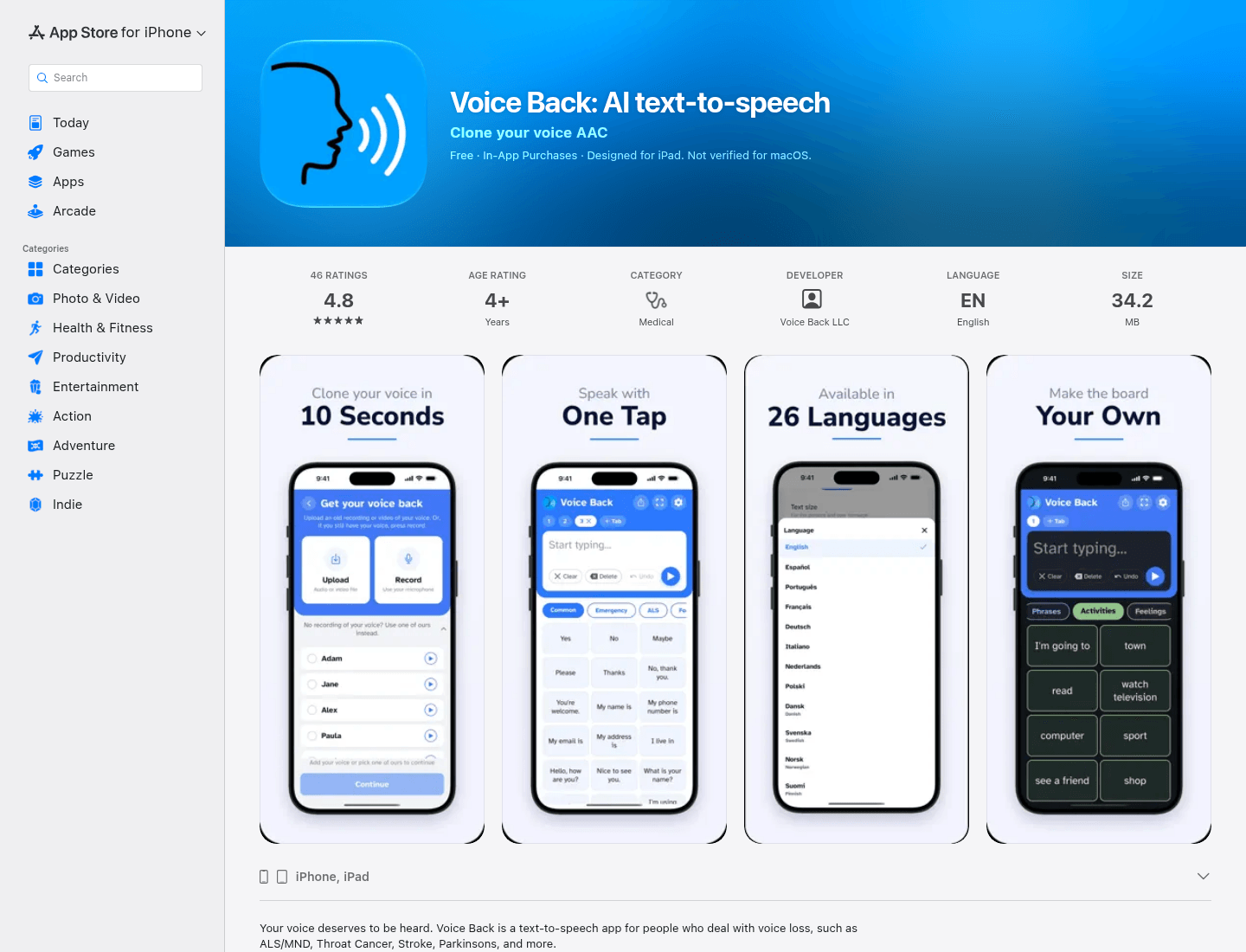
Voice Back is an augmentative and alternative communication (AAC) app: a tool that gives people another way to talk when speech becomes hard or impossible. Its core is a voice clone, an AI copy of how one person sounds. A family records or uploads a short clip of the person speaking, about 10 to 60 seconds according to the company, and the voice is ready in under a minute. An old voicemail or home video can work, so people who can no longer speak can still use their own voice. Without a recording, the user picks a library voice.
The user then types a message or taps a button with a saved phrase, such as “Yes,” “Please” or “Thanks,” and the phone or tablet says it aloud in the cloned voice. Users can change the speaking speed, spell out how a name should sound, and organize phrases in tabs, including one for emergencies. On iPhones, the app can also speak during phone calls.
Voice Back runs on iPhones, iPads and Android devices. It also works with TD Pilot and other iPad-based eye-gaze systems, which let people with very limited movement choose words by looking at the screen. It does not run on Windows-based AAC devices. The company does not say which AI model or voice company powers the cloning.
In February 2026, the app could clone voices only in English. By November 2026, its site listed 26 languages, from Spanish and Hindi to Yoruba, Hausa, Zulu and Swahili.
Impact
Voice Back is live and updated often: version 2.0.4 came out on November 18, 2026. All usage figures come from the company, and they differ. Its September 20, 2026 press release and its November website say more than 60,000 downloads in more than 23 countries. ALS News Today, citing the company nine days after the release, reported more than 50,000. In February 2026, GrepBeat reported that the app had more than 30,000 sign-ups and partnerships with more than 30 clinics, “from Durham to South Africa”. Downloads are not the same as people who use the app every day.
On Apple’s App Store, the app holds 4.8 out of 5 stars from 46 ratings.
The app is free to download, and full access costs $4.99 a month after a 7-day trial or $29.99 for life, on a phone or tablet the person already owns. The company compares this with the thousands of dollars a dedicated speech-generating device can cost. Its website lists no separate free plan for people with ALS.
No study has measured how the app changes daily life, so the evidence so far is personal accounts. “I felt I sounded like Alexa,” said Lizzy Hernandez, an advisory team member who was diagnosed with ALS in 2023, as quoted by ALS News Today. “With Voice Back I finally sound like myself again.”
Dr. Richard Bedlack, who founded and directs the Duke ALS Clinic, is quoted on the company’s website: “I’ve never seen an app that is simpler to use or more impactful for voice cloning.”
People
Voice Back LLC is a one-person company. Jain studies public policy and entrepreneurship at Duke. As of February 2026, she ran the company without outside funding, from the app’s own revenue. It also offers licenses to healthcare providers and nonprofits.
An advisory team of people living with ALS and other conditions that take away speech tests new features and suggests changes based on their own needs.
“When ALS took away my ability to speak, it did not take away what I have to say. Voice Back helps bridge the distance between the voice inside me and the world that still needs to hear it.”Kristie L. Taddie, Voice Back advisory team member, diagnosed with ALS in May 2025, quoted by ALS News Today
Kris MacNamara, diagnosed in July 2025, was part of the team. She said she had been limiting her conversations before. “I have gained back confidence to speak, and it sounds just like me,” she said in the company’s press release. MacNamara died of ALS in September 2026.
Jain’s grandmother used Voice Back in the last months of her life, Jain told GrepBeat. She described watching her grandmother clone her voice and hear it for the first time: “the way her eyes light up just immediately signaled to me how successful this company can be and how many people it can help.”
Why it matters
The people with ALS quoted here describe sounding like themselves as part of staying in the conversation. Other projects we have covered offer free voice clones through charities and patient groups (Talk to Me, Goose!, the ElevenLabs program in Spain) or share their code openly (Invincible Voice). Voice Back shows a different route: a low-cost app that needs only a short clip of audio, even an old one, built by a student who listened to the people using it.
What we could not confirm (7)
- How many people use the app. The company reports more than 60,000 downloads in more than 23 countries (September and November 2026); ALS News Today, citing the company, reported more than 50,000 (September 29, 2026). We found no independent count, and downloads are not active users.
- When it launched. The company and ALS News Today say August 2025; GrepBeat says July 2025.
- How much audio it needs. The company says 10 to 60 seconds; the App Store description says a 10 to 15 second clip.
- Which AI powers the voice cloning. Voice Back does not name the model or company behind it.
- What happens to voice recordings. The company says audio is encrypted and never sold or shared, and can be deleted. This has not been independently checked. The App Store privacy labels, declared by the developer and not checked by Apple, list an email address and user ID linked to the user and identifiers used for tracking.
- The clinic partnerships and recommendations. The 30+ clinic partnerships (February 2026) and the list of clinics whose speech-language pathologists recommend the app come from the company. We did not confirm them with the clinics.
- Outcomes. No study or independent evaluation of the app’s effect on communication or quality of life has been published. The user stories are personal accounts shared by the company or in interviews.
FAQs (5)
What is Voice Back?
An augmentative and alternative communication (AAC) app for iPhone, iPad and Android. It makes an AI copy of a person's voice from a short recording, then speaks typed words or saved phrases in that voice.
Who made Voice Back?
Riya Jain, a Duke University student, who taught herself to code at 19 after her grandmother lost her speech to ALS in 2024. Her company, Voice Back LLC, launched the app in summer 2025.
Can someone who has already lost their voice use it?
Yes, if they have an old recording. The company says about 10 to 60 seconds of speech is enough, and a voicemail or home video can work. Without a recording, users can pick a library voice.
How much does Voice Back cost?
It is free to download. Full access costs $4.99 a month after a 7-day trial, or $29.99 once for lifetime use. No separate free plan for people with ALS is listed.
How is it different from Talk to Me, Goose!?
Talk to Me, Goose! was built by David Betts, who has ALS, and is free for registered ALS families in the US and Canada through a charity. Voice Back was built by a family member, is a low-cost paid app, and focuses on cloning a voice from very short clips.
Sources (6)
Voice Back press kit, accessed November 19, 2026
Apple App Store, Voice Back: AI text-to-speech listing (version 2.0.4), accessed November 19, 2026
Fact-checked against sources on November 19, 2026. Spot an error? Tell us.
This story supports