
Problem
Olivier Goy is a French entrepreneur and an ambassador of the Paris Brain Institute (Institut du cerveau). He was diagnosed with ALS in December 2020.
ALS can take away a person’s ability to speak. Most people with ALS die within three to five years of their first symptoms, though about 1 in 10 live for 10 years or more, according to the US National Institute of Neurological Disorders and Stroke. The French disability news site Handicap.fr puts the number of people living with ALS worldwide at about 450,000, without giving a source.
“When you lose your voice, your whole relationship with other people becomes more fragile,” he told Handicap.fr (translated from French).
Before Invincible Voice, he wrote out his interview answers in advance. Testing the tool, he talked about time: “It’s crazy how much time I’m going to save. I won’t have to pre-write all my interviews anymore” (translated).
AI solution
Invincible Voice started when Patrick Perez, managing director of Kyutai, met Goy. The two wanted to show that research could leave the lab and become a real tool for independence and human connection.
The tool runs on a computer or a smartphone. First, speech recognition turns what the other person says into text. Then a language model, the kind of AI behind chatbots, writes several possible replies, drawing on what it knows about the user: their personality, their relationships, their usual tone and earlier conversations. The user can accept a suggestion, edit it or reject it. Finally, the voice engine says only the reply the user chose, in a copy of their own voice.
In the Handicap.fr demo, someone greets him: “Salut Olivier, tu vas bien ?” (“Hi Olivier, how are you?”). The tool offers three replies that start the same way and end differently, and Goy picks the first. “It doesn’t just turn text into sound,” said Gabriel, the Kyutai engineer behind the project. “It can understand the overall context of the discussion and suggest answers based on what the other person said, which lets users respond in real time and keeps the exchange flowing” (translated).
Goy’s own voice was rebuilt from clips of an old podcast he had recorded before he fell ill. According to Gabriel, the AI can imitate a voice from about 10 seconds of recording. People who can no longer use their hands can choose replies with their eyes, through interfaces that follow their eye movements.
Kyutai built the tool on Unmute, its own open design for voice assistants. The speech recognition and voice copying can come from Gradium, a voice AI start-up created by Kyutai’s original co-founders, or from Kyutai’s own speech models.
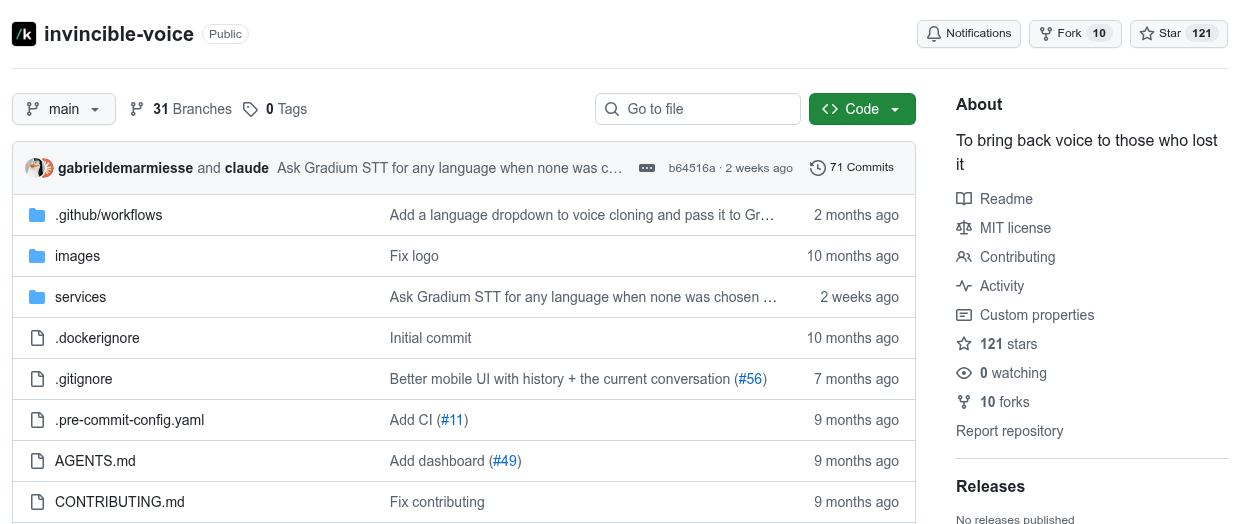
The code is published on GitHub under the MIT license, which lets anyone use, change and share it. It can run in two ways. The simpler one uses Gradium’s service plus an outside language-model service, and the instructions say their free tiers “should be enough to get you started”. The other runs everything on your own hardware with a graphics processor, for full privacy. There is also an online demo, which asks visitors to sign in with Google or create an account. The project site says saving your voice takes 10 seconds and is free.
Impact
Invincible Voice is a research prototype, and Kyutai says so itself: an experimental open-source project, not a commercial product. No trial has been published. We found no count of users and no independent testing. The public demonstrations, including a film by the agency Jacques Paris covered in the press in March 2026, all feature Goy.
The evidence so far is Goy’s own account. “Getting my voice back was already huge,” Goy said in the film’s press material. “But being able to talk again, to answer spontaneously, to joke, to fully exist in a conversation… that is something else again. Invincible Voice didn’t just give me back a sound, it gave me back a freedom” (translated).
Kyutai is still working on the code. The repository was created on January 16, 2026. A layout for phones was added in April 2026, and updates on September 7 and November 2, 2026, added a choice of language for voice copying (English, French, Spanish, Portuguese or German) and kept automatic language detection working in the speech recognition. On November 17, 2026, it had 121 stars (bookmarks from GitHub users) and 10 copies made by other developers. Those numbers measure interest from developers and say nothing about how many people use the tool. Feature requests filed in February 2026 by a Kyutai developer, still open, ask for mobile-browser support and better handling of conversations with several speakers. No patient feedback appears on GitHub.
People
Goy took part in developing the tool from the start and tested it. “Being able to communicate was already great,” he said. “Doing it with my own voice is incredible!” (translated).
At Kyutai, Gabriel is the engineer behind the project, and the lab’s managing director, Patrick Perez, explains why it is free. “At Kyutai, we believe research in artificial intelligence only makes sense if it is shared and useful,” he said. “Invincible Voice is a prototype, deliberately open source, because we want this technology to live beyond our lab and, thanks to the community, become a real lever of impact for patients” (translated).
Gradium announced in January 2026 that it powers the tool’s speech, with Kyutai leading the science. Kyutai does not present the prototype as a finished answer. It invites researchers, developers and entrepreneurs to improve it and adapt it for patients, and its film asks people to record their voice while they still can.
Why it matters
The other AI voice tools for ALS we have covered are run by one company or charity. Invincible Voice is shared code that other teams can adapt, built with a patient from the start, and it aims at what Goy says matters most: answering spontaneously in a live conversation. It is early and tested in public only by one man, but anyone can now build on it.
What we could not confirm (7)
- Whether anyone besides Olivier Goy uses it. We found no user numbers, trials, independent tests or feedback from other patients. GitHub stars and copies are not users.
- How well it works in each language. Since September 2026 the code offers voice copying in English, French, Spanish, Portuguese and German, and the screens are translated into the same five languages. But the project site and all demonstrations are in French, and we found no tests in other languages.
- Eye-tracking in the public code. Kyutai and press coverage say replies can be chosen by gaze with eye-tracking devices, but the code’s instructions on GitHub do not mention it, so we could not confirm how it is set up.
- Limits and cost of the online demo. The demo asks for a sign-in. We could not find usage limits, whether it costs anything, or what self-hosting costs once free tiers run out.
- What happens to voice recordings in the online demo. The demo links to Kyutai’s general privacy policy, but we found no statement specific to how the demo stores or uses voice recordings.
- Funding. We could not confirm who funds this project in particular.
- The engineer’s full name. Coverage names him only as Gabriel. We could not confirm whether he is the Kyutai developer who wrote most of the public code.
FAQs (5)
What is Invincible Voice?
An open-source AI prototype from the Paris nonprofit lab Kyutai for people who are losing or have lost their speech, such as people with ALS. It listens to a conversation, suggests several replies, and speaks the one the user picks in a copy of their own voice.
Who built it?
Kyutai, with Olivier Goy, a French entrepreneur living with ALS who took part in developing and testing it. Gradium, a voice AI start-up created by Kyutai's original co-founders, supplies the speech technology.
Is it free?
The code is free under the MIT license. Running it needs either Gradium and a language-model service, whose free tiers the developers say should be enough to start, or your own computer with a graphics processor. An online demo asks for a sign-in.
How much recording does it need to copy a voice?
About 10 seconds, according to a Kyutai engineer. Goy's voice was rebuilt from an old podcast.
Is it ready for patients?
Not as a finished product. Kyutai calls it a research prototype and invites developers and researchers to improve and adapt it. No trial results have been published.
Sources (7)
Invincible Voice official site, accessed November 17, 2026, and online demo
Fact-checked against sources on November 17, 2026. Spot an error? Tell us.
This story supports