
Problem
Rukayat Yunusa, a first-time mother in Lagos, heard about Solayo when an outreach team visited the main healthcare center in Meiran, along the Lagos-Abeokuta expressway. She tried it on her husband’s phone and kept using it. “It answers the questions that I can’t even ask a doctor because of how silly it sounds,” she told reporter Joy Onuorah of bird story agency, an African news agency, in a story published by the South African news site IOL in October 2026.
Pregnancy in Nigeria carries real risk. The country accounted for 28.7 percent of estimated maternal deaths worldwide in 2023, about 75,000 women, according to WHO figures cited by IOL. Conditions behind many of these deaths, such as eclampsia (dangerously high blood pressure with seizures), heavy bleeding and sepsis (a severe reaction to infection), are largely preventable if they are caught early, BusinessDay reports.
Solayo’s founders see a gap in information. “Access is the core problem. Women don’t always lack hospitals, they lack timely information and guidance,” co-founder Damilola Oladiipo told BusinessDay. Between antenatal visits, and outside clinic hours, a woman may not know whether a symptom can wait.
AI solution
Solayo means “safe delivery” in Yoruba. The founders chose WhatsApp because women already use it. A woman sends “Hi.” The system asks for her identity and authorization, then whether she is pregnant, trying to conceive or a new mother. If she is pregnant, she enters her expected delivery date, so the answers fit her week.
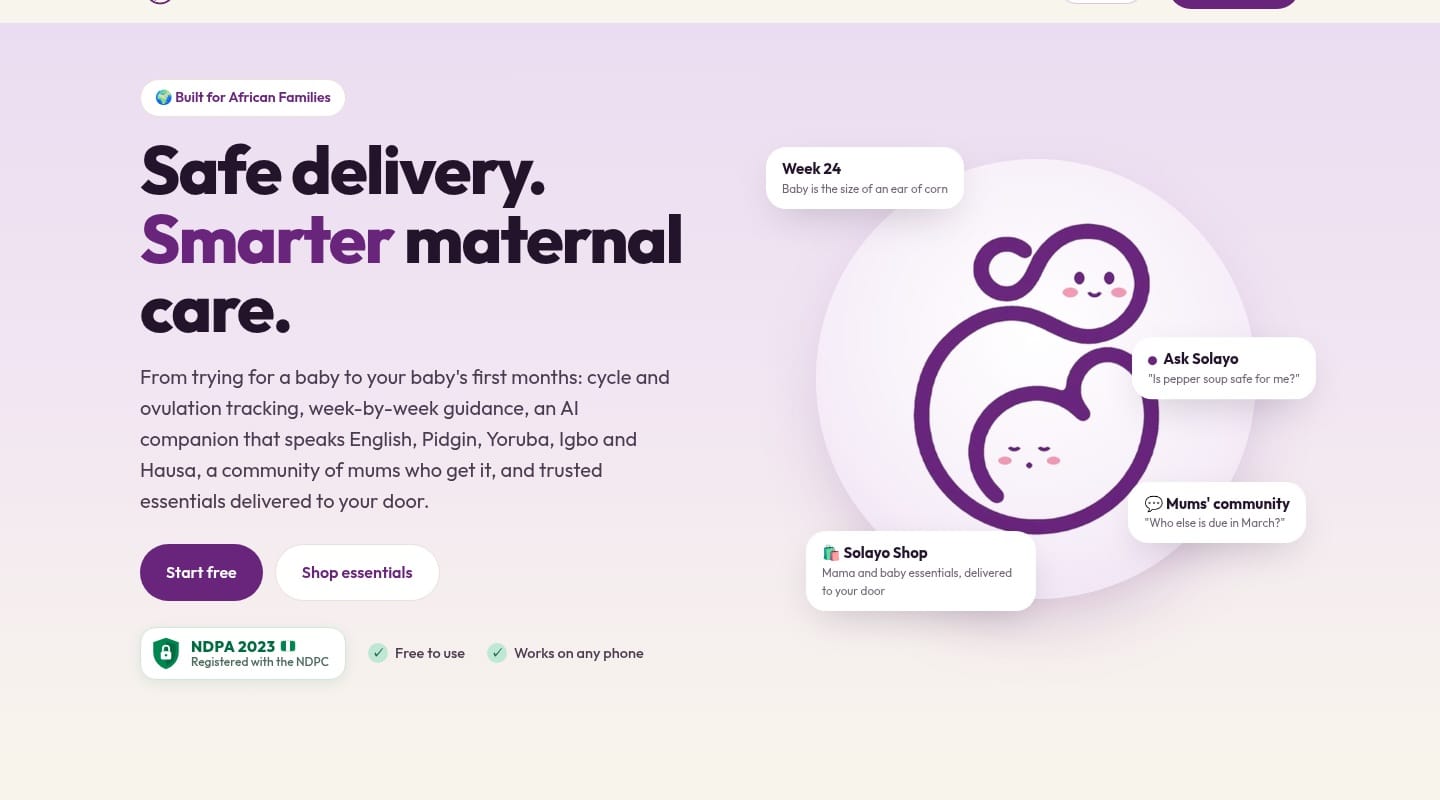
After that she can ask about symptoms, food, breastfeeding and more. The service follows a woman from trying for a baby to her child’s first year, with week-by-week guidance and reminders such as vaccinations. The company’s website calls the AI part “Ask Solayo” and says its answers are “grounded in WHO and Nigerian guidance.” No source we found names the AI model behind it.
BusinessDay and one online article call the chatbot “Moma.” The company’s website and IOL use Solayo, so we do too.
Oladiipo describes Solayo as an information companion, not a tool for diagnosis. “When a user inputs terms indicating red-flag symptoms or high-risk conditions, the system automatically triggers a recommendation to connect directly with a qualified medical professional,” he told IOL. He says medical specialists help to update the system. The website lists danger signs, including heavy bleeding, a severe headache or blurred vision, fits, high fever and a baby moving less than usual, and tells women to go to the nearest hospital or call 112.
In November 2026 Oladiipo said people can use Solayo through WhatsApp and through a web app that can be added to a phone’s home screen. It is not in the app stores. The website adds trackers, a moderated community for women 18 and over, sessions with maternal health experts, and a shop. It says health logs stay on the user’s phone, that questions sent to Ask Solayo are not stored, and that the company is registered with the Nigeria Data Protection Commission, the country’s data regulator.
Impact
Solayo is live and early. Its reach is self-reported, and there are no outcome data and no independent evaluation.
Oladiipo told IOL that Solayo had reached over 15,000 women through education, community groups and outreach. That number includes women reached through activities other than the AI, so it is not a count of chatbot users. In November he said Solayo has users across Nigeria, other parts of Africa and beyond, without giving numbers.
Oladiipo said the team has “received encouraging feedback from users,” but added: “we must be careful not to make claims about health outcomes that we cannot properly measure or prove”.
User feedback has already changed the product. At first the automated flow had no route to a person. “However, user feedback showed that women feel significantly more secure when they know a real human professional is accessible,” IOL quotes the team. Women can now book consultations, and the company runs a separate WhatsApp community with over 20 medical specialists.
Omolara Owojuyegbe, a health education officer in Lagos’s Alimosho Local Government, met the founders at the Meiran outreach. “I took time to check it out. I saw that it will be very helpful for women generally,” she told IOL. She also stressed that women with health problems that need clinical attention should go to a health center or hospital.
The sources disagree on languages. The website says Ask Solayo answers in English, Pidgin, Yoruba, Igbo and Hausa. In October, IOL reported that the multilingual feature was “not yet available.” In November, Oladiipo said the team was working to support major Nigerian languages and that users can send voice messages.
By comparison, a 2025 trial of Kenya’s PROMPTS text-message service with 6,139 women found moderate improvements in awareness, readiness for delivery and newborn care. Solayo has no such study yet.
People
Theresa Oyewole, co-founder and chief operating officer, sold baby products in Idumota Market in Lagos before moving into healthcare business development. Oladiipo, the other co-founder, worked in branding, marketing and communications for technology companies. He has no medical background, but his mother ran a maternity center.
Their first idea, which joined shopping, education and community, “did not provide the desired results,” IOL reports. Research then pointed them to the questions women have between appointments. The shop stayed. “Pregnancy is not just clinical. It is economic and logistical. We designed the system around how women actually experience it,” Oyewole told BusinessDay.
Oladiipo describes an AI engineer he has known since his youth and a UK-based friend with technology and product experience in the medical field. “In the early days, some people contributed their time, expertise, and belief before there was money to offer,” he said. BusinessDay also names George Odiana as a co-founder.
Oladiipo wants partnerships with hospitals, pharmacies and diagnostic providers, and may explore short-code menus that work on basic phones, though he says that is “not a service we are claiming to offer today”.
Why it matters
Nigeria carries more than a quarter of the world’s maternal deaths, and many women carry everyday worries alone between clinic visits. Solayo tries to answer those worries on a phone women already use, and to send them to care when a worry is serious. Whether it changes health outcomes is still unknown, and its founders say so plainly.
What we could not confirm (8)
- How many women use the AI companion itself. The “over 15,000 women” figure is the founder’s own and includes outreach and community activities.
- An online article says the chatbot handles “thousands of daily queries.” It gives no source, and we could not confirm it.
- Which AI model Solayo uses, who the medical specialists are, and how answers are checked for safety and accuracy.
- Which languages work today. The website lists five; in October 2026 IOL reported that multilingual support was not yet available.
- Whether talking to a professional costs money. BusinessDay describes a “premium service” for complex cases, the founder says professionals set their own consultation fees, and the website says users pay only for shop items.
- Whether WhatsApp and the web app are the same service. The website mentions only the web app; the founder says both exist.
- Funding, investors, George Odiana’s current role and the founders’ job titles (IOL names Theresa Oyewole as chief operating officer; no source we could read gives Oladiipo a title beyond co-founder).
- Any independent evaluation or health outcome data.
FAQs (5)
What is Solayo?
Solayo is a free AI companion for women who are trying to conceive, pregnant or caring for a baby in its first year, built by the Lagos startup Solayo Africa. It answers questions on WhatsApp and in a web app, and points women to care when they mention danger signs.
Is Solayo the same as Moma?
Yes, as far as we can tell. BusinessDay and one online article call the chatbot "Moma." The company's website and the IOL report call it Solayo, and its AI feature "Ask Solayo."
Does Solayo replace a doctor or midwife?
No. The company calls it an information companion, not a tool for diagnosis. When a woman describes red-flag symptoms, it recommends contacting a qualified professional, and its website tells women with danger signs to go to the nearest hospital or call 112.
Is Solayo free?
The company says the guide, trackers and Ask Solayo are free. It sells maternity products, and consultations with professionals may have fees.
Has Solayo been shown to improve health?
Not yet. The founders report reaching over 15,000 women through mixed activities and say they must be careful not to claim health outcomes they cannot measure. We found no independent evaluation.
Sources (5)
Solayo, official website, accessed 24 November 2026
Fact-checked against sources on November 24, 2026. Spot an error? Tell us.
This story supports