Problem
“If a mom in a rural part of Kenya starts bleeding at 2 a.m., she can’t just Google it,” says Jay Patel, director of technology at Jacaranda Health. Many women in rural Kenya have no internet, and some live more than an hour from the nearest health facility, Patel told Amazon Web Services.
About 6,000 women in Kenya die each year from causes linked to pregnancy or childbirth, about 16 a day, and almost a third of those deaths are believed to be linked to delays in seeking care. Forty percent of pregnant women in Kenya do not get the recommended number of antenatal visits, and only slightly more than half get any care after giving birth.
PROMPTS began as one-way text reminders for clinic appointments. Then mothers started writing back, asking whether swelling or headaches were normal, or whether avocados were safe to eat. At first one helpdesk agent read and answered up to 100 questions a day.
AI solution
Mothers sign up for free at public clinics. They get messages timed to their stage of pregnancy and can text a question at any hour, in English, Swahili or Sheng, a Nairobi mix of the two. The service stays with them through pregnancy and the first year after birth.
Every incoming message first goes through a classifier, a program trained on thousands of real questions that sorts messages into urgent and not urgent. About 7% are flagged as possibly urgent. “It bypasses all AI functionality and gets straight to the help desk, into a special queue,” Patel told NPR. For these high-risk cases, the replies are written in advance by people, not generated by the AI.
Routine questions, such as those about diet and exercise, go to UlizaLlama, a Swahili large language model (the kind of AI behind chat tools) that Jacaranda built from Meta’s open Llama model. The team trained it on more than a million past questions and answers from PROMPTS. It answers about 70% of messages, usually within two minutes.
A team of 18 nurses monitors, audits and answers questions around the clock. If a mother replies that an answer did not help, the conversation goes to a person, and a clinical team reviews AI answers for medical accuracy. Jacaranda’s own write-up admits the answers “aren’t 100% perfect”.
Impact
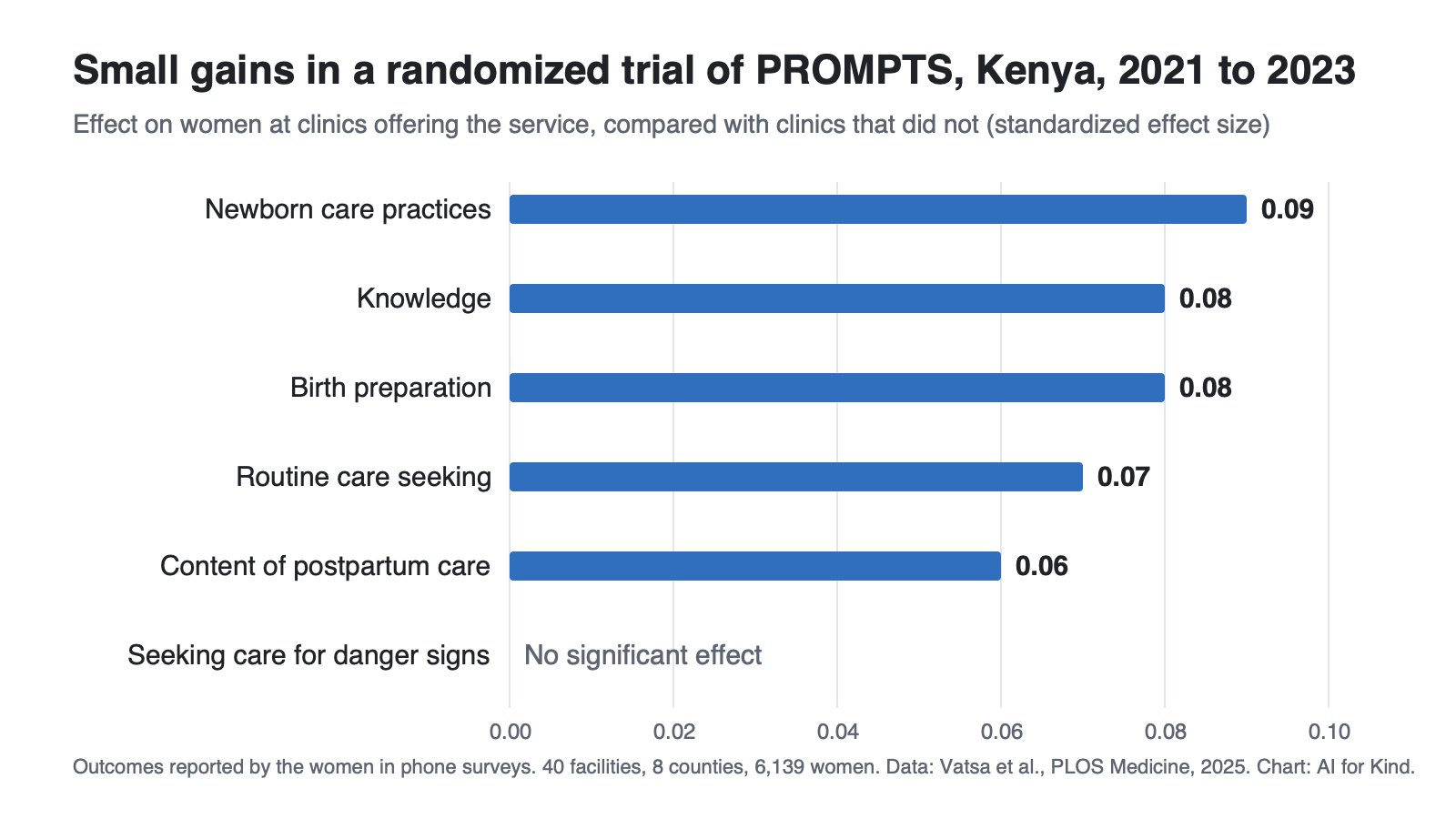
PROMPTS has been tested in a randomized trial. Researchers from Harvard, the World Bank, Innovations for Poverty Action (IPA) and Jacaranda ran it in 40 health facilities in 8 Kenyan counties from 2021 to 2023, with 6,139 pregnant women. About 85% of women offered the service signed up.
The results, published in PLOS Medicine in February 2025, were positive but small. Women at PROMPTS clinics knew more, prepared better for birth, used routine care more and followed more recommended newborn care practices. IPA’s summary describes a 17% relative increase in women getting the recommended number of postnatal visits.
One result did not move: the trial found no significant change in whether women sought care for danger signs, the warning symptoms that should send a woman to a clinic quickly. The authors also note limits. The outcomes were reported by the women themselves in phone surveys, and the trial was not designed to detect effects on health outcomes such as illness or death. They conclude that more work is needed to learn the effect of services like PROMPTS on health outcomes. The trial also ran from 2021 to 2023, before Jacaranda began adding UlizaLlama answers, which it planned for early 2024.
Jacaranda reports bigger gains from its own data: 20% more prenatal visits and postpartum family planning up 1.85 times. These figures are self-reported and come without a published study.
“At the time I joined I think we were getting less than 100 questions a day,” Patel told NPR in September 2026. “Now it’s 15,000”. Totals differ too: NPR reported an estimated 700,000 users each year, while Jacaranda’s partners cite 3 million or 3.8 million mothers reached overall. The trial put the cost at 74 cents per woman enrolled; NPR reported about $2 per user, paid by the nonprofit.
In October 2025, Jacaranda signed a national agreement with the Ghana Health Service, starting in Greater Accra, and says monthly sign-ups there rose from under 100 to over 3,000.
People
One mother, Millicent, reported severe headaches and blurred vision, and a nurse called her. “PROMPTS was like a lifeline,” she said in an article Jacaranda co-wrote. “If I had waited at home, I might have lost another baby”. Mothers can also rate their clinic visits anonymously. “Lots of mothers are reporting that they’re getting blood pressure checks, but very few report getting breast exams,” spokesperson Laura Down told NPR.
The nurses on the helpdesk do the urgent work. Javan Waita, Jacaranda’s director of programs in Kenya, says humans are responsible for the quality of the messages that go out. Anneka Wickramanayake, director of research, evaluation and design, puts the aim simply: “All of this is designed to get a mom to go to the hospital at the right time,” and to help her know what care to expect and ask for once she gets there.
Smisha Agarwal, director of global digital health at Johns Hopkins University, told NPR the AI lets the conversation center “on what the mother actually wants to know,” but said such tools work best where health systems already function. Javaid Iqbal Sofi, an AI policy researcher at Virginia Tech, asked: “The first thing I want to know is, what happens when the system gets a message wrong?”. We found no published figures on how often the urgency check misses a message.
Why it matters
PROMPTS shows a careful way to add AI to a health helpline: urgent messages go to people, and the AI handles the questions that would otherwise bury a small nurse team. A trial found real but modest gains, and Jacaranda is now taking the service to new countries. How often the system misses an urgent message is the next thing mothers, and the health services that use it, need to see measured.
What we could not confirm (10)
- How many mothers use PROMPTS: sources give about 700,000 a year (NPR), 3 million (International Development Research Centre, IDRC, and Observer Research Foundation, ORF) and 3.8 million (Amazon Web Services, AWS) in total. All are self-reported, and none says how it counts users.
- The daily volume: 15,000 messages a day (Patel, NPR, 2026) is the newest figure; earlier sources give 10,000 to 12,000.
- Why the cost is $2 per user in NPR’s report and 74 cents per woman in the trial. They may measure different things.
- How many Kenyan counties it covers: NPR says public clinics in 24 counties; ORF’s 2026 case study says all 47.
- When it started: 2016 according to the Agency Fund article (AWS gives 2016 as the year Jacaranda was founded), 2018 according to ORF.
- How accurately the classifier spots urgent messages, how many it misses, and what happens to a mother whose urgent message is not flagged. We found no published accuracy or audit results.
- Whether PROMPTS reduces deaths or illness among mothers or babies. The trial was not designed to measure this, and the 20% and 1.85 times figures are Jacaranda’s own.
- Whether the current model is built on Llama 2 (Jacaranda, 2023) or Llama 3 (AWS case study).
- The status of versions in Nigeria (Hausa) and Tanzania, and which languages are live in Ghana.
- How mothers are told that an AI may answer their message, and how their data is protected.
FAQs (5)
What is PROMPTS?
PROMPTS is a free two-way text-message service from the Kenyan nonprofit Jacaranda Health for pregnant women and new mothers. Mothers sign up at public clinics, get messages timed to their pregnancy and can text questions at any time from a basic phone.
How does PROMPTS use AI?
A classifier sorts incoming messages by urgency. About 7% are flagged as possibly urgent and go straight to nurses. A Swahili language model called UlizaLlama answers about 70% of messages, mostly routine ones, and nurses review its answers.
Does PROMPTS work?
A randomized trial with 6,139 women in Kenya, published in PLOS Medicine in 2025, found small gains in knowledge, birth preparation, routine care and newborn care, but no significant change in seeking care for danger signs. It did not measure deaths, and it tested the service before the current AI answers.
What are the concerns?
Researchers quoted by NPR ask what happens when the system treats an urgent message as routine, and note that such tools work best where health systems already function. No accuracy figures for the urgency check have been published.
Where is PROMPTS available?
In Kenya, through public clinics, and in Ghana under a 2025 national agreement with the Ghana Health Service. Versions for Nigeria and Tanzania are reported as planned or in preparation.
Sources (9)
NPR, "Can an AI chatbot save lives by fielding pregnancy questions?", 2026-09-17
The Agency Fund with Jacaranda Health, "A Lifeline for Mothers", 2025-09-02
Observer Research Foundation, "Global AI Impact Commons Stories: Jacaranda Health", 2026-10-12
Jacaranda Health, national MoU with Ghana Health Service to scale PROMPTS, 2025-10-13
Jacaranda Health, launch of UlizaLlama, 2023-10-31
Fact-checked against sources on November 20, 2026. Spot an error? Tell us.
This story supports