Problem
In April 2026, a team at the Malawi University of Business and Applied Sciences (MUBAS) began a study with a plain question: can AI give safe, sensible advice for the cases that walk into a Malawian clinic? Six AI models, including ChatGPT and Gemini, answered 200 made-up but realistic clinical cases. The team is collecting its data at Limbe and Ndirande health centers in Blantyre.
Medical AI is usually graded on multiple-choice exams written for medicine in wealthy countries. The lab behind the Malawi study argues that such exams cannot show whether an answer is safe and fitting in a given language, clinic or level of resources. And there is little evidence on how safe AI language tools are in primary care in sub-Saharan Africa, the study team writes.
AI solution
The Malawi study is one part of MOOVE, built by the Laboratory for Intelligent Global Health and Humanitarian Response Technologies (LiGHT) at EPFL. On MOOVE, people are the testers and AI models are what they test.
Clinicians and humanitarian experts sign in and write hard cases from their own work. The platform shows them two answers from AI models without saying which model wrote which. The expert picks the better answer, flags mistakes, harm, bias and poor fit with local conditions, and can rewrite the answer to their own standard. They can also share local practice guidelines. Several experts can rate the same case.
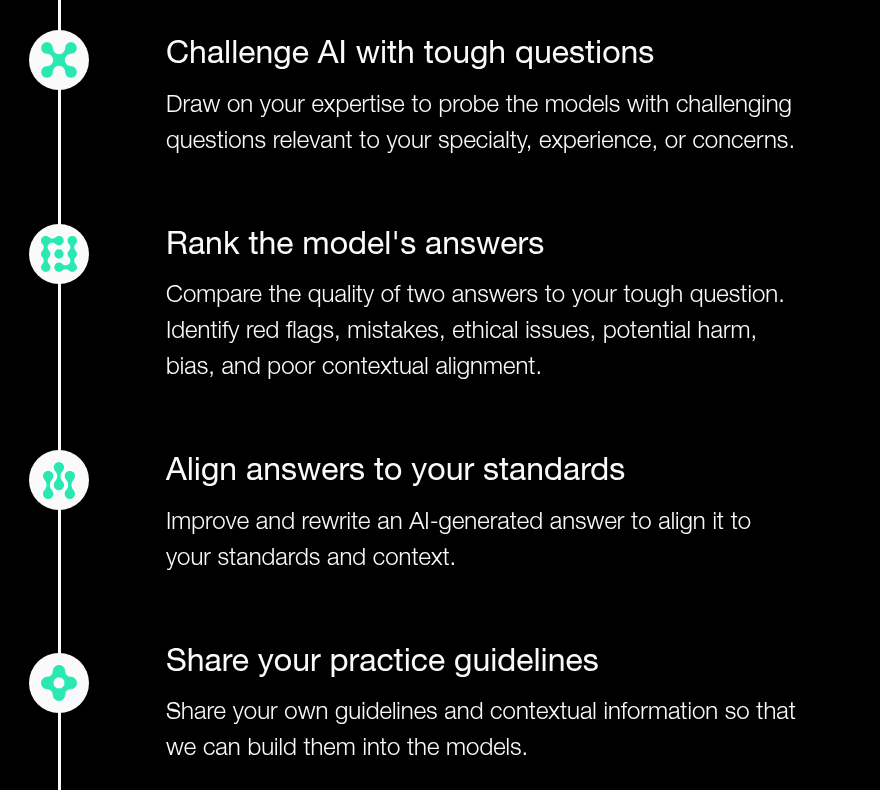
MOOVE works with both open and commercial models, connected through an interface, and it records each rating, correction and model version. The screens are in English, but experts can evaluate in any language. Today, the exported feedback can be used to further train open models outside the platform; a built-in loop to retrain and recheck a model is planned. The rating data is released publicly under an open license after a grace period for contributors. Contributors keep ownership of their data. Once an organization’s contributions pass a threshold, the team says it will adapt a model for that organization for free.
The lab describes MOOVE as a ladder. First, experts rate AI on made-up cases. Next, AI is tested on real patient records without affecting care. Last come randomized controlled trials, one of the strongest kinds of medical study.
Impact
MOOVE is live and open to sign-ups, but its results are early.
The first multi-country study is described in a protocol posted on medRxiv in September 2026. It is a plan, not a result, and it has not been peer reviewed. In each of Kenya, Malawi and Tanzania, experienced clinicians write 200 to 250 cases, each with a human care plan. Six open and commercial models answer the same cases. Then other clinicians rate the AI and human answers side by side without knowing which is which, at in-person workshops the team calls valiDATAthons. They score five things, including safety and fit with local conditions, and the study needs at least 1,253 paired ratings per country. The main question is whether each model is at least as safe as the human answers. Results are to be shared with each country’s ministry of health.
The authors are clear about the limits: answers to constructed cases cannot prove that AI is safe or useful with real patients.
In Malawi, the first phase is done. Its findings were presented at a meeting of partners in Lilongwe on September 25, 2026, where the Ministry of Health also spoke. “The responses from the research are safe, and they are performing at the same level as human experts in Malawi,” principal investigator Dr Chiyembekezo Kachimanga said, according to MUBAS. No figures have been published. A randomized trial is next, and the study is due to end in December 2026.
How many people take part is harder to say, because MOOVE’s own numbers do not match. On November 3, 2026, the animated counters on the MOOVE website showed about 1,400 users, more than 230,000 clinical evaluations and 9 countries. The lab’s entry in the ITU’s 2026 interim report, which gives no date for its figures, lists more than 1,000 clinical experts, more than 19,000 contributions and more than 10 countries. The lab’s own home page, on the same day, claimed more than 500,000 clinical evaluations on MOOVE and said the lab works in 19 countries. All three are self-reported.
MOOVE also runs in India, where it launched through a project called PrAImaan with the Indian Council of Medical Research (ICMR), and in Switzerland. There, the lab is preparing multi-center trials with Lausanne University Hospital to see how doctors use AI advice and what happens to patients.
People
Mary-Anne Hartley heads LiGHT, an international lab hosted by EPFL, Harvard’s Ariadne Labs, Ashoka University’s Koita Centre for Digital Health in India and C4IR Rwanda. Its team includes doctors, clinical trialists and data scientists. “It’s not good enough to make a good algorithm,” Hartley said in 2025, speaking about another of the lab’s projects. “We have to ensure it is acceptable and accessible for real-world implementation.”
The lab also builds its own open medical models, called Meditron. The 2026 version, MeditronFO, draws on MOOVE, and a panel of four physicians checked its training data. “We would never trust a doctor whose training cannot be verified. The same should apply to AI in healthcare,” said Xavier Theimer-Lienhard, the PhD student who leads the project.
The MOOVE website shows the logos of hospitals and groups such as Kenyatta National Hospital, the University of Nairobi and Last Mile Health under Collaborators, and of the Gates Foundation and the Kristian Gerhard Jebsen Foundation under Funders, without saying what each one does or funds. In Malawi, Dr Andrew Gonani, the Ministry of Health’s Director of Quality Management and Digital Health, welcomed the first findings.
The clinicians who write the cases, rate the answers and rewrite them are not named publicly.
Why it matters
AI chat tools are being tried in health care before there is much evidence about them, especially in low-resource clinics. MOOVE gives the checking to clinicians who know what a safe answer looks like where they work. If its studies hold up, health ministries could judge medical AI on evidence from their own clinics instead of on exam scores set somewhere else.
What we could not confirm (8)
- How many clinicians take part today. MOOVE’s three sets of figures (about 1,400 users and more than 230,000 evaluations on its website’s animated counters on 2026-11-03; 1,000+ experts and 19,000+ contributions in the ITU report; 500,000+ evaluations on the lab’s home page) differ, are self-reported, and do not define a user, a contribution or an evaluation.
- What the funders and collaborators shown on the MOOVE website fund or do. The site shows their logos only.
- Any figures behind the Malawi first-phase findings. The claim that answers were safe and at the level of human experts comes from the study lead’s remarks, reported by his university; no data has been published.
- Results from Kenya and Tanzania. The multi-country protocol is a preprint and has not been peer reviewed.
- Any public example of an AI model that was changed or rejected because of clinician reviews on MOOVE.
- The status of MOOVE’s work in Rwanda and Ethiopia, and the full list of partners (the lab shares partner details only with permission).
- The size of the threshold for the free adapted model, and whether any organization has received one.
- We found no clinician contributor who has spoken publicly about using MOOVE.
FAQs (5)
What is MOOVE?
MOOVE (Massive Open Online Validation and Evaluation) is an open online platform from the LiGHT lab at EPFL where clinicians and humanitarian experts test AI models on cases from their own practice, compare anonymous answers, flag errors and rewrite answers.
Who can join MOOVE?
The platform is open to sign-ups from clinicians and humanitarian experts. Contributors keep ownership of their data, and the team says organizations that contribute enough can get a free model adapted to their setting.
Is medical AI safe for primary care in Africa?
That is what MOOVE's study in Kenya, Malawi and Tanzania is testing. Malawi's study lead said in September 2026 that answers were safe and at the level of human experts, but no data has been published, and tests on made-up cases cannot prove safety with real patients.
Which AI models does MOOVE test?
It works with both open and commercial models. In Malawi, six models were tested, including ChatGPT and Gemini. The lab also tests its own open medical models, Meditron and MeditronFO.
Where does MOOVE work?
Its own pages name Kenya, Malawi, Tanzania, Rwanda and Ethiopia (MOOVE Africa), Switzerland and India, among others.
Sources (9)
MOOVE home page, accessed November 3, 2026 (animated counters read from two screenshots that day)
LiGHT Laboratory, Programs page, accessed November 3, 2026
LiGHT Laboratory, home page, accessed October 25, 2026, rechecked November 3, 2026
Macharia et al., hypMOOVE-PHC study protocol, medRxiv preprint (not peer reviewed), September 2026
MUBAS, MOOVE Study Advances Evaluation of AI for Healthcare in Malawi, October 8, 2026
BioAlps, MeditronFO: EPFL launches the first fully transparent medical AI model, June 18, 2026
ITU, AI for Good Innovate for Impact Interim Report 2026, MOOVE use case
Fact-checked against sources on November 3, 2026. Spot an error? Tell us.
This story supports