Problem
On February 22, 2025, about 100 people gathered at Hanshin University’s campus in Gyeonggi Province to look at what school students had made with AI. There were exhibits and a drone contest, and nine prizes. One award went to a middle-school student who had used AI to recreate a scene from a magic class.
Hanshin wants more kinds of students in rooms like that one. Its camp program sets out to reach students with disabilities, children from multicultural families and students in remote areas, and its website adds a track for older adults.
When the ITU included the project in its 2026 AI for Good report, Kim Ae-young, who heads Hanshin’s Digital Saessak project team, called it recognition of the university’s years of “warm technology education” and its work to close the digital divide.
AI solution
AI Art Coding is a teaching method. Professors at Hanshin’s AI and software college began developing it in 2022, with versions for each school level. Hanshin does not train its own model. Students use generative AI tools that already exist, the kind that write text, draw pictures or make sound from a short instruction.
In 2026 the tools named are Google’s Gemini and Flow, and the music generator Suno. Students plan and make their own picture books, songs, videos and space-themed projects in classes that combine school subjects. Hanshin says learners have also produced storybooks and webtoons, comics made to be read on a phone.
The classes reach schools through Digital Saessak (“digital sprout”), a national camp program run by the Ministry of Education, Korea’s 17 regional education offices and the Korea Foundation for Science and Creativity. Hanshin has been chosen as a camp operator seven times in a row since 2022. For 2026 it received about 1 billion won in public funding and plans to teach 4,800 students across the country by February 2027.
This year there are seven AI Art Coding programs. Five are basic courses. Two are for students in special education: “AI Literature Coding” and “AI Music Coding.” Hanshin runs them with the Korea Blind Union and a national parents’ association for people with severe brain lesion and multiple disabilities, using the two groups’ networks across the country. In 2025, the Korea Association of Welfare Institutions for Persons with Disabilities was part of Hanshin’s consortium.
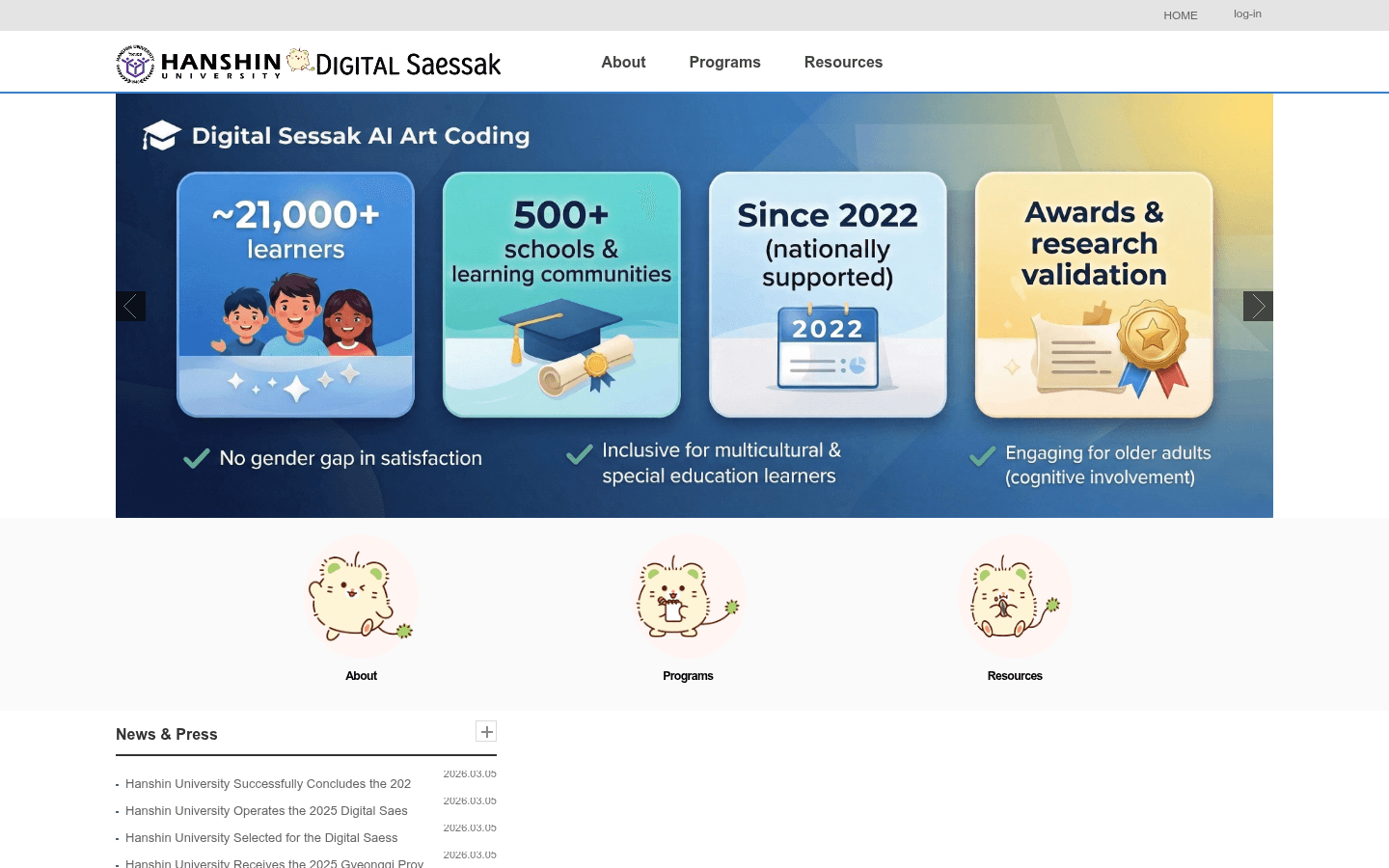
The program’s website lists four tracks: general learners, inclusive learning for special needs, digital inclusion for older adults, and training for instructors. For older adults, Hanshin’s ITU entry describes an “AI Art Coding Silver Instructor Training Program”.
Impact
AI Art Coding is deployed at scale in South Korea and has had public funding every year since 2022. All the results below come from Hanshin itself.
- One year of camps: from March 2024 to February 2025, Hanshin ran more than 440 camps for 8,212 elementary, middle and high school students, according to the program director at the time, Ryu Seung-taek, quoted by University Journal.
- Since 2022: Hanshin says it has reached more than 21,000 learners in more than 500 schools and community learning settings. The figure appears in its entry in the ITU’s AI for Good report and on its own website; no independent source confirms it.
- Learners with disabilities: Hanshin told the ITU that the number grew from 56 in 2022 to 1,022 in 2025. We found this figure in no other source.
- Planned for 2026: 4,800 students and seven programs, two of them for special education.
The method has also moved into the university. In the autumn 2025 semester, “AI Art Coding and Ethics” ran as a liberal-arts course with 14 sections, and in February 2025, 33 Hanshin students made art, literature and music at an AI Art Coding hackathon.
What students take away from a camp has not been measured independently. The studies of the method that Hanshin cites are master’s theses written at the university. Hanshin also registered “AI Art Coding” as a trademark in Korea in March 2026.
People
The work is led by Hanshin’s Digital Saessak project team. University Journal named Kim Ae-young as its director in May 2025 and May 2026. A February 2025 article named Ryu Seung-taek as program director.
“This year, we will spread an integrated AI education model, where disabled, multicultural and general students learn and grow together, across the country, so that it can become a tool for every child to express their creativity without discrimination.”Kim Ae-young, Hanshin University, to University Journal, May 2026 (translated from Korean by AI for Kind)
Partners carry much of the reach. The special-education courses run through the national networks of the Korea Blind Union and the parents’ association. Hanshin’s ITU entry also lists the special-education support center of the Hwaseong-Osan Office of Education, the Korea Muscular Disability Association and the university’s own lifelong education center among its partners. Training the instructors who teach the classes is one of the four tracks on the program’s website.
Why it matters
Generative AI is reaching classrooms quickly, and students with disabilities are at risk of getting a turn last. Hanshin describes its model as low cost. It runs on widely available tools and starts with making a story or a song. In 2026 its special-education courses are part of the same publicly funded program as the basic courses: a working example that other universities and schools can study.
What we could not confirm (5)
- Hanshin’s totals since 2022 (more than 21,000 learners, more than 500 schools and communities) and the rise in learners with disabilities from 56 to 1,022. They come only from Hanshin.
- How many blind or disabled students have taken the two special-education courses in 2026.
- What students can do after a camp. No outside evaluation has been published.
- Details of the silver instructor program for older adults. We found no press coverage of it.
- Hanshin’s claim, in its ITU entry, that student storybooks have been published in English on Amazon.
FAQs (4)
What is AI Art Coding?
A teaching method from Hanshin University in South Korea. Students use existing generative AI tools such as Gemini, Flow and Suno to make picture books, music and videos, instead of writing code line by line.
Who can take part?
Mostly elementary, middle and high school students, through the government's Digital Saessak camps. In 2026 two courses are for students in special education, and Hanshin also runs tracks for older adults and for instructors.
How many people has it reached?
Hanshin's director said 8,212 students took part from March 2024 to February 2025. Hanshin says more than 21,000 learners since 2022; that total has not been independently confirmed.
Is there evidence that it works?
Not independent evidence. The learning studies Hanshin cites are master's theses written at the university.
Sources (8)
On Jong-rim, 한신대, '디지털새싹' 7회 연속 선정, University Journal, May 21, 2026 (Korean)
한신대, 수도권 대학 유일 '디지털새싹 사업' 6회 연속 선정, University Journal, May 8, 2025 (Korean)
한신대, 2024 디지털새싹캠프 3기 AI·SW 페스티벌 성과 공유회, University Journal, February 25, 2025 (Korean)
한신대 'AI 아트 코딩', UN ITU 'AI for Good' 글로벌 우수 사례 등재, University Journal, September 9, 2026 (Korean)
University Journal, AI Art Coding hackathon, February 2025 (Korean)
University Journal, AI Art Coding and Ethics course, September 2025 (Korean)
Hanshin University, Digital Saessak and AI Art Coding site (accessed October 28, 2026)
ITU, AI for Good Innovate for Impact Interim Report 2026, Hanshin University, AI Art Coding use case, pp. 895–904
Fact-checked against sources on October 28, 2026. Spot an error? Tell us.
This story supports