Problem
In late February 2026, forecasters at Uganda’s Department of Meteorological Services spent five days in Kampala and Entebbe with ICPAC, WFP and Oxford. For two days they worked hands-on: checking how accurate past forecasts had been, and using machine learning to correct them. For the other three, they sat down with the people who rely on forecasts, from agriculture and disaster risk to health, transport, water and the environment.
Floods and failed rains hit the Greater Horn of Africa again and again. More warning time lets governments and aid agencies act before a disaster strikes.
A useful warning tells people how likely different outcomes are. Large forecast centers get that range by running a weather model many times from slightly different starting points, which is called an ensemble forecast. Many national weather services in the region cannot afford the supercomputers this takes, especially for the medium range of up to two weeks.
AI solution
Two linked projects tackle this. SEWAA (Strengthening Early Warning Systems for Anticipatory Action), funded by Google.org, works with Kenya and Ethiopia. Anticipatory action means acting before a hazard hits, on the strength of a forecast. ACRIFI (Artificial Intelligence for Climate Risk and Forecasting Innovation), funded by the Government of Denmark, works with Uganda and Rwanda. ICPAC leads both from Nairobi, with WFP, Oxford and the European Centre for Medium-Range Weather Forecasts (ECMWF).
Both use a conditional generative adversarial network (cGAN), a type of machine learning. It takes ECMWF’s global ensemble forecast and learns to correct it, using satellite measurements of rainfall as the answer key.
A generative adversarial network trains two parts against each other. One draws possible rainfall maps. The other tries to tell those drawings from real satellite rainfall, and both improve until the drawings are hard to spot. “Conditional” means every drawing starts from the day’s forecast.
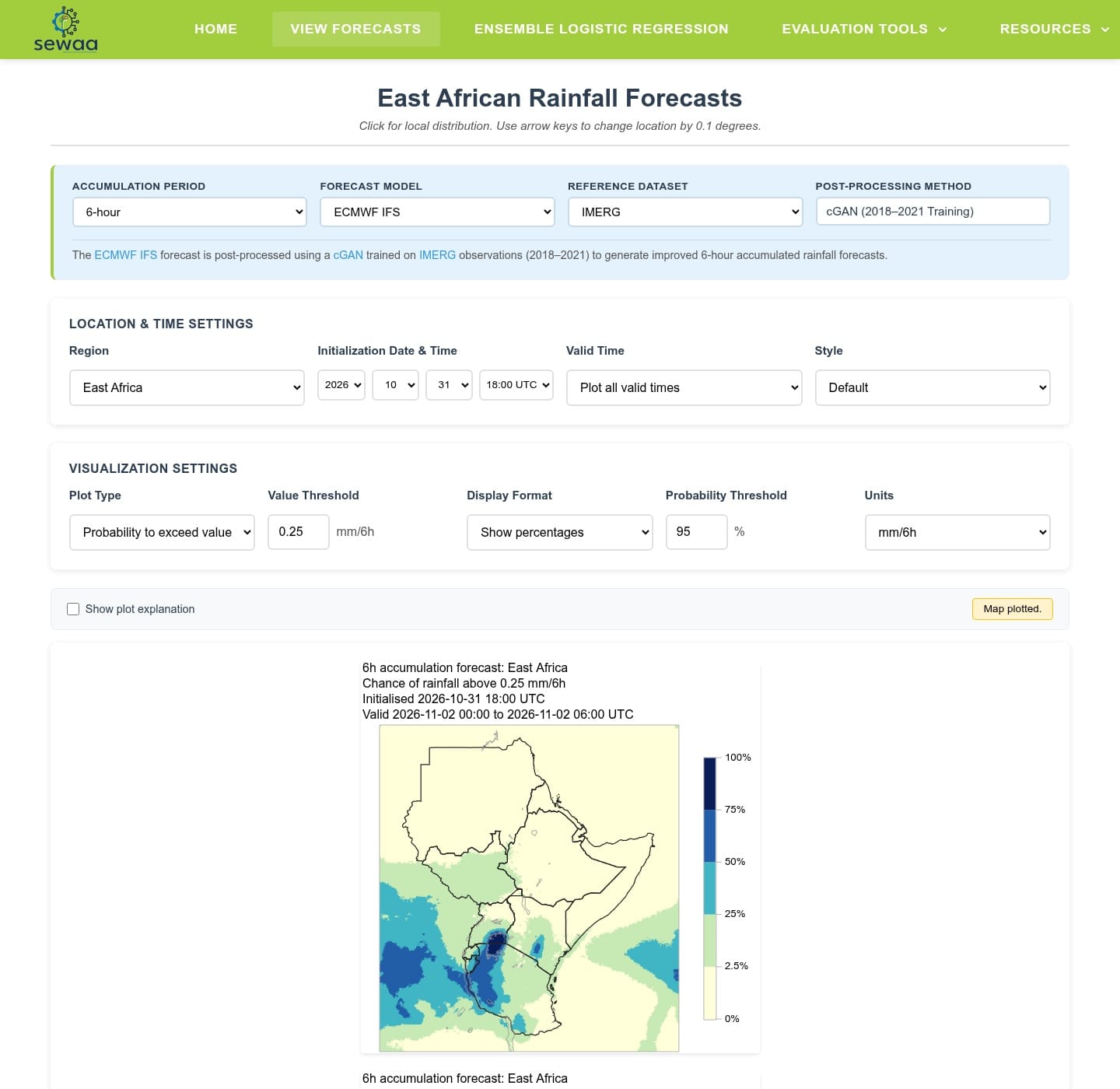
The result is many possible versions of the next 6 or 24 hours of rain, so a forecaster can see how likely heavy rain is in each place. According to the project’s technical paper, the model makes 1,000 of these versions per forecast cycle on a standard desktop computer. Forecasters see the results on a public website, cgan.icpac.net, as extra guidance next to their usual models.
Alongside the model work, Uganda has rescued and digitized paper weather observations going back to the 1940s. ICPAC’s authors say AI is not a silver bullet: in their view it works alongside the physics-based weather models and the forecasters’ own judgment.
Impact
This is a pilot, and most of the results so far come from the partners themselves.
By mid-2025, WFP reported, the system produced a set of 50 probabilistic forecasts in 40 minutes, where one single forecast used to take three hours. It updated four times a day, looked 30 to 54 hours ahead, and ran on a personal computer and a web browser with donated cloud computing credits. WFP also wrote that meteorologists at the Ethiopian Meteorological Institute and the Kenya Meteorological Department used the forecasts in their daily operations.
ICPAC describes the stage more carefully. In July 2026 it said the national services were still testing and validating the model alongside their usual systems. Early validation was “encouraging,” it said, but more testing is needed before full operational adoption. In December 2025, a SEWAA workshop in Addis Ababa brought the Ethiopian institute and regional partners together to plan how to move the model from pilot to routine use, covering standard procedures, regular validation, data governance and financing. The project said the model had improved short-range rainfall forecasts, particularly over southern Ethiopia, but published no figures.
The most detailed evidence is a technical paper by researchers from Oxford, ICPAC, the Kenyan and Ethiopian weather services, ECMWF and WFP. It was posted online as a preprint in December 2025 and revised in September 2026, and we could not confirm that it has been peer reviewed. The authors found that the cGAN’s skill was comparable to a statistical correction method and to corrected forecasts from two other AI weather models, FuXi and GraphCast, and that these methods substantially improved on the uncorrected ECMWF forecast. Useful skill reached beyond seven days ahead, with notable gains for 6-hour and 24-hour rainfall over densely populated areas of Kenya, Ethiopia, Uganda, Rwanda, Burundi and Tanzania. The authors add that the Kenyan and Ethiopian services valued the model’s ability to show individual possible rainfall patterns when they assessed it in their work.
People
The partners want the skills to stay in the region. Oxford trained staff at the Ethiopian and Kenyan services and at ICPAC. In April 2026, ICPAC and Uganda’s meteorological department ran a five-day course in Python, Jupyter notebooks, GitHub and climate data analysis, followed by six months of online mentorship, with an advanced course planned. In Kenya, the aim is to spread these skills across operational forecasting teams.
“The SEWAA & ACRIFI initiatives have strengthened our ability to explore new forecasting approaches while investing in the people who will drive this work into the future,” said Godfrey Mujuni of Uganda’s Department of Meteorological Services.
Hanna Kimani, Assistant Director of Forecasting at the Kenya Meteorological Department when WFP published its 2025 brief, sees value in the range of outcomes the model gives. “Machine learning forecasts provide a flexible, actionable approach for anticipatory action, offering a wide range of probabilities to help decision-makers set risk tolerance thresholds,” she said in that brief.
Behind the project’s papers and training stories are people such as Masilin Gudoshava and Jason Kinyua at ICPAC, and Fenwick Cooper and Tim Palmer at Oxford.
Why it matters
On October 30, 2026, ministers from IGAD countries meeting in Mombasa committed to acting earlier on disasters, with the aim of national anticipatory action protocols for priority hazards by 2027. Plans like these need rain forecasts that say how likely trouble is. This pilot is testing whether weather services without supercomputers can produce such forecasts themselves, and whether their own staff can keep improving them.
What we could not confirm (7)
- We could not find a published figure for how much the AI improves rainfall forecasts. The project reports improvement; the preprint compares methods, and we read only its summary and introduction in full.
- Whether the model is now an official operational forecast tool at the Ethiopian or Kenyan weather service. WFP’s 2025 brief says forecasters use it daily; ICPAC said in July 2026 that services were still testing and validating it.
- Whether the September 2026 preprint has been peer reviewed. Its authors include project partners, so it is not an independent evaluation.
- A real case where an AI forecast led to earlier action, such as aid or warnings sent before a flood.
- How many forecasters have been trained in each country.
- Which countries belong to which project. ICPAC’s SEWAA page lists only Kenya and Ethiopia, while its July 2026 article describes four countries across SEWAA and ACRIFI.
- How the rescued Uganda records feed into the AI model, if at all.
FAQs (5)
What is SEWAA?
SEWAA (Strengthening Early Warning Systems for Anticipatory Action) is a project led by ICPAC with WFP and the weather services of Kenya and Ethiopia, funded by Google.org. A sister project, ACRIFI, funded by Denmark, works with Uganda and Rwanda.
How does the AI improve rainfall forecasts?
A conditional generative adversarial network takes the European ECMWF global forecast and corrects it toward satellite rainfall measurements. It produces many possible versions of the next 6 or 24 hours of rain, so forecasters can see the chance of heavy rain in each area.
Do East African weather services use AI forecasts officially?
Not fully yet. WFP reported in 2025 that Kenyan and Ethiopian forecasters used the forecasts daily, but ICPAC said in July 2026 that the services were still testing and validating the model before full operational adoption.
Does it need a supercomputer?
No. The project's preprint says the model makes 1,000 forecast versions per cycle on a standard desktop computer, and WFP said in 2025 that it ran on a personal computer and a web browser.
Can anyone see the forecasts?
Yes. The forecast maps are on a public website, cgan.icpac.net.
Sources (10)
ICPAC, SEWAA project page, undated, checked 2026-11-01
ICPAC, ACRIFI project page, undated, checked 2026-11-01
WFP, SEWAA mid-term results brief, August 2025
ICPAC / IGAD, Mombasa Ministerial Declaration on Anticipatory Action, 2026, 2026-10-30
SEWAA public forecast viewer, checked 2026-11-01
Fact-checked against sources on November 1, 2026. Spot an error? Tell us.
This story supports