Problem
In August 2026, halfway through India’s monsoon crop season, Karthikeyan Lanka was watching the soil swing between wet and dry. “Momentarily soil will be wet, but then there will be long dry periods,” the IIT Bombay scientist told Down To Earth. Some areas, he said, had not recovered for weeks.
This is agricultural drought: soil that holds too little water for crops. Rain totals can hide it, because a season can look normal on average while the soil dries out between downpours.
“There may be crop yield loss in kharif,” Lanka warned, meaning the monsoon-season crop. Down To Earth added that if farmers pump more groundwater to make up the gap, the next crop, sown in the rabi (winter) season, could face stress too.
His group’s experimental maps for four weeks that August showed severe to exceptional drought persisting across the Indo-Gangetic belt and parts of the peninsula. The forecast note advised that planning for the rabi season, from crop choice and sowing windows to irrigation, might need to begin early.
AI solution
In October, the same group put its forecasts on a public website. KrishiDrought.in comes from the Ecohydrology Group that Lanka leads at IIT Bombay’s Centre of Studies in Resources Engineering, working with the institute’s Centre for Climate Studies. It launched on October 28, 2026, during the centre’s Golden Jubilee celebrations.
What the forecasts measure
The forecasts follow one number for each patch of land about 9 km across: the soil-moisture anomaly, or how much wetter or drier the soil is in a given week than is normal for that week. The team takes “normal” to be the average from 2015 to 2024.
Satellites usually see only the top 5 cm of soil. The team tracks the top 100 cm, the root zone, where crops draw their water. In August, Down To Earth listed the main data: a NASA soil moisture satellite (Soil Moisture Active Passive), records from the India Meteorological Department, and ERA5, a global reconstruction of past weather.
IIT Bombay says the platform combines satellite observations, climate and water datasets, physics-based weather forecasts and “advanced deep learning models”. Deep learning is a kind of machine learning that finds patterns in large amounts of past data. According to The Better India, these models bring the inputs together to forecast soil moisture in the weeks ahead. The team has not published a paper or code that describes the models, and the August interview does not mention them.
How the map works
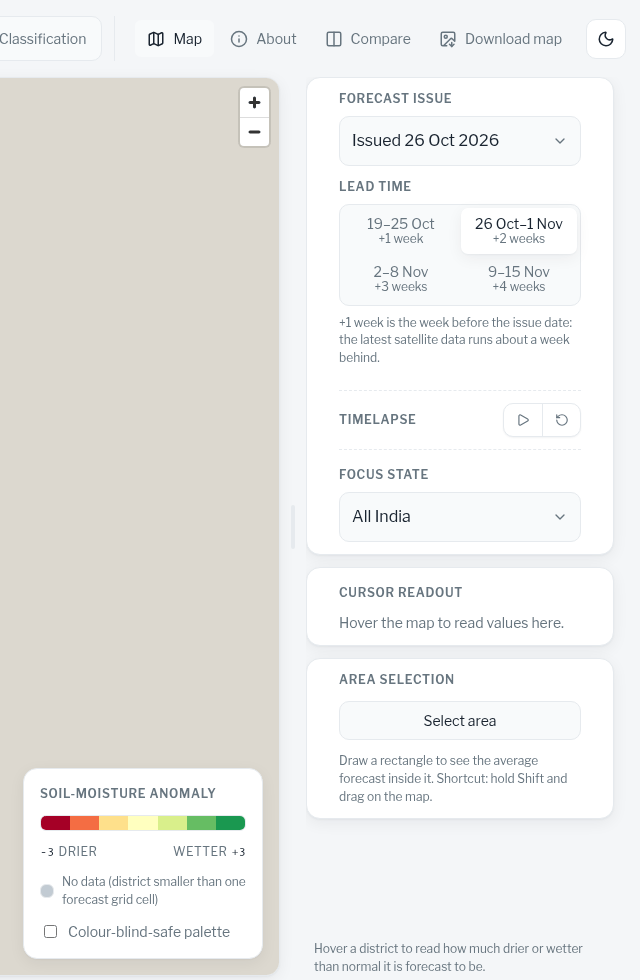
Visitors choose a state and a district and pick a lead time of one, two, three or four weeks. Red means drier than normal and green means wetter, on a scale from -3 to +3, and a color-blind-friendly palette is available. Districts smaller than one forecast cell show “no data”. A second view sorts districts into the five drought categories, D0 to D4, used by the US Drought Monitor. New forecasts come out every week.
The lead times need a careful read. The site explains that the “+1 week” map covers the week before the issue date, because the latest satellite data runs about a week behind. The forecast issued on October 26, 2026, covered October 19 to November 15. So the furthest map reaches about three weeks past the day it was issued.
Impact
It is too early to measure impact, and we found no independent results.
The public portal is live and runs weekly: the run labelled 2026-W44 was online on November 4, 2026. Before the launch, the team produced experimental all-India forecasts through the 2026 monsoon season. Everything said about the forecasts so far comes from IIT Bombay itself.
We found no published accuracy test that compares the forecasts with what the soil actually did, no user numbers and no farmer feedback in any source. The Tribune noted that IIT Bombay did not say how farmers would receive the forecasts or how the information would reach the field. The site we checked was in English only. The forecasts are presented as an extra aid for decisions, not a replacement for local agricultural advice.
Related work at the same institute
A separate IIT Bombay team, led by Prof. Subimal Ghosh with the Indian Institute of Tropical Meteorology in Pune, has built a different tool. It is an irrigation planner that uses forecasts one to three weeks ahead to estimate how much water crops need. In 2025, IIT Bombay reported that its computer model showed the plan could cut water use by 10 to 30% compared with traditional irrigation across 12 sub-districts of Bankura, West Bengal. That is a modelled estimate from the institute itself, not a measured field result. Describing an earlier version tested with grape farmers in Nashik, Ghosh said in 2023 that the idea was “a simple tool to help farmers, especially poorer ones who cannot afford [soil moisture] sensors, decide how much water they should use”. The planner is not part of KrishiDrought.
People
Karthikeyan Lanka, an associate professor, leads the Ecohydrology Group and is principal investigator of the forecasts. Down To Earth named three researchers in his group who work on them: Saurabh Verma, Sarthak Somani and Aditi Goel. IIT Bombay’s Centre for Climate Studies shares the forecasts.
The map is public and needs no login. We found no public comment yet from farmers or district agriculture officers who have used it.
Why it matters
A drought that hides between rainstorms is hard to plan for. A free, weekly, district-level forecast of the soil where roots grow gives farm advisers and officials one more way to see dry weeks coming, and to start planning the next season early, as the team urged in August. Whether people come to rely on it depends on what comes next: a published accuracy check, local languages and a clear path to the people who plant.
What we could not confirm (7)
- How accurate the forecasts are. IIT Bombay has not published a test comparing forecasts with observed soil moisture that we could find.
- How the deep-learning models work. We found no paper, model description or code; the AI claim rests on IIT Bombay’s announcement.
- How farmers or agriculture officers receive the forecasts, in which languages, and whether anyone uses them yet. We found no farmer or official voices.
- Who funds KrishiDrought.
- Whether KrishiDrought is exactly the same system as the experimental all-India forecasts described in August 2026. Same lead scientist and group, but no source says so directly.
- Whether the 10 to 30% water saving of the separate irrigation planner, a computer-model estimate for Bankura, holds up in farmers’ fields.
- We did not read the India Today report of November 2, 2026, which other outlets cite.
FAQs (5)
What is KrishiDrought.in?
A free public website from IIT Bombay, launched on October 28, 2026, that shows weekly forecasts of agricultural drought (dry soil under crops) for India's districts, up to four weeks ahead, at about 9 km resolution.
Who made it?
The Ecohydrology Group led by Prof. Karthikeyan Lanka at IIT Bombay's Centre of Studies in Resources Engineering, with the Centre for Climate Studies.
How does it use AI?
IIT Bombay says deep-learning models combine satellite soil moisture, climate data and physics-based weather forecasts to predict soil moisture in the weeks ahead. The team has not published details of the models.
How accurate are the forecasts?
Not yet known publicly. The site calls itself experimental, and we found no published accuracy test.
Does "four weeks ahead" mean four weeks into the future?
Not exactly. The site says the first lead week is the week before the issue date, because satellite data runs about a week behind, so the furthest map reaches about three weeks past the issue date.
Sources (6)
The Better India, IIT Bombay team builds AI tool to spot drought risk 4 weeks early, 2026-11-03
Eos, New forecasting tool could help Indian farmers plan irrigation, 2023-05-18
Fact-checked against sources on November 4, 2026. Spot an error? Tell us.
This story supports