
Problem
In late September 2026, at the Korea Social Value Festa in Seoul’s COEX convention center, the NC Cultural Foundation showed visitors an app called My AAC at its booth. The foundation co-hosted the fair.
The app is for people who find it hard to say what they want, out loud or in writing. In 2016 the foundation named people with developmental disabilities, Parkinson’s disease and aphasia, a loss of language that often follows brain injury. For them, asking for something or saying that something hurts can be hard.
One answer is augmentative and alternative communication (AAC): ways to communicate that add to or replace speech, usually by combining pictures with a spoken voice. A person points to a symbol, and a device or app says the word.
How that voice sounds matters. NC AI, the NCSOFT group company whose voice technology the app uses, argues in its ITU entry that much text-to-speech software lacks expression, and that people with speech impairments face extra barriers to natural, personal communication (Source: ITU, AI for Good Innovate for Impact Interim Report 2026).
AI solution
My AAC (Naui AAC in Korean) began as a tablet app called My First AAC in 2014, and a free smartphone version followed in 2015. In 2022 the foundation began a full rebuild, and in March 2024 it merged three separate apps, each for a different level of language ability, into one.
A user sets up boards of picture symbols for words and ideas, and tapping a symbol makes the app say the word aloud. People who can type can have longer messages spoken, and users can build picture stories in time order. They can add their own photos or search Google Images for a symbol, and a guardian’s account can share a board to the user’s device in one step.
How it works
- 01 Tap or type The user taps a picture symbol on a board, or types a longer message.
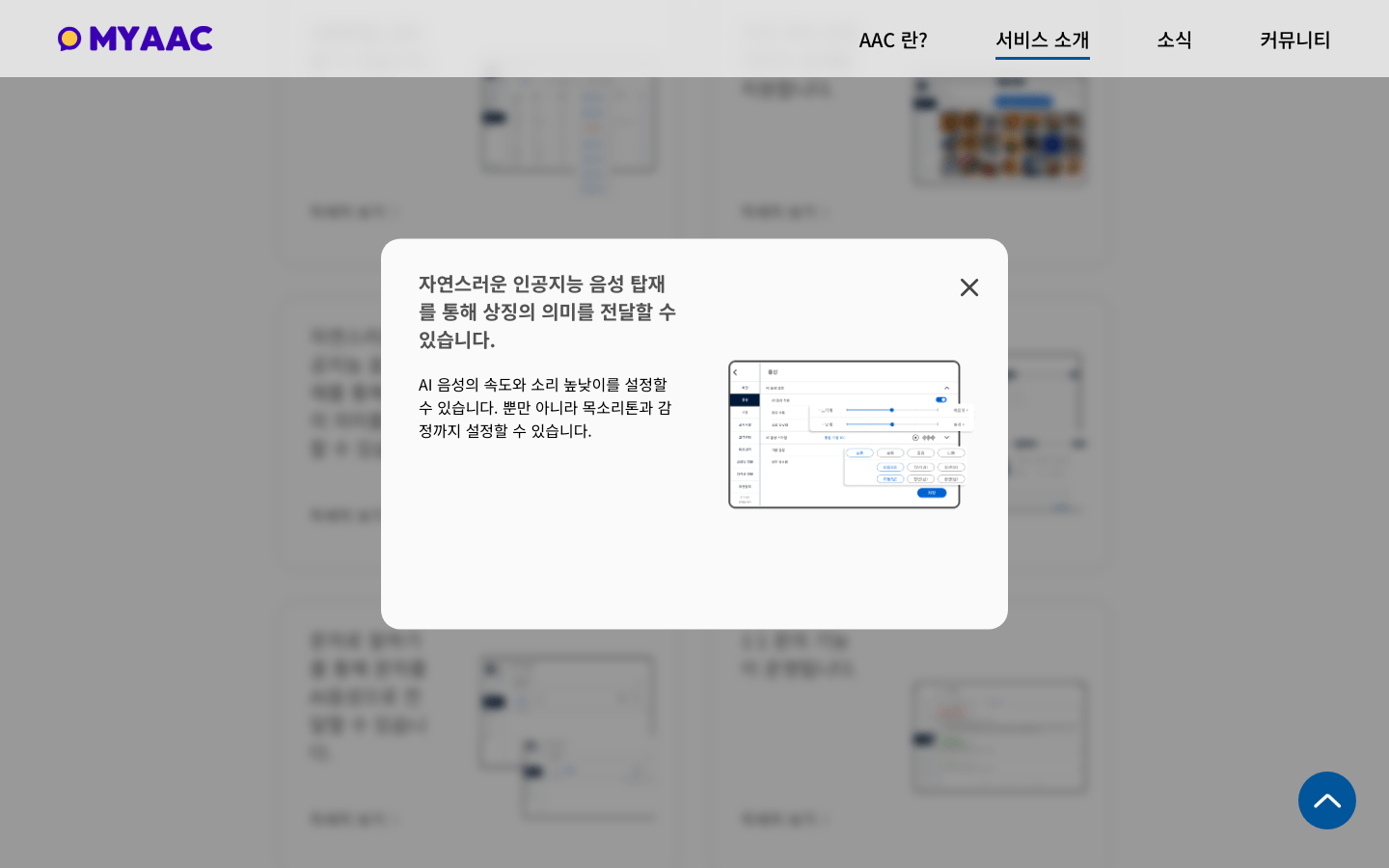
- 02 Choose a voice They pick an age group and an emotion, and can adjust pitch, volume and speed.
- 03 Hear it spoken The app reads the word or message aloud in a synthetic AI voice, and suggests related words.
Since the relaunch, the voices have come from speech technology made by NCSOFT’s AI unit, called the NC AI Tech Center in 2024 coverage; NCSOFT spun its AI research off into a separate company, NC AI, in February 2025. This is text-to-speech (software, trained on recordings of human speech, that reads any text aloud in a natural-sounding voice). The user picks an age group and an emotion, and the voice and its tone change to match. Pitch, volume and speed are adjustable too.
A recommendation algorithm also suggests related words, based on how the person uses the app, to help them put a message together.
The voices are synthetic: no source we found says users can recreate their own voice.
The app is free, works on Apple and Android devices, and is in Korean only. Its symbols come from three sets, including one from the Seoul Disability Communication Rights Promotion Center, and its lettering uses a universal-design font from the Korea Institute for Disability Development.
Impact
My AAC is live and maintained. The App Store listing shows better AI voice quality in July 2025, high-contrast color themes in November 2025 and, on September 17, 2026, printing of boards without a watermark, for use on paper.
The only usage figure we found comes from the foundation. In December 2024, its vice chair, Park Myung-jin, said the app had been downloaded 15,000 times in the nine months since the relaunch. Downloads are not the same as regular users, and no later figure has been published.
In December 2024 the app won two top prizes at the i-Awards, one for non-profit apps and one for services that support vulnerable people. One judge said it helps speech-language therapists as well as disabled users, because they can make several profiles and edit boards freely. The earlier version won the grand prize at the Human Technology Award in 2016. In 2024 the app also earned Korean web and mobile accessibility certification.
We found no evidence of what changes for the people who use it: no independent study, survey or user story. Its App Store page has too few ratings to show a score.
People
The NC Cultural Foundation was set up in 2012 for NCSOFT’s 15th anniversary. Yoon Song-yi, named as its chair in 2016 and 2024 coverage, said in 2016 that the foundation wanted to spread helpful technology that companies find hard to offer because it earns little money. NCSOFT’s AI company sells the same family of voice technology commercially; My AAC is the foundation’s free, non-profit use of it.
The foundation says special-education experts helped choose and arrange the app’s words. With the 2024 relaunch it planned training visits to disability and special-education centers, starting on March 22, 2024, at a disability welfare center in Busan and then moving to the Seoul area and other provinces.
In July 2025 it began working with the Special Education Digital Education Association, and the two showed the app together at an education fair at COEX that August. “It is a non-profit free app launched in 2015 and renewed in March last year,” a foundation official told the trade paper Industry Daily at the fair. The partnership began “so that more people with communication disabilities can use it.” (translated from Korean by AI for Kind)
“can communicate freely through AAC and understand and respect one another.”NC Cultural Foundation, at the March 2024 relaunch, translated from Korean by AI for Kind
Why it matters
AI voices are often in the news as products to sell or as tools for fakes. Here a free app, kept up for more than ten years, uses them so that a person who cannot easily speak can pick a voice that fits their age and mood. The numbers are early and come from the foundation, and we have not yet heard from users themselves.
What we could not confirm (7)
- How many people use My AAC regularly. The only figure, 15,000 downloads in the nine months after the March 2024 relaunch, comes from the foundation, counts downloads rather than users, and has not been updated since December 2024.
- Whether the app improves communication for its users. We found no independent evaluation and no user, family or therapist describing it in public.
- How many words or symbols the app has. Korean press reports say more than 2,000 vocabulary items or picture symbols; the App Store listing and official site say about 10,000 or more symbols. The two numbers may count different things, a curated vocabulary and a full symbol library, but the foundation has not said.
- Who the app was designed for. NC AI’s ITU entry says it was built for people who lost speech to conditions such as amyotrophic lateral sclerosis (ALS), cerebral palsy or aphasia after a stroke (Source: ITU, AI for Good Innovate for Impact Interim Report 2026). The foundation’s own statements and Korean press describe people who find it hard to speak or write, and in 2016 named developmental disabilities, Parkinson’s disease and aphasia. We could not confirm how many users have ALS or have had a stroke.
- Which exact voice engine runs in the app today. The ITU entry links it to NC AI’s VARCO Voice; Korean press says only “NC AI technology”.
- The foundation’s current leadership. Press in 2024 named Yoon Song-yi as chair and Park Myung-jin as vice chair; the footer of the My AAC website in October 2026 lists Park Myung-jin as chair.
- How many schools, therapists or welfare centers use the app.
FAQs (5)
What is My AAC?
A free Korean app from the NC Cultural Foundation that speaks picture symbols or typed text aloud for people who find it hard to talk or write. It has run since 2015 and added AI voices in March 2024.
What does the AI do in My AAC?
It generates the spoken voice. Users choose an age group and an emotion, and can adjust pitch, volume and speed. A recommendation feature also suggests related words.
Does My AAC copy the user's own voice?
No source we found says so. The app uses synthetic AI voices that users choose and adjust.
How much does My AAC cost, and where can I get it?
It is free on the App Store and Google Play. It is available in Korean only.
How many people use it?
The foundation reported 15,000 downloads in the nine months after its March 2024 relaunch. No figure for active users has been published.
Sources (9)
Kyunghyang Sports, report on the Human Technology Award, June 16, 2016 (in Korean)
Inven Global, NC Cultural Foundation co-hosts Korea Social Value Festa, September 21, 2026
My AAC official website, NC Cultural Foundation, checked October 30, 2026
KED Global, NCSoft to spin off AI, game divisions into four units, October 21, 2024
ITU, AI for Good Innovate for Impact Interim Report 2026, VARCO Voice: Multilingual AI Voice Platform for Creators, Education, and Public Communication, NC AI Co., Ltd., pp. 840–846
Fact-checked against sources on October 30, 2026. Spot an error? Tell us.
This story supports