
Problem
In 2022, at peak times, the MomConnect helpdesk had a team of three people and more than 1,200 messages a day. For each message, an operator searched a list of standard answers to frequently asked questions (FAQs) and forwarded the closest one. When nothing fit, the question went to a trained midwife.
Those messages came from a very large group of women. South Africa’s National Department of Health launched MomConnect in 2014. Almost 5 million mothers have registered since then, in over 95% of public health facilities, and the service sends them health messages until their baby turns two. It is free in all 11 official languages, and nobody has to stay on it.
When the service moved to WhatsApp, the questions grew. Reach says over 1,000 a day reached a helpdesk with few staff, and a question about a routine topic could sit in the same queue as a warning sign.
AI solution
IDinsight built the first version of AAQ with Reach in 2021 and 2022. It matched questions to answers. A mother typed a question in her own words, and natural language processing (software that works with everyday written language) compared it with the stored, expert-approved answers. She saw the closest matches, plus a button to send her question to a person on the helpdesk if none of them helped. The tool did not write new answers.
It was also built to look for signs of urgency. In the 2022 design, medical keywords that suggested urgency would put a message higher in the operators’ queue, and the mother would get a template message asking her to contact her nearest medical provider.
During the pilot, the team tested the tool on old helpdesk chats. The right answer was among its top five suggestions about 65% of the time, above the 50% bar Reach had set.
Since then, the team has moved to large language models, the type of AI behind chat tools such as ChatGPT. Reach says the newer version copes with misspellings and informal wording, can ask a short follow-up question when a message is unclear, and passes the chat to the helpdesk when it detects urgency. In Reach’s own example, a mother types “pain in my belly” and the chatbot either asks a clarifying question or escalates.
In 2024, IDinsight wrote that it had rolled out “a first version of guardrails to prevent misuse and LLM hallucinations”, meaning answers the AI makes up. None of the sources we read says whether the newer system writes its own replies or still only chooses from approved answers.
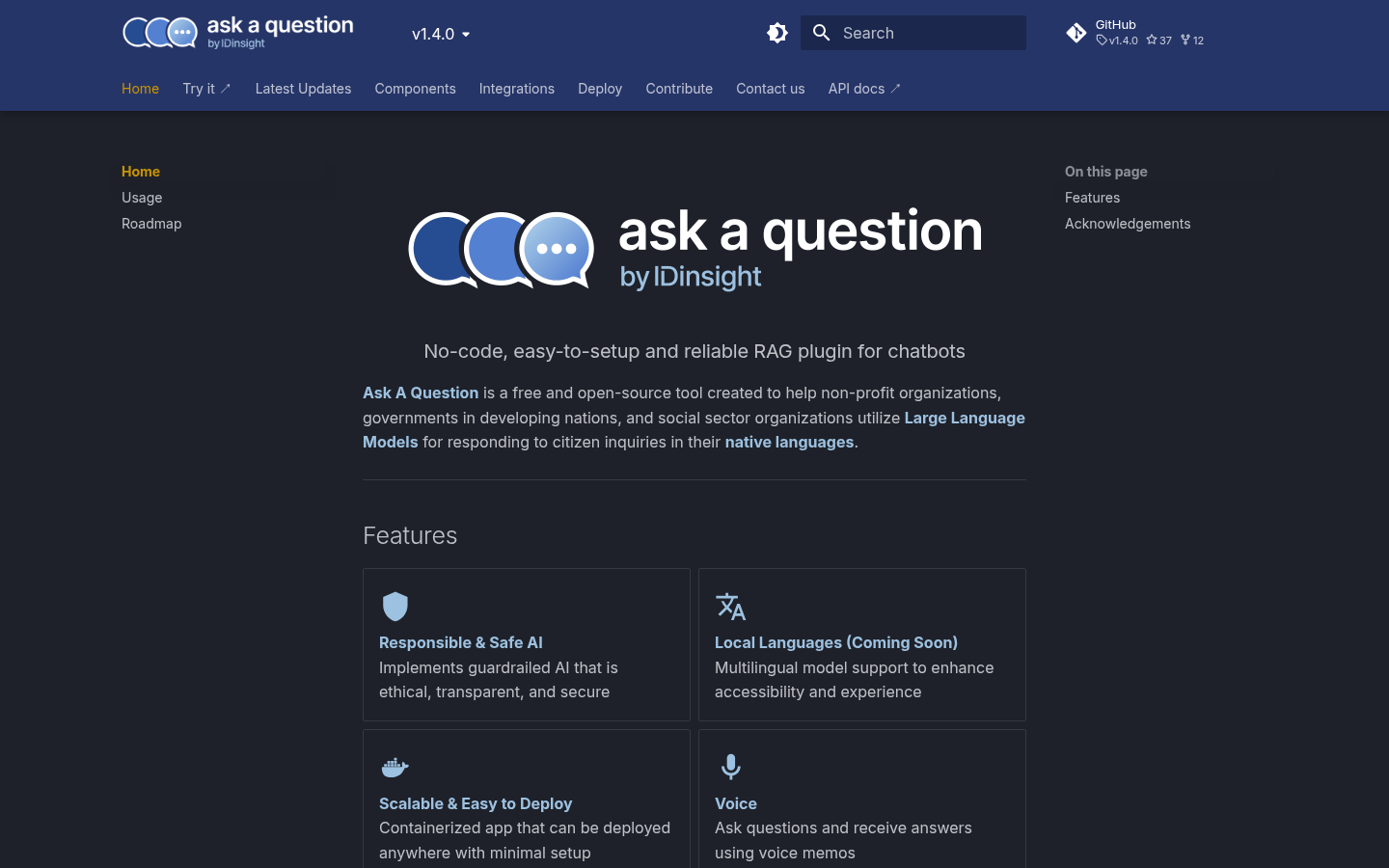
AAQ is open source, so other organizations can use it, and Google.org supported its development.
MomConnect still offers a human-operated helpdesk alongside the automated chatbot. Mothers can also use a separate symptom checker from Ada Health on the same helpdesk, a different tool from a different company.
Impact
MomConnect is a national service in daily use, and AAQ is part of its main WhatsApp chat flow. Every AAQ figure below comes from Reach or IDinsight. We found no independent evaluation of the tool.
IDinsight says the first version cut the helpdesk’s workload by 60%, without saying how it measured this.
Reach’s two main sources give different totals. A Reach blog post from October 2025 says that “by 2025, AAQ had successfully handled over 880,000 questions”, and that about 100,000 urgent queries had needed human help by May 2025. In an undated entry for the Global AI Impact Commons, a public collection of AI projects linked to the India AI Impact Summit 2026, Reach reports over 600,000 questions “matched” and more than 71,000 urgent queries escalated to staff. Neither source defines its terms. “Handled” and “matched” do not mean a question was answered correctly.
The accuracy figures differ too. The blog gives 83% accuracy in matching questions to the right answer; the Commons entry gives 70%. Both report 85% accuracy in detecting urgent messages, with no method or date. That leaves room for some urgent messages to be missed, and no source says how often this happens or what follows when it does. The Commons entry adds that 52% of responses were upvoted.
Reach also tests AI features against the usual version, and not every test goes its way. In a separate trial with OpenAI and the Agency Fund, 56% of mothers finished an AI-assisted survey, against 81% for the standard one, although mothers in the AI group later sent 29% to 42% more messages.
The Ada symptom checker has stronger evidence. A peer-reviewed study in the journal Nature Health, announced in June 2026, followed 968 participants: the share who sought care rose from 17% to 43% within a week. Those results belong to Ada’s tool, not to AAQ.
People
MomConnect belongs to the National Department of Health. Reach Digital Health, a Cape Town nonprofit founded in 2007 and formerly called Praekelt.org, works with the department to run it.
Debbie Rogers is Reach’s CEO. “We see every day what happens when women don’t have access to timely, reliable health information,” she said in a June 2026 release about the Ada study.
Daniel Futerman, Reach’s head of engineering, presented AAQ with IDinsight at Google’s AI in Action event in Johannesburg in October 2025. At IDinsight, a data and evidence organization, Tanmay Verma wrote the 2022 article on the tool and co-wrote the 2024 one with Suzin You.
The service also depends on people the sources do not name: the experts who approve the answers the AI chooses from, the helpdesk operators who take urgent and complex questions, and the trained midwives who answer what no standard reply covers.
Why it matters
Many health helplines are adding AI chat. MomConnect, a national service for millions of mothers, uses it in a careful way: the AI was built to answer routine questions with text that experts approved beforehand and to get urgent ones to people sooner. Nobody outside the team has yet checked how often it gets things wrong, especially with urgent messages, and mothers and health workers deserve that answer.
What we could not confirm (10)
- What Reach’s “over 880,000 questions handled” counts, and why its Global AI Impact Commons entry gives “over 600,000 matched” instead, and when that entry was written. Both are self-reported.
- Why Reach reports 83% accuracy in matching answers in one place and 70% in another, and how either figure, or the 85% for urgency detection, was measured.
- How many urgent messages the AI misses, and what happens to a mother whose urgent message is not flagged.
- Whether the current version writes its own replies or only chooses from approved answers, and which AI model it uses.
- Whether anyone with clinical training reviews the AI’s replies today, beyond approving the answer library.
- Any independent evaluation of AAQ. The government’s published evidence for MomConnect is about its health messages, not the AI.
- How IDinsight measured the 60% cut in helpdesk workload.
- How many mothers use MomConnect each month: Reach and partner pages give figures from about 260,000 to 450,000.
- How mothers are told that an AI, not a person, is reading their first message, and how their data is protected.
- The Ada study figures come from the company’s press release; we did not read the Nature Health paper itself.
FAQs (5)
What is MomConnect?
MomConnect is South Africa's free National Department of Health service for pregnant women and new mothers, launched in 2014. It sends health messages until the baby is two, and mothers can ask questions through a chatbot or a human helpdesk. Almost 5 million mothers have registered.
How does MomConnect use AI?
An open-source tool called Ask-A-Question (AAQ), built by Reach Digital Health and IDinsight, matches a mother's WhatsApp question to answers that experts approved in advance and flags urgent messages so human staff see them first. A separate symptom checker from Ada Health suggests what level of care to seek.
Does an AI give medical advice on MomConnect?
AAQ was built to pick from approved answers and hand urgent cases to people. Published descriptions do not say whether the newest version also writes its own replies. Midwives and helpdesk staff handle questions the standard answers do not cover.
How well does it work?
Reach reports 70% to 83% accuracy in matching questions to the right answer and 85% in detecting urgent messages, depending on the source. These figures are self-reported, and we found no independent evaluation of the tool.
Can other countries use the tool?
Yes. Ask-A-Question is open source, developed by IDinsight with support from Google.org.
Sources (9)
Reach Digital Health, MomConnect case study, September 15, 2025
IDinsight, Using AI to improve maternal health chatbots in South Africa, November 14, 2022
IDinsight, Improving health chat helplines in South Africa, November 24, 2022
National Department of Health, South Africa, MomConnect, seen November 2, 2026
Ada Health, Ada launches new collaboration for mothers across South Africa, September 5, 2023
Ada Health press release on the Nature Health study, via AOL, June 16, 2026
Fact-checked against sources on November 2, 2026. Spot an error? Tell us.
This story supports