Problem
At the end of July 2026 in Islamabad, Pakistan’s Ministry of IT and Telecommunication and UN Women Pakistan signed a memorandum of understanding. Then, in a symbolic step, UN Women handed its AI School over to the ministry. Pakistan became the first country in South Asia to host the school’s full national “Training of Trainers” track, the part that prepares local people to teach the course themselves.
Generative AI, the kind that writes text and makes images, is spreading fast. UN Women says women remain underrepresented in science, technology and AI jobs, and face barriers to leadership roles in the field. Its own policy brief warns that nearly 80% of women’s jobs could face disruption or automation because of AI.
National rules reflect that gap. According to UN Women, only around two dozen of nearly 140 national AI policies worldwide mention gender at all.
AI solution
The AI School is a training course. UN Women’s regional office for Asia and the Pacific, based in Bangkok, started it in May 2024 to teach people to use, build and govern AI with gender in mind.
There are three tracks. UN staff get five one-hour sessions over two days. Policy makers get a similar short course. A three-month public cohort, open to civil society groups, youth leaders, journalists, educators and innovators, meets weekly with mentoring and ends with a graduation challenge.
Participants practice with common tools such as ChatGPT, Gemini, NotebookLM and Microsoft Copilot. They learn prompt writing, the craft of asking an AI tool clearly for what you need, and how to spot bias. They also build their own custom chatbots without writing code, set up for a single job. Lessons use UN Women’s own Humanitarian Hub chatbot as a worked example, and the agency has built others, including one on technology-facilitated gender-based violence, meaning abuse carried out through phones and the internet.
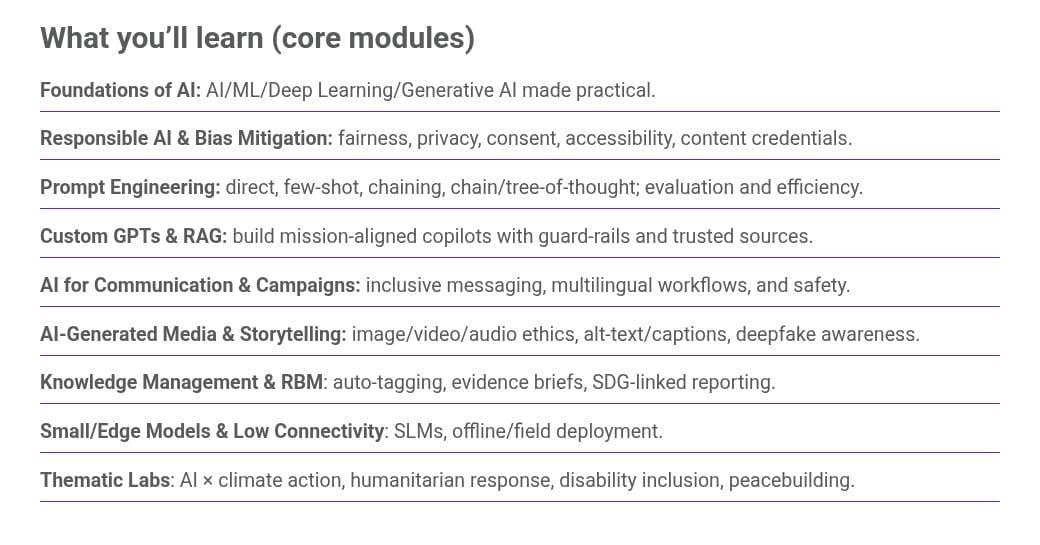
Modules range from campaigns and deepfakes to small AI models that work with a weak internet connection. Weekly expert talks are open to everyone, and a “Companion GPT” chatbot answers learners’ questions at any hour. The materials come with captions, image descriptions and low-bandwidth options, and UN Women describes them as open for others to reuse.
For graduation, participants can submit a policy brief, a knowledge product, a dataset or an AI tool. A “Grand Challenge” asks them what a gender-inclusive AI looks like.
Impact
The 2024 pilot trained more than 1,000 people, according to UN Women’s entry in the ITU’s AI for Good report, and the 2025 edition aimed for 1,200. UN Women announced the 2025 course on International Women’s Day in Bangkok as an online course running from June to August. A graduation booklet published in December 2025 lists that year’s class, with graduates from Bangladesh, Nepal, India, Pakistan, the Philippines, Uganda, Australia, Mongolia, Viet Nam and other countries.
The total reach is harder to pin down. UN Women’s own material gives three figures, all counted from 2024: more than 2,000 participants on the programme page (still shown in November 2026), more than 3,000 in an interview from December 2025, and more than 5,000 in the Pakistan launch report of July 2026. The figures may count different things, from a one-hour workshop to the full three-month course. UN Women also reports 100% overall satisfaction.
Some numbers are more specific. A workshop on custom chatbots reached 217 UN staff, who rated it 9 out of 10, and 98% said they learned something new. More than seven UN country teams and working groups have been trained. These figures, too, come from the organizers.
Evidence of what people did after the course is thin. UN Women says its Humanitarian Hub chatbot helped review a gender profile and pick out priority issues during humanitarian response work, but gives no further detail. AtoANI, a social venture in the Philippines that works with farmers, wrote that it completed the school in 2025. The AI projects it connects to the course, such as crop recommendations to cut waste, are described as ongoing or planned.
In Pakistan, the work started before the signing. Ahead of the launch, trainings were held for members of parliament, government officials, UN staff, universities and civil society, to build what the organizers call a national network of AI champions. The Pakistani course adds topics such as AI agents and AI for public administration.
People
Emad Karim, UN Women’s advocacy, campaigns and innovation coordinator for Asia and the Pacific, founded the AI School. He runs it with Federica Tornincasa, a programme analyst for innovation, AI and green skills.
“We built the AI School around what we call ‘the human factor’,” Tornincasa wrote in the 2025 booklet. “AI mirrors our choices and behaviors: blind faith breeds technocracy; blanket fear forfeits progress.”
Facilitators from partner groups share the teaching. The booklet profiles six of them, among them Sanjana Chhantyal, a researcher and youth leader in UN Women’s 30 for 2030 network; Kirthi Jayakumar, a feminist researcher; and Bea Guevarra of NetMission.Asia, a youth internet governance program. One served on the school’s steering committee, and another took the 2024 pilot herself.
The graduates are a mix. The 2025 class included a disability advocate in Australia, a sexual and reproductive health coordinator in Uganda, a social-venture founder in the Philippines and the head of a UN office in Pakistan. One anonymous learner, quoted on the programme page, described going “from zero level and fear of technology to a better understanding of AI tools, and how to use them safely and productively”.
In Islamabad, the launch brought together Jamshed M. Kazi, UN Women’s country representative in Pakistan, Sodam Baek of the Korea International Cooperation Agency (KOICA), which supports the work, and Shaza Fatima Khawaja, Pakistan’s federal minister for IT and telecommunication.
Why it matters
Few national AI policies mention gender. The AI School puts officials, activists and young leaders through the same lessons on using AI and checking it for bias. With Pakistan’s IT ministry hosting a national version, a government has taken on that training itself, and the open question is what its graduates will build and change.
What we could not confirm (6)
- How many people the AI School has trained. UN Women gives 2,000+, 3,000+ and 5,000+ “since 2024” in different documents, and does not say how a participant is counted.
- How many participants are women, and how many are UN staff, officials or civil society.
- What graduates built after the course. The 2025 booklet names graduates but lists no tools, policy briefs or datasets, and we found only one company account and one example of a UN Women chatbot in use.
- Any independent evaluation. Satisfaction scores and learner quotes come from the organizers and are anonymous.
- Results of Pakistan’s Training of Trainers track. The launch included presentations on its outcomes in governance, parliamentary research, education and community engagement, but no numbers or detailed examples were published.
- Whether a new public cohort will run in 2026. The programme page says registration “will be announced soon”.
FAQs (5)
What is the UN Women AI School?
A training programme run by UN Women's regional office in Bangkok since May 2024. It teaches UN staff, policy makers, civil society and young leaders in Asia and the Pacific to use generative AI responsibly and with attention to gender.
Is it only for women?
No. The tracks are for UN staff, policy makers, civil society groups, youth leaders, journalists and educators. The focus is on making AI work better for women and girls.
What did Pakistan agree to in July 2026?
Pakistan's Ministry of IT and Telecommunication signed a memorandum of understanding with UN Women Pakistan, with support from the Korea International Cooperation Agency (KOICA), to host the school nationally, including a track that trains local trainers.
How many people have taken the course?
UN Women's figures range from more than 2,000 to more than 5,000 since 2024, depending on the document. None has been independently checked.
Can other organizations use the materials?
UN Women describes its curriculum and toolkits as open for replication, and its team has asked partners to fund and co-host new cohorts.
Sources (7)
TNN, Pakistan Becomes First in South Asia to Host UN Women's AI School, 2026-07-31
UN Women Asia and the Pacific, UN Women AI School programme page, accessed 2026-11-04
UN Women Asia and the Pacific, AI School 2025 Graduation Booklet, December 2025
UN Global Pulse Asia Pacific, In Conversation with UN Women: A.I. School, December 2025
UN Women Asia and the Pacific, International Women's Day 2025 feature, 2025-03-06
AtoANI, AtoANI completes the UN Women Asia-Pacific AI School program, 2025-11-27
ITU, AI for Good Innovate for Impact Report 2025
Fact-checked against sources on November 4, 2026. Spot an error? Tell us.
This story supports